


Cloud Computing Trends: Navigating AWS vs Azure vs Google Cloud, Migration Strategies, and Hybrid Solutions
Estimated reading time: 15 minutes
Key Takeaways
- Cloud computing delivers scalable IT resources on demand, enabling agility, cost efficiency, and global reach.
- Multi-cloud adoption, AI integration, edge and serverless computing are shaping the future of cloud infrastructure.
- AWS, Azure, and Google Cloud each have unique strengths; selection depends on specific business needs and workloads.
- Effective cloud migration strategies include phased approaches and governance to reduce risks.
- Hybrid cloud solutions balance control and flexibility by bridging on-premises and public clouds securely.
Table of contents
- Introduction
- Overview of Current Cloud Computing Trends
- Comparing Major Cloud Infrastructure Providers: AWS vs Azure vs Google Cloud
- Cloud Migration Strategy: Best Practices and Considerations
- Hybrid Cloud Solutions: Bridging On-Premises and Cloud Infrastructure
- Selecting the Right Cloud Infrastructure Provider for Your Needs
- Conclusion
- Frequently Asked Questions
Introduction
Cloud computing is the on-demand delivery of computing services—servers, storage, databases, networking, software, and analytics—over the internet. Instead of owning physical hardware, businesses rent scalable IT resources from cloud providers, gaining flexibility and reducing capital expenses. This model enables organizations to scale their infrastructure effortlessly and access advanced technologies from anywhere.
— source: Denodo | Salesforce
In modern IT, cloud computing has become fundamental because it offers agility, elasticity, cost efficiency, and global reach. It powers digital transformation initiatives, supports AI and big data workloads, and accelerates remote work capabilities. Cloud computing also enables faster innovation cycles, making it essential for organizations aiming to stay competitive.
— source: Future Processing | Adivi | McKinsey
Given this growing importance, keeping up with evolving cloud computing trends is critical for businesses to innovate and maintain competitive advantage. This blog covers the latest cloud landscape by exploring key trends, comparing major cloud infrastructure providers—AWS vs Azure vs Google Cloud, outlining effective cloud migration strategies, and detailing hybrid cloud solutions for bridging on-premises and cloud environments.
Overview of Current Cloud Computing Trends
Cloud computing trends represent the latest developments shaping IT infrastructure delivery today and in the near future. Staying ahead in these areas helps organizations optimize investments and accelerate innovation.
Multi‑Cloud Adoption
Using multiple cloud providers simultaneously is becoming widespread to improve resilience, optimize for cost and performance, and prevent vendor lock-in. Multi-cloud distributes workloads strategically, boosting uptime and flexibility by balancing where applications run and shifting workloads based on demand or cost.
— source: Sira Consulting
AI and Machine Learning Integration
Cloud platforms now embed managed AI services, pre-trained machine learning models, and custom hardware accelerators. These capabilities allow businesses to conduct large-scale analytics and extract real-time insights without heavy upfront investments. Leveraging cloud AI accelerates data-driven decision-making and creates value from big data.
— source: Future Processing | Adivi | Revolgy
For more about the latest developments in AI and how they impact business technology, see our detailed post on The Latest AI Trends in 2025: Key Advances, Business Impacts, and Future Outlook.
Edge Computing
Edge computing processes data closer to where it’s generated, lowering latency essential for IoT devices, AR/VR applications, and autonomous systems. This approach balances the need for local responsiveness with centralized cloud management, enabling hybrid environments that support both real-time processing and cloud scale.
— source: Sira Consulting | TierPoint
Serverless Architectures
Serverless computing, or Functions as a Service (FaaS), lets developers deploy code without managing servers or infrastructure. Customers pay only for execution time, which reduces operational complexity and accelerates development cycles, fitting perfectly with event-driven architectures and microservices.
— source: TierPoint
Enhanced Security and Governance
Security continues to be a top priority with the rise of zero-trust models, strong encryption, identity and access management (IAM), and regulatory compliance frameworks. Security, privacy, and governance are woven into cloud designs to protect sensitive data and meet stringent industry standards.
— source: Sira Consulting | Adivi
Impact on Business Strategies
These trends influence how organizations plan their cloud migration strategy, choose among hybrid cloud solutions, select vendors, and develop internal cloud expertise. Businesses must incorporate multi-cloud and hybrid models for flexibility, embed AI deeply into operations, strengthen security postures, and consider serverless to reduce management overhead and speed up innovation.
Comparing Major Cloud Infrastructure Providers: AWS vs Azure vs Google Cloud
Choosing between leading cloud infrastructure providers requires understanding their unique strengths, offerings, and how they align with your business needs.
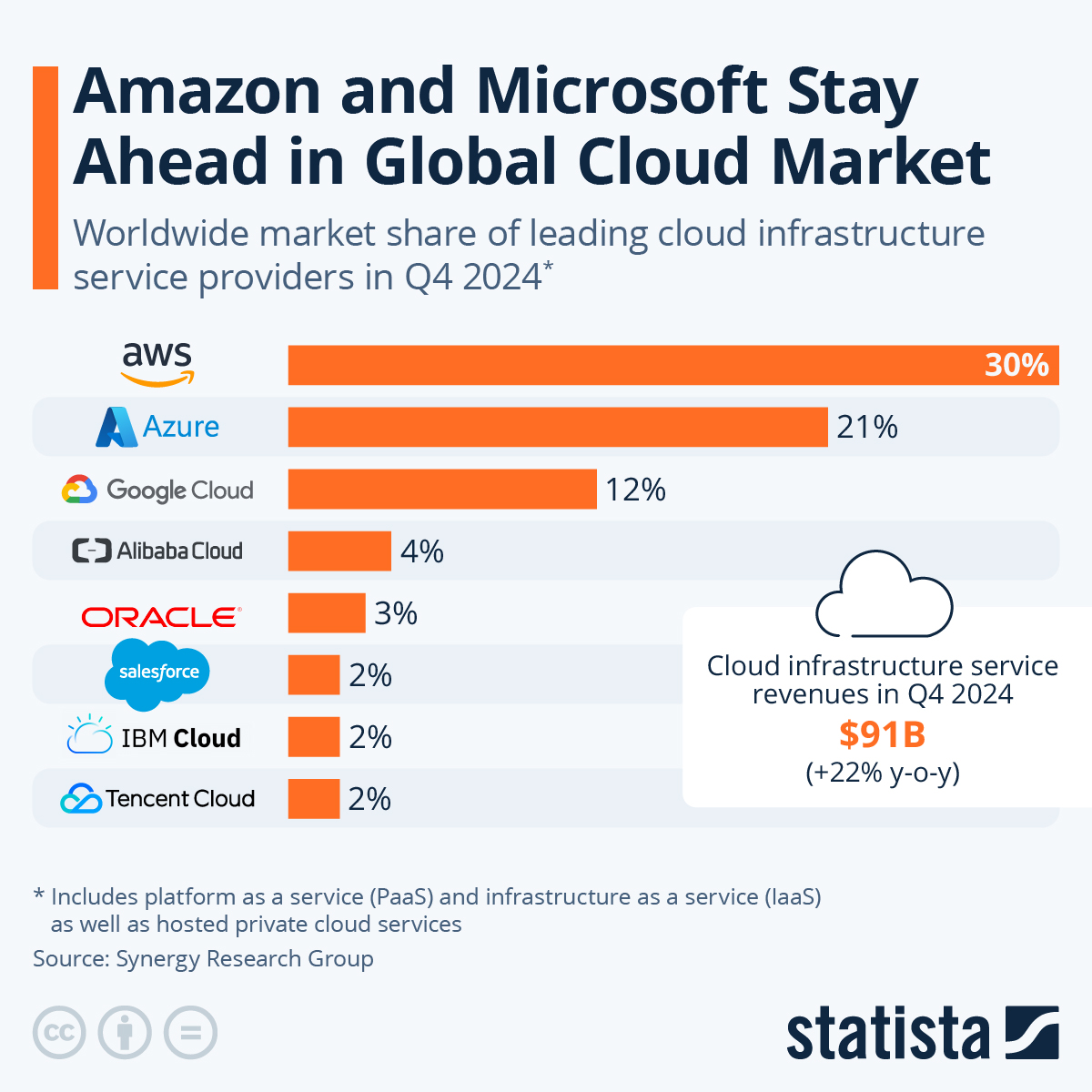
Market Overview
- AWS: The largest and earliest cloud provider known for its broadest service catalog and mature ecosystem. It dominates the market in scale, breadth of tools, and global reach.
— source: McKinsey - Azure: Deeply integrated with the Microsoft ecosystem, Azure appeals strongly to enterprises invested in Windows Server, Active Directory, Office 365, and other Microsoft products.
— source: Azure | McKinsey - Google Cloud Platform (GCP): Smaller in market share but leading in AI, machine learning, data analytics, Kubernetes, and modern cloud-native tooling.
— source: Revolgy
Core Service Categories Comparison
| Service Domain | AWS | Azure | Google Cloud |
|---|---|---|---|
| Compute | EC2, ECS, EKS, Lambda | Virtual Machines, AKS, Azure Functions | Compute Engine, GKE, Cloud Functions |
| Storage | S3, EBS, Glacier | Blob Storage, Disk Storage | Cloud Storage, Persistent Disks |
| Databases | RDS, DynamoDB, Aurora | SQL Database, Cosmos DB | Cloud SQL, Spanner, Bigtable |
| Analytics & AI | Redshift, Athena, Bedrock/Nova ML | Synapse, Fabric, Azure AI | BigQuery, Vertex AI |
Strengths and Weaknesses
- AWS
- Strengths: Largest breadth of services, global infrastructure, mature tooling.
- Weaknesses: Complexity in service selection, somewhat challenging pricing models.
- Azure
- Strengths: Best fit for Microsoft-centric enterprises, strong hybrid cloud solutions.
- Weaknesses: Complexity in legacy integrations, slower innovation pace in some niches.
- Google Cloud
- Strengths: Leading data analytics and AI capabilities, strong Kubernetes support.
- Weaknesses: Smaller ecosystem, less recognized in traditional enterprises.
Recent Provider-Specific Trends
- AWS is focusing intensely on AI, industry-specific cloud offerings, and expanding serverless platforms.
- Azure advances hybrid cloud through Azure Arc, emphasizes security and compliance, and integrates AI deeply into business applications.
- Google Cloud invests heavily in Vertex AI, promotes multi-cloud portability through Anthos, and drives innovations in data cloud services.
Cloud Migration Strategy: Best Practices and Considerations
A cloud migration strategy is the roadmap guiding how an organization moves workloads, applications, and data from on-premises or legacy environments into the cloud efficiently and safely.
Key Phases of Cloud Migration
- Assessment and Discovery
- Conduct a detailed inventory of applications, infrastructure, dependencies, and integration points.
- Identify compliance, latency, and security requirements to determine suitability for migration.
- Define Business Goals and Target Architecture
- Establish the objectives (cost reduction, scalability, innovation).
- Choose deployment models: public cloud, private cloud, hybrid cloud, or multi-cloud depending on needs.
— source: Sira Consulting | Denodo
- Select Migration Approaches (The “6 Rs”)
- Rehost: Lift-and-shift existing workloads with minimal changes.
- Replatform: Make modest optimizations for the cloud.
- Refactor: Re-architect applications for cloud-native capabilities.
- Repurchase: Switch to SaaS products.
- Retire: Decommission obsolete apps.
- Retain: Keep workloads on-premises for now.
Choose based on use case, cost, complexity, and long-term strategy.
- Pilot and Phased Migration
- Start small with less critical systems to validate tools and processes.
- Gradually migrate mission-critical workloads, minimizing downtime.
- Optimization and Governance
- Implement cost monitoring, automate security compliance, and operational controls.
- Transition towards cloud-native architectures including containers and serverless functions.
— source: Future Processing | Adivi
For a deeper dive into AI-powered automation and cloud innovation that can accelerate migration success, please refer to our blog on Harnessing Generative AI Tools: Best AI Tools for Business and How They Transform Productivity.
Risks and Challenges
- Potential downtime or outages during migration can impact users.
- Data loss or corruption risks if not carefully managed.
- Performance regressions post-migration.
- Cultural and skills gaps within teams adapting to new environments.
- Cost overruns without effective governance.
- Regulatory compliance challenges, especially in highly regulated industries.
— source: Adivi | Denodo
Role of Cloud Computing Trends in Migration
- Hybrid cloud solutions enable gradual migration and workload distribution.
- Increasingly strict security and governance requirements demand early integration of compliance controls.
- Serverless and container technologies are factored into refactoring strategies to modernize post-migration.
— source: Sira Consulting
Example Migration Scenarios
- Quick lift-and-shift migration for rapid data center exit, followed by gradual modernization with managed cloud services and serverless.
- Regulated industries adopt hybrid cloud, keeping sensitive data on-premises while leveraging public cloud for analytics and AI.
- Cloud-native startups begin with multi-cloud, serverless, and container-based cloud migration from inception to maximize flexibility.
Additional context on managing emerging technology risks can be found in the AI Regulation Updates: Navigating Ethical Concerns, Risks, and Government Policies in 2025 blog.
Hybrid Cloud Solutions: Bridging On-Premises and Cloud Infrastructure
A hybrid cloud integrates private or on-premises infrastructure with one or more public clouds, enabling applications and data to move seamlessly between environments.
— source: Sira Consulting | Denodo
Why Hybrid Cloud is Increasingly Popular
Hybrid cloud provides a practical balance between control and flexibility. Organizations retain sensitive or latency-critical systems on-premises while exploiting the scalability and innovation capacity of public cloud for other workloads.
Key Benefits of Hybrid Cloud
- Flexibility & workload placement
- Legacy, sensitive, or latency-sensitive workloads remain on-premises.
- Public cloud handles elastic, experimental, or high-scale workloads.
- This division lowers latency, maintains compliance, and optimizes performance.
— source: Sira Consulting | Denodo
- Cost Optimization
- Leverage existing on-prem investments.
- Burst capacity into public cloud during peaks to avoid overprovisioning.
- Security & Compliance
- Maintain strict control on critical or regulated data while using public cloud for analytics and innovation.
— source: Adivi
- Maintain strict control on critical or regulated data while using public cloud for analytics and innovation.
For practical hybrid cloud approaches and vendor-specific offerings, see our comparison on AWS vs Azure vs Google Cloud above.
Hybrid Cloud’s Connection to Cloud Computing Trends and Migration
- Hybrid and multi-cloud strategies move from exceptions to norms for many organizations.
- Hybrid often serves as a migration intermediate or long-term state.
- Edge computing, serverless, and container workloads are integrated increasingly in hybrid setups to support distributed architectures.
— source: TierPoint
Selecting the Right Cloud Infrastructure Provider for Your Needs
Choosing the ideal cloud vendor depends on aligning provider strengths with your organization’s goals, workload characteristics, compliance demands, and existing IT ecosystem.
Factors to Consider
- Existing Technology Stack and Licensing
- Microsoft-heavy environments benefit from Azure.
- Google Workspace and Kubernetes users often prefer Google Cloud.
- AWS provides the broadest range and mature ecosystem for general-purpose deployments.
— source: Azure Docs | Revolgy | McKinsey
- Workload Types
- Heavy data and AI workloads match well with GCP’s BigQuery and Vertex AI, AWS’s AI/analytics suite, or Azure Synapse/Fabric.
- Legacy enterprise workloads integrate better with Azure or AWS’s hybrid capabilities.
- Security, Governance, and Compliance
- Assess provider certifications, regional presence, and compliance tools against your regulatory framework.
- Hybrid and Multi‑Cloud Needs
- Evaluate on-premises integration tools: Azure Arc, AWS Outposts, Google Anthos.
- Open standards and portability should be prioritized for multi-cloud flexibility.
- Cost Management
- Look beyond sticker price, considering discount programs, reserved instances, and cost governance capabilities.
— source: Future Processing | Adivi
- Look beyond sticker price, considering discount programs, reserved instances, and cost governance capabilities.
For strategies on scaling innovation and aligning tech adoption with growth, see Essential Startup Growth Strategies: A Comprehensive Guide to Scaling Your Startup Successfully.
Future-Proofing Recommendations
- Prioritize cloud-native, portable architectures leveraging containers, Kubernetes, and serverless that reduce vendor lock-in.
- Choose providers with strong AI, data, security roadmaps to stay ahead.
- Plan for multi- and hybrid-cloud to ensure agility in a rapidly evolving landscape.
— source: Sira Consulting | Revolgy
Conclusion
Understanding and embracing cloud computing trends like multi-cloud adoption, hybrid cloud architectures, AI integration, edge computing, serverless computing, and enhanced security are vital for strategic IT decisions.
— source: Future Processing | Sira Consulting | Revolgy | McKinsey
These trends guide how organizations select cloud platforms, plan their cloud migration strategy, and develop hybrid cloud solutions that meet evolving business requirements.
Thoroughly evaluating your workloads, compliance needs, existing technology stack, and strategic goals will help you make informed decisions about AWS vs Azure vs Google Cloud and hybrid models. Begin with a clear migration plan, adopt cloud-native architectures, and continuously monitor emerging trends to maintain competitiveness in the dynamic cloud ecosystem.
Frequently Asked Questions
- What is cloud computing?
Cloud computing is the delivery of on-demand computing services—including servers, storage, databases, networking, and software—over the internet, allowing organizations to avoid owning physical infrastructure and enabling scalability and flexibility. See Denodo.
- How do I choose between AWS, Azure, and Google Cloud?
Choice depends on your existing technology ecosystem, workload types, compliance requirements, and cost considerations. Microsoft-centric organizations benefit from Azure, AI-heavy workloads from Google Cloud, and large-scale general use cases from AWS. Refer to the comparison section for details.
- What are best practices for cloud migration?
Key best practices include thorough assessment and discovery, defining clear business goals, selecting appropriate migration approaches (the “6 Rs”), piloting migration phases, and implementing ongoing optimization and governance. See Cloud Migration Strategy for more.
- Why is hybrid cloud important?
Hybrid cloud offers the ability to keep sensitive or latency-critical workloads on-premises while leveraging public cloud scalability, innovation, and cost benefits. This balance supports compliance, security, and performance optimization. Details in Hybrid Cloud Solutions.
- What are the main cloud computing trends?
Major trends include multi-cloud adoption, AI and machine learning integration, edge computing, serverless architectures, and enhanced security and governance mechanisms. See Overview of Trends for a full list.