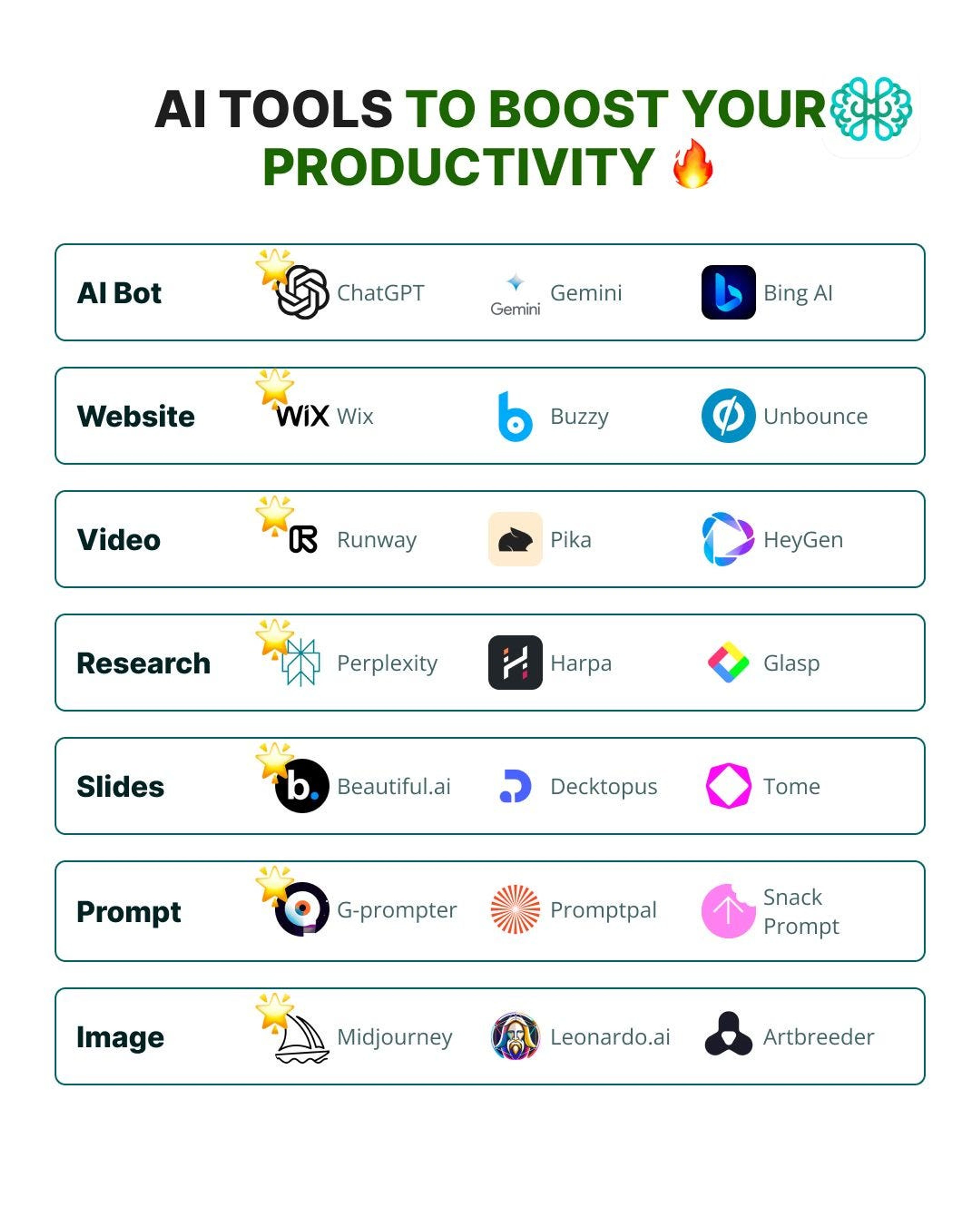
Harnessing Generative AI Tools: The Best AI Tools for Business and How They Transform Productivity
Estimated reading time: 12 minutes
Key Takeaways
- Generative AI tools are revolutionizing business productivity by automating content creation, data analysis, and customer support.
- Enterprises using generative AI report up to 40% time savings and ~33% productivity improvements during AI-assisted hours.
- Understanding how generative AI and LLMs work is key to leveraging their potential effectively.
- The best AI tools for business serve diverse use cases: content marketing, software dev, data analysis, and customer support.
- Exploring GPT alternatives helps organizations find tailored, cost-effective, and privacy-conscious AI solutions.
- Successful adoption requires evaluating scalability, integration, cost, and ease of use.
Table of contents
- What Are Generative AI Tools? Understanding How Generative AI Works and LLMs Explained
- Overview of the Best AI Tools for Business: Generative AI Tools in Action
- Exploring GPT Alternatives: Safe, Specialized, and Open-Source Generative AI Tools
- How AI Productivity Tools Can Transform Workflow: Unlocking Efficiency and Innovation
- Choosing the Right Generative AI Tools for Your Business: A Detailed Guide
- Conclusion: Embracing Generative AI Tools to Drive Business Success
- Frequently Asked Questions
What Are Generative AI Tools? Understanding How Generative AI Works and LLMs Explained
Generative AI tools belong to a subset of artificial intelligence specializing in creating original content. Unlike traditional AI, which classifies or predicts from existing data, these tools actively produce new text, images, code, or data by learning from vast datasets.
Sources: North Carolina Commerce
Core Functionalities of Generative AI Tools
These tools enable enterprises with:
- Content Generation: Drafting marketing copy, technical docs, creative content.
- Task Automation: Automating report creation, data entry, and workflows.
- Data Synthesis: Creating synthetic data to boost machine learning projects.
- Pattern Recognition & Insight Generation: Extracting trends and actionable insights from large datasets.
Applications span automated marketing campaigns, customer communication, and analytics, accelerating innovation and minimizing manual labor.
How Generative AI Works: Neural Networks and Training Data
At its core, generative AI uses neural networks made of layered interconnected nodes processing millions of examples. It learns statistical patterns and relationships to understand context and complex structures in language, images, or code.
The model generates content by probabilistically predicting coherent, relevant outputs based on what it has seen. Output quality depends heavily on model sophistication and training data diversity.
LLMs Explained: The Backbone of Generative AI Tools
Large Language Models (LLMs) are generative AI models trained on massive text corpora. With billions of parameters, they capture nuance, semantics, and context enabling them to:
- Interpret natural language user intent.
- Generate coherent, context-aware responses.
- Perform complex tasks such as summarization, translation, creative writing.
LLMs power many AI productivity tools, facilitating natural language interactions that anyone can use without technical skill.
Overview of the Best AI Tools for Business: Generative AI Tools in Action
The AI tool ecosystem offers solutions customized to key business productivity areas. Here are the major categories:
Content Creation and Marketing Automation
- ChatGPT (OpenAI): Human-like text generation for emails, blogs, and marketing.
- Claude (Anthropic): Safety-focused with nuanced content creation.
- Midjourney & DALL-E: Tools for advanced image generation to enhance marketing visuals.
These accelerate campaign creation, reduce turnaround times, and support rapid messaging iteration.
Software Development
AI coding assistants enable:
- Automated code generation.
- Bug detection and suggestions.
- Technical documentation creation.
Tools such as GitHub Copilot and other AI IDE plugins help developers write code faster and reduce errors. They shorten cycles and improve quality.
Sources:
Glean
Data Analysis and Business Intelligence
Generative AI assists by:
- Extracting key insights from large datasets.
- Producing concise report summaries.
- Modeling “what-if” scenarios for strategic planning.
These capabilities accelerate data-driven decision-making and improve accuracy.
Customer Service and Support
Generative AI powers chatbots and virtual assistants that:
- Handle routine inquiries automatically.
- Draft personalized responses using customer history.
- Summarize conversation threads for escalation.
This enhances response speed, reduces costs, and frees staff for complex cases.
Sources:
Glean
Strengths and Weaknesses Comparison
Category
Key Strengths
Considerations
Content Creation
Fast iteration, high creativity
May require human review for accuracy
Software Development
Speeds coding, bug detection
Integration with existing tools needed
Data Analysis
Provides clear insights, scenario modeling
Complexity of data privacy concerns
Customer Support
24/7 availability, personalized
Limited in handling highly nuanced cases
Choosing the right tool depends on business priorities, budget, and infrastructure.
Source:
Glean
Exploring GPT Alternatives: Safe, Specialized, and Open-Source Generative AI Tools
What is GPT and Why Consider Alternatives?
GPT models by OpenAI, such as ChatGPT, power many popular AI tools but businesses look for alternatives due to:
- Concerns over API usage costs.
- The need for greater privacy and data control.
- Requirements for domain specialization or customization.
Notable GPT Alternatives
- Claude (Anthropic): Emphasizes safety and reliable complex reasoning.
- Open-source models:
- Meta’s Llama and Mistral allow self-hosting for full control and customization but require technical expertise.
- Specialized models:
- Google Gemini: Integrates generative AI into Google Cloud ecosystem for hybrid AI-data workflows.
Selecting GPT Alternatives for Business Scenarios
- Data privacy: Self-hosted open-source options.
- Cost efficiency: Open-source and specialized models reduce fees.
- Domain expertise: Specialized models for legal, scientific, or niche content.
Access to alternatives offers flexibility to match operational and compliance needs.
How AI Productivity Tools Can Transform Workflow: Unlocking Efficiency and Innovation
Generative AI tools do more than accelerate tasks — they fundamentally transform workflows by automating repetition and augmenting creativity.
Automating Repetitive Tasks
- Fully automate data entry, report, and document creation.
- Smooth workflow orchestration reducing errors and manual handoffs.
For example, finance firms auto-generate compliance documents and extract regulatory data with greater speed and accuracy.
Source:
LS Online
Content Generation and Personalization
- Marketing teams create personalized multilingual campaigns and product descriptions at scale.
- E-commerce platforms automate SKU descriptions across languages.
- Customer communication personalization enhances engagement and loyalty.
Source:
Infor
Data Analysis and Scenario Modeling
- Quickly summarize complex reports for leadership.
- Generate synthetic data for ML without exposing sensitive info.
- Use predictive analytics to support strategic decisions.
Source:
Glean
Customer Service Enhancements
- Draft chatbot responses and autonomously handle routine queries.
- Summarize customer histories to personalize service.
- Escalate complex issues smartly to human agents.
Measurable Impact and ROI
- 5% to 40% time savings across departments.
- ~33% productivity increase during AI-assisted hours.
- Reduced operational costs and errors.
- Faster product/service deployment.
- Higher employee satisfaction fostering innovation.
AI productivity tools enable organizations to work smarter and innovate faster.
Source:
Glean
Choosing the Right Generative AI Tools for Your Business: A Detailed Guide
Key Evaluation Criteria
- Scalability: Can the tool handle growing data volumes & users? Opt for cloud/on-prem scalable solutions.
- Integration: Compatibility with CRM, CMS, analytics, communication tools.
- Cost: Pricing models (per token/user/license) must fit budget.
- Ease of Use: Intuitive UIs and natural language interfaces maximize adoption.
- Specialized Capabilities: Need for image generation, domain-specific analysis.
- Data Privacy and Security: Vendor policies, encryption, on-prem options for compliance.
- Support and Documentation: Strong tech support, good docs, active communities.
Practical Trial Approach
- Shortlist 2-3 candidate tools.
- Run 4-8 week pilots with cross-functional teams on real challenges.
- Measure time savings, error reduction, output quality quantitatively.
- Collect qualitative feedback on user experience and integration.
Measuring ROI and Adoption
- Compare improvements vs. baseline.
- Assess employee satisfaction and willingness to use tools.
- Use results to select tools, plan rollout, design training and governance.
Source:
Glean
Conclusion: Embracing Generative AI Tools to Drive Business Success
Generative AI tools are reshaping business productivity, unlocking efficiencies, excellence, and innovation previously unattainable.
Mastering the concepts behind LLMs and generative AI empowers leaders to confidently choose tools that align strategically with their goals.
From GPT-based platforms to a myriad of GPT alternatives, businesses have choices tailored to diverse needs and compliance.
By conducting structured trials and thorough evaluation, organizations can harness AI tools to realize significant time savings, improved product quality, and more engaged employees.
The future belongs to those adopting generative AI swiftly and strategically, cementing competitive advantage in an AI-augmented world.
We encourage you to explore top generative AI tools, run targeted pilots, and stay informed through rapidly evolving AI landscapes.
Frequently Asked Questions
- What are generative AI tools and how do they differ from traditional AI?
- Which AI tools are best for content creation and marketing?
- Why should businesses consider GPT alternatives?
- How do AI productivity tools improve workflow and efficiency?
- What criteria should businesses use to select the right generative AI tools?
What are generative AI tools and how do they differ from traditional AI?
Generative AI tools create original content such as text, images, or code by learning statistical patterns from large datasets. Traditional AI mostly classifies or predicts based on existing data, whereas generative AI actively produces new outputs.
Which AI tools are best for content creation and marketing?
Popular tools include ChatGPT for text generation, Claude for safe nuanced content, and image generators like Midjourney and DALL-E for marketing visuals.
Why should businesses consider GPT alternatives?
Alternatives address concerns such as high API costs, data privacy, and the need for domain-specific customization. Options include safe models like Claude, open-source models like Meta’s Llama, and specialized offerings such as Cohere and AI21 Labs.
How do AI productivity tools improve workflow and efficiency?
They automate repetitive tasks, generate personalized content, analyze and summarize data, and enhance customer support, leading to time savings, error reduction, and increased innovation.
What criteria should businesses use to select the right generative AI tools?
Important factors include scalability, integration capability, cost models, ease of use, specialized features, data privacy and security policies, and quality of support/documentation.