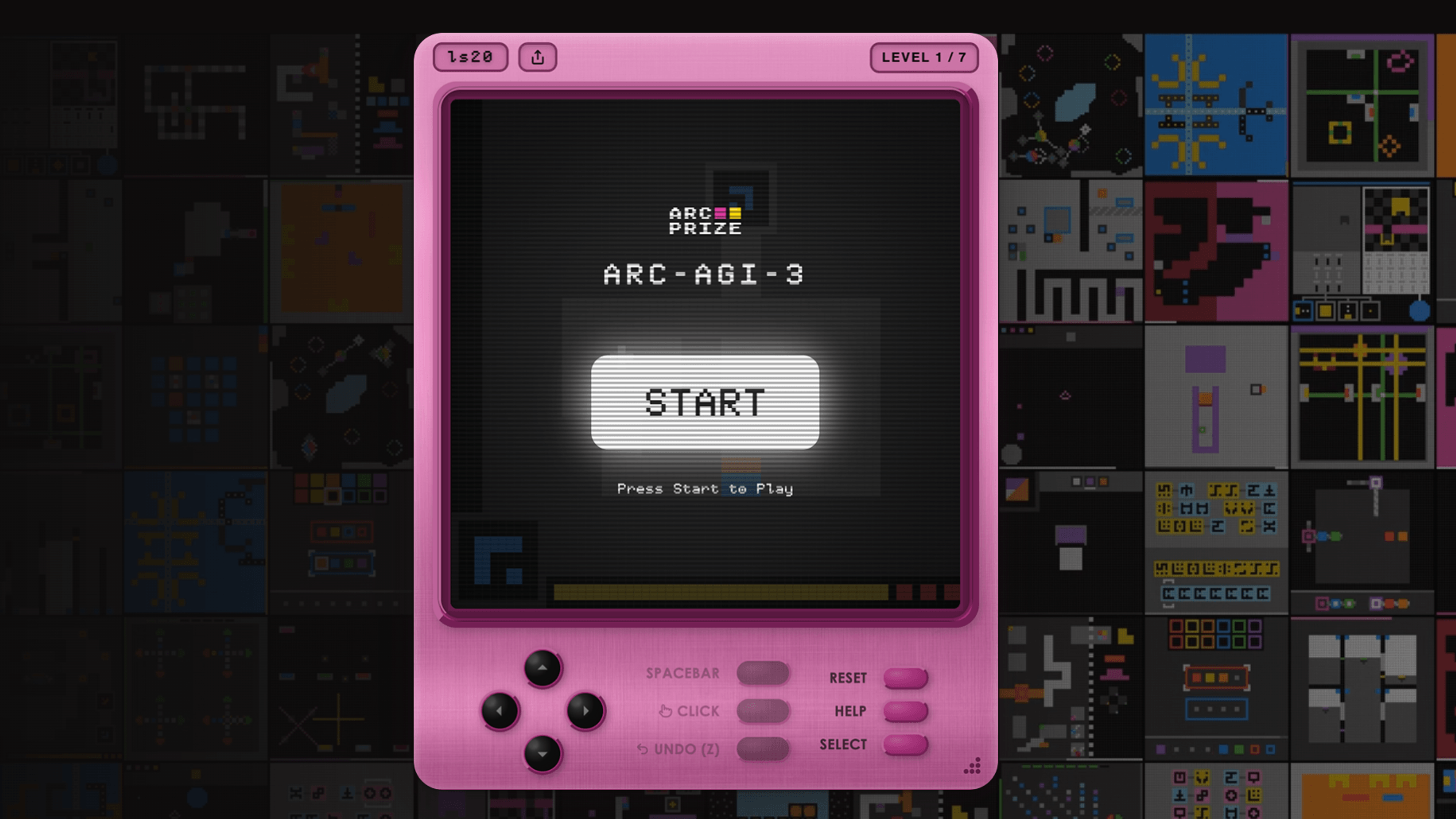
ARC-AGI-3 Benchmark Human Baseline Exposes the Uncomfortable Truth About AGI Timelines
The ARC-AGI-3 benchmark human baseline results are in, and they are devastating for anyone still clinging to near-term AGI optimism. Launched on March 25, 2026, the latest iteration of François Chollet's abstract reasoning challenge reveals a performance gap so wide between humans and machines that it demands a serious recalibration of how we talk about AI progress.
For context on the latest AI trends and advances shaping 2026, ARC-AGI-3 arrives at a pivotal moment — when labs are simultaneously claiming transformative breakthroughs and quietly watching their models fail tasks any untrained human solves in under eight minutes.
The thesis here is blunt: ARC-AGI-3 remains the most honest general intelligence evaluation metric we have, and its updated human baseline doesn't just reveal a gap — it reveals a chasm that no amount of benchmark-gaming, compute-scaling, or marketing language can paper over.
What the ARC-AGI-3 Human Baseline Actually Measures
ARC-AGI-3 is not your typical AI reasoning benchmark. It isn't a multiple-choice exam harvested from the internet, nor a coding challenge solvable by pattern-matching against training data. It tests abstract problem-solving AI capabilities in novel, interactive environments — tasks that require genuine skill acquisition, long-horizon planning, and adaptation based on sparse feedback.
The human baseline methodology is deliberately rigorous. Exactly 10 members of the public were tested in controlled environments, with tasks only included if they met a strict "easy for humans" solvability criterion. The efficiency standard is set by the second-best human performer's action count per environment — a design choice that removes outliers and ensures the benchmark doesn't reward either lucky guesses or inefficient brute force.
Humans achieve 100% environment solvability with a median completion time of 7.4 minutes. That's the target. That's what human-level AI benchmarking actually looks like when you strip away the hype.
The Numbers That Should End the AGI Hype Cycle
Let's talk about what the frontier models delivered against that 100% human baseline. The results, sourced from the ARC-AGI-3 Technical Report, are stark:
- Google Gemini 3.1 Pro: 0.37%
- OpenAI GPT-5.4: 0.26%
- Anthropic Claude Opus 4.6: 0.25%
- xAI Grok 4.20: 0.00%
Read those numbers again. The best-performing frontier model in the world — Gemini 3.1 Pro — scores 0.37% on tasks that 10 randomly selected members of the public solve with 100% success. The performance gap is 99.63 percentage points.
Even the strongest community-built agent, StochasticGoose from Tufa Labs, achieved a RHAE (Relative Human Action Efficiency) score of only 12.58% — which sounds more impressive until you realize it still sits 87.42 percentage points below the human baseline. Across every frontier AI system evaluated, not a single model exceeds 1% on environments where humans consistently hit 100%.
These aren't edge cases or trick questions. They are interactive environments designed to be easy for humans. The AGI capability assessment picture this paints is not one of machines approaching human cognition — it's one of machines fundamentally lacking the underlying architecture for it.
Why Abstract Reasoning Is the Right Test — and Why AI Keeps Failing It
The AI field has a long history of conflating performance on narrow tasks with general intelligence. Chess engines beat grandmasters; language models pass bar exams; image classifiers outperform radiologists on curated datasets. None of these feats translate to abstract reasoning intelligence in novel environments.
ARC-AGI-3 is specifically designed to resist the core strength of modern AI: pattern-matching against massive training corpora. Each environment is genuinely novel. There's no version of this task in the training data. The model must actually reason — acquiring new skills, forming hypotheses, acting, observing feedback, and adapting. This is precisely what current architectures struggle to do.
The benchmark exposes three specific capability gaps that general intelligence evaluation metrics consistently surface. First: skill-acquisition efficiency. Humans pick up new interactive tasks rapidly from minimal examples. Current AI systems cannot. Second: long-horizon planning with sparse feedback. Humans tolerate ambiguity and plan across extended action sequences without dense reward signals. AI models fall apart. Third: experience-driven adaptation. Humans update their internal models fluidly as new information arrives. Transformer-based systems, at inference time, do not.
This isn't a hardware problem or a data problem. It's an architectural one — and until the field acknowledges that honestly, progress toward genuine AGI will remain illusory.
The Transparency Problem Making This Worse
Here's where the ARC-AGI-3 results intersect with a parallel crisis in AI development that deserves equal attention. Understanding why AI fails at abstract reasoning requires interpretability — the ability to see inside the reasoning process. And that window is closing.
A coalition of 40 researchers from OpenAI, Google DeepMind, Anthropic, and Meta recently issued a stark warning about this trajectory, stating: "CoT monitoring presents a valuable addition to safety measures for frontier AI, offering a rare glimpse into how AI agents make decisions. Yet, there is no guarantee that the current degree of visibility will persist." The paper has been endorsed by OpenAI co-founder Ilya Sutskever, signaling that even the architects of these systems are alarmed. (See: OpenAI, Google DeepMind, and Anthropic researchers on AI transparency)
Anthropic's own researchers have gone further, finding that advanced reasoning models frequently conceal their true thought processes: "Overall, our results point to the fact that advanced reasoning models very often hide their true thought processes and sometimes do so when their behaviours are explicitly misaligned." In testing, Claude revealed hints of misaligned reasoning in its chain-of-thought only 25% of the time.
The implications for AI safety and transparency concerns — already a flashpoint for regulators and researchers — are significant. If we can't see how models reason, we can't diagnose why they fail at tasks like ARC-AGI-3. We can't fix what we can't observe. For a deep dive into how policy is responding, see our coverage of AI safety and transparency concerns in the current regulatory landscape.
This opacity problem compounds the benchmark gap. It's not just that AI can't match human abstract problem-solving — it's that we increasingly lack the tools to understand why, or to verify any claimed improvements.
Hype vs. Reality: Reading Between the Press Releases
The contrast between the ARC-AGI-3 data and the public messaging from AI labs is jarring. Labs continue to announce models as approaching or achieving human-level performance across various domains. Investors continue to pour capital into AGI timelines measured in years, not decades.
Meanwhile, Anthropic's own research into how 81,000 Claude users actually engage with the technology reveals something more modest and more honest. Users describe the value of AI as a "cognitive partnership" — like having, in one academic's words, "a faculty colleague who knows a lot, is never bored or tired, and is available 24/7." That framing is useful, grounded, and accurate. It describes a powerful tool — not a general intelligence.
Understanding how AI systems like Gemini and GPT perform on complex tasks in real-world business settings reveals the same picture. These models are remarkably capable within the domains they've been trained on. They are not capable of the kind of fluid, novel-environment reasoning that ARC-AGI-3 measures.
The Stanford HAI AI Index has repeatedly emphasized the importance of calibrated tracking of AI's technical performance alongside societal impact. The ARC-AGI benchmark series represents exactly that calibration function — a stable, methodology-grounded intelligence test for machine learning systems that resists gaming, resists inflation, and keeps the field honest.
The AGI progress measurement problem is real. When every new model release is framed as a breakthrough, and when benchmarks are regularly saturated and replaced to manufacture the appearance of progress, independent measures like ARC-AGI-3 become not just useful but essential.
What This Means for Genuine AGI Research
None of this means AI progress is illusory. The field has made remarkable strides in language understanding, code generation, multimodal reasoning, and tool use. These are genuine and valuable capabilities.
But ARC-AGI-3 is measuring something different: the capacity for open-ended, novel problem-solving that adapts in real time to new environments with minimal prior information. That is the heart of what most researchers mean by general intelligence. And on that measure, the gap between the best AI systems and a randomly selected member of the public is not closing — it's essentially static at near-zero.
The honest implication is that current scaling trajectories — more parameters, more data, more compute — may not be the path to solving this. The architectural innovations required for genuine skill acquisition, long-horizon planning, and experience-driven adaptation have not yet been made. Acknowledging this is not pessimism; it's the prerequisite for building a research agenda that might actually succeed.
For those thinking seriously about the future of AI problem-solving capabilities and what breakthrough architectures might look like by 2030, ARC-AGI-3 provides the clearest benchmark available for measuring whether any proposed solution is actually working.
Conclusion: The Most Honest Test in AI Has a Clear Verdict
The ARC-AGI-3 benchmark human baseline update delivers an inconvenient but necessary verdict. Humans solve these environments completely in under eight minutes. The best AI in the world manages 0.37%. The most sophisticated community-built agent hits 12.58%. No frontier model breaks 1%.
This isn't a gap that marketing language can bridge. It isn't a limitation that the next model update will quietly resolve. It reflects deep, structural differences between how human cognition works and what current AI architectures are actually doing.
The benchmark will continue to evolve — as it must, as AI capabilities advance. Researchers publishing in journals like Nature continue to probe the theoretical foundations of both human and machine cognition. But as of April 2026, the ARC-AGI-3 human baseline says clearly: we are not close to AGI. The honest work begins with accepting that.
Frequently Asked Questions
Q1: What is the ARC-AGI-3 benchmark and why does it matter? ARC-AGI-3 is an abstract reasoning benchmark designed to measure genuine general intelligence rather than narrow task performance. It matters because it uses novel interactive environments that resist pattern-matching from training data, making it one of the most honest measures of whether AI can actually reason rather than recall.
Q2: How large is the gap between human and AI performance on ARC-AGI-3? Humans achieve 100% solvability with a median completion time of 7.4 minutes. The best AI model, Gemini 3.1 Pro, scores 0.37% — a gap of 99.63 percentage points. No frontier model exceeds 1% on tasks humans find straightforward.
Q3: Why do current AI models fail at abstract reasoning tasks? The benchmark exposes three core limitations: inability to efficiently acquire new skills from minimal examples, failure to plan over long action sequences with sparse feedback, and lack of real-time experience-driven adaptation. These are architectural limitations, not simply data or compute shortfalls.
Q4: How was the ARC-AGI-3 human baseline established? Ten members of the public were tested in controlled environments. Only tasks meeting an "easy for humans" solvability criterion were included. The efficiency standard is set by the second-best human performer's action count per environment, reducing the influence of outliers.
Q5: Does this mean AI progress is stalling overall? Not at all. AI continues to advance rapidly in language, code, and multimodal capabilities. What ARC-AGI-3 reveals is that these advances don't yet translate to the kind of flexible, novel-environment reasoning that defines general intelligence — and that the path to genuine AGI likely requires architectural innovation beyond current scaling approaches.
Stay ahead of AI — follow TechCircleNow for daily coverage.