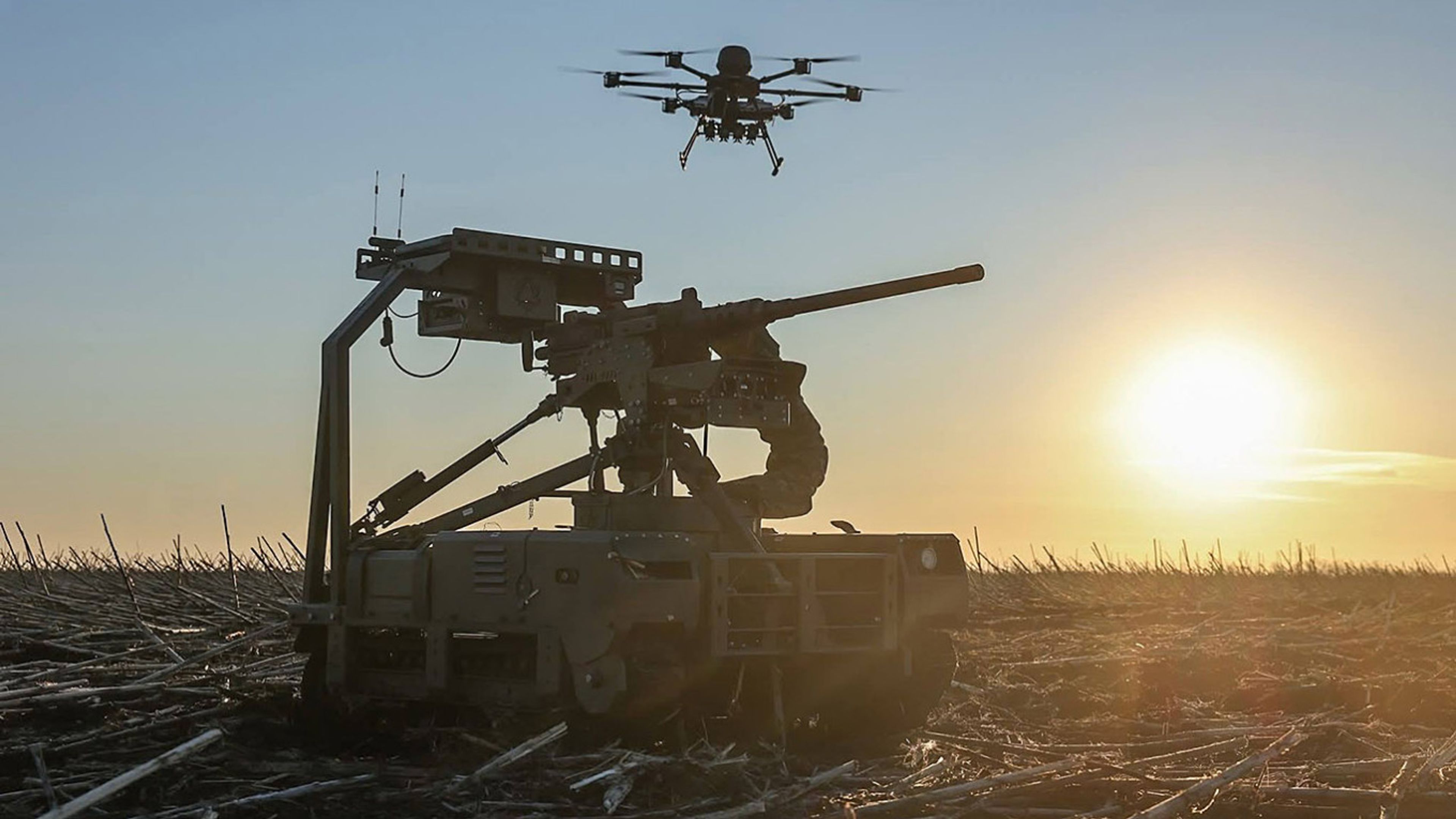
Autonomous Military Robots Warfare: Drones and Ground Robots Seize Enemy Positions Without a Single Soldier
Autonomous military robots warfare has crossed a threshold that strategists, ethicists, and arms-control advocates have long dreaded—and long debated in the abstract. In December 2024, Ukrainian forces deployed dozens of robotic and unmanned systems, including machine-gun-equipped ground drones, in a coordinated soldierless assault on Russian positions near Lyptsi, marking the first documented case of fully autonomous military robotics achieving territorial objectives independently.
This is not a prototype test. This is not a simulation. This is the turning point.
The implications cascade outward instantly: into autonomous weapons international law, into the global AI arms race defense technology competition, and into every policy chamber that has spent years drafting guidelines for lethal autonomous weapons systems while the battlefield moved faster than the bureaucrats. The AI advancements driving autonomous systems have compressed the timeline from science fiction to operational reality by a decade, minimum.
What Actually Happened Near Lyptsi—And Why It Changes Everything
The Lyptsi operation wasn't a random experiment. It was a deliberate, coordinated deployment of unmanned systems battlefield autonomy at scale. Dozens of platforms—aerial drones, machine-gun-armed ground robots, and reconnaissance systems—executed a combined-arms assault without boots on the ground.
Ukrainian forces have been iterating on drone warfare faster than any military in history, driven by existential necessity and a startup-like culture of rapid field modification. The Lyptsi attack represented the convergence of two previously separate threads: aerial drone swarm tactics and autonomous agent military applications on the ground.
What makes this milestone categorically different from previous drone strikes is the territorial objective. These systems weren't just killing—they were seizing, holding, and controlling space. That's the definition of warfare's most fundamental act, and machines did it alone.
The Market Signal: $102 Billion Says This Is No Outlier
The financial architecture behind this moment is enormous and accelerating. The military drone market projected to reach $22.81 billion by 2030, up from $15.8 billion in 2025, reflects defense procurement pipelines that were already locked in before Lyptsi. The broader UAV market—spanning air, land, and maritime autonomous systems—is expected to surge to $102.7 billion by 2030.
These aren't speculative venture bets. These are government contracts, sovereign wealth investments, and defense ministry line items. When nation-states write nine-figure checks into robotic warfare policy and production, they're not hedging—they're committing.
The robotic warfare market forecasted to grow from $33.63 billion to $66.55 billion by 2035, at a 7.06% CAGR, tells an additional story: ground robotics are not the afterthought to aerial drones. They're the co-equal second front of the autonomous warfare revolution. The combination of aerial and terrestrial autonomous platforms is precisely what made Lyptsi operationally significant.
Even the defensive side of this equation is exploding. The anti-drone counter-UAS market is projected to reach $14.51 billion by 2030 at a blistering 26.5% CAGR—proof that autonomous drone threats in warfare are now considered a baseline planning assumption, not an edge case.
The AI Arms Race No Treaty Has Caught Up To
Here is the uncomfortable geopolitical reality: there is no binding international framework governing the deployment of lethal autonomous weapons systems. None. The UN Convention on Certain Conventional Weapons has been discussing LAWS (Lethal Autonomous Weapons Systems) since 2014. Twelve years of discussion have produced zero binding prohibitions.
Meanwhile, the AI arms race defense technology competition has produced operational battlefield systems.
The United States, China, Russia, Israel, South Korea, Turkey, and now Ukraine have all invested heavily in AI drones ground robotics combat capabilities. Each nation justifies its program as a defensive necessity given its adversaries' investments—a classic security dilemma that makes collective restraint structurally improbable without external enforcement mechanisms.
China's PLA has been explicit about its military AI strategy, targeting autonomous swarm capabilities specifically. The U.S. Department of Defense's Replicator Initiative—announced in 2023—aimed to field thousands of attritable autonomous systems within 18 to 24 months. Russia, despite battlefield losses in Ukraine, has accelerated its own unmanned systems programs. The competition is not theoretical. It is running code.
The regulation and ethical concerns in autonomous warfare have never been more urgent to address, and yet the political will to impose binding constraints has never been more absent. Every month that passes without a treaty framework is another month in which operational precedents—like Lyptsi—harden into doctrine.
The Ethics Problem That Engineers Can't Code Away
Military AI deployment ethics is not a soft concern that gets addressed after the hardware ships. It's a hard systems problem with life-or-death consequences, and the Lyptsi operation forces it into sharp focus.
Who is accountable when an autonomous ground robot kills a civilian? The operator who set the mission parameters? The software engineer who trained the targeting model? The defense contractor who sold the platform? The commanding officer who authorized deployment? Under current international humanitarian law frameworks, accountability requires a human decision-maker in the kill chain. Autonomous systems break that chain by design.
The principles of distinction, proportionality, and precaution—the foundational pillars of the laws of armed conflict—require judgment. They require contextual reasoning about who is a combatant, whether an attack's expected civilian harm is proportionate to the anticipated military advantage, and whether all feasible precautions have been taken. Current AI systems do not perform this kind of moral reasoning. They optimize objectives. Those are not the same thing.
The cybersecurity implications of autonomous warfare compound the ethics problem further. An adversary who can spoof GPS coordinates, inject false sensor data, or compromise the command-and-control architecture of an autonomous weapons system could redirect a swarm of armed ground robots against friendly forces or civilian infrastructure. The attack surface for catastrophic misuse is vast, and it grows with every new platform fielded.
What the Lyptsi operation demonstrated, despite its tactical success, is that we are deploying systems whose failure modes we don't fully understand, at speeds that outpace our ability to establish accountability structures.
Doctrine Is Being Written in Real Time—On the Battlefield
Military doctrine for autonomous systems is not being written in war colleges or policy institutes. It's being written in the Zaporizhzhia steppes, the Red Sea shipping lanes, and the hills around Lyptsi. That's the actual state of affairs.
Ukraine's drone warfare program is the world's most advanced real-world laboratory for robotic warfare policy by necessity. Ukrainian engineers are iterating in weeks what NATO procurement cycles take years to accomplish. Their learnings—about swarm coordination, autonomous targeting, electronic warfare countermeasures, and soldierless assault tactics—are feeding directly into the next generation of systems.
Israel's experience with autonomous aerial systems in Gaza has similarly produced operational doctrine that now exists independently of any formal international framework. The IDF's use of AI-assisted targeting systems—systems that generate strike recommendations at machine speed—has already generated intense scrutiny from international legal bodies, with limited practical effect on operational decisions.
The pattern is consistent: capability precedes doctrine, doctrine precedes law, and law arrives after the damage is done. What makes the current moment different is the speed of the capability curve. The future of military technology and autonomous systems is being determined right now, not in 2035 when the think-tank papers catch up.
Nations that establish operational doctrine first will have enormous advantages—not just militarily, but in shaping the international norms that eventually do emerge. This is why the geopolitical stakes of the autonomous weapons race extend far beyond any single battlefield.
What Comes Next: Swarms, Superintended Autonomy, and the Point of No Return
The Lyptsi operation used remote-controlled and semi-autonomous systems. The next iteration won't require a human operator in the loop at all. The trajectory is clear.
Swarm intelligence—multiple autonomous platforms coordinating in real time without centralized human control—is the near-term frontier. DARPA's OFFensive Swarm-Enabled Tactics (OFFSET) program has already demonstrated urban swarm operations with over 250 coordinated drones. Commercial off-the-shelf drone hardware, increasingly cheap and accessible, means swarm capability is proliferating below the nation-state level.
The convergence of large language models with robotic control systems is an additional inflection point. AI systems that can interpret complex mission objectives in natural language, plan multi-step operations, adapt to unexpected obstacles, and coordinate with other autonomous agents represent a qualitative leap in autonomous agent military applications. Several defense contractors and national laboratories are already working on this integration.
At some threshold of autonomy and capability, these systems may be genuinely difficult to meaningfully distinguish from artificial general intelligence applied to warfare. That prospect should concentrate minds considerably.
The window for establishing binding international frameworks—before autonomous military systems become so embedded in national security architectures that no nation will accept meaningful constraints—is closing. It may already be closed for certain categories of system.
Conclusion: The Point Has Already Been Crossed
The Lyptsi assault didn't announce a future—it documented a present. Autonomous military robots warfare is not a technology trend to monitor. It's an operational reality that is reshaping the fundamental nature of armed conflict, state sovereignty, and human accountability in violence.
The market numbers confirm the direction of travel. The ethical frameworks confirm the inadequacy of current governance. The battlefield confirms that doctrine is being written faster than law can follow.
What the world's militaries, international bodies, and technology companies choose to do in the next 24 to 36 months will determine whether autonomous warfare systems become a stabilizing deterrent or an uncontrollable escalation mechanism. There is no neutral position on this question. Inaction is itself a policy choice—one that defaults to the most aggressive actor setting the terms.
Stay informed on every development as it breaks. Follow [TechCircleNow.com](https://techcirclenow.com) for daily coverage of AI, autonomous systems, defense technology, and the policy battles that will shape the next decade of warfare and security.
FAQ: Autonomous Military Robots and the Future of Warfare
Q1: What was the significance of the Lyptsi operation in December 2024?
The Lyptsi operation marked the first documented instance of fully autonomous and remote-controlled robotic systems achieving a territorial battlefield objective without human soldiers on the ground. Ukrainian forces deployed dozens of unmanned platforms—including machine-gun-equipped ground drones—in a coordinated assault on Russian positions. This shifted autonomous systems from a surveillance and strike tool to a force capable of seizing and controlling terrain.
Q2: Are lethal autonomous weapons systems currently legal under international law?
There is no binding international treaty prohibiting lethal autonomous weapons systems. The UN Convention on Certain Conventional Weapons has debated the issue since 2014 without reaching a binding agreement. Existing international humanitarian law—including principles of distinction, proportionality, and precaution—technically applies, but was written for human decision-makers and creates significant accountability gaps when applied to autonomous systems.
Q3: Which countries are leading the autonomous military robotics arms race?
The United States, China, Russia, Israel, Turkey, South Korea, and Ukraine are all major players. The U.S. Department of Defense's Replicator Initiative targets mass deployment of attritable autonomous systems. China's PLA has explicitly prioritized autonomous swarm capabilities. Ukraine has emerged as an unexpected leader through rapid battlefield iteration driven by existential military necessity.
Q4: How large is the market for autonomous military systems?
The military drone market alone is projected to reach $22.81 billion by 2030. The broader UAV market—including land and maritime platforms—is expected to hit $102.7 billion by the same year. The robotic warfare market, which includes autonomous ground systems, is forecast to grow from $33.63 billion in 2025 to $66.55 billion by 2035 at a 7.06% CAGR.
Q5: What are the biggest ethical risks of deploying autonomous weapons systems?
The primary risks include accountability gaps (no clear human responsible for unlawful kills), AI targeting errors that cannot apply nuanced judgment required by laws of armed conflict, vulnerability to adversarial cyberattacks that could redirect autonomous systems against unintended targets, and escalation dynamics in which machine-speed decision-making removes human restraint from crisis situations. The absence of binding governance frameworks amplifies all of these risks substantially.
Stay ahead of AI — follow TechCircleNow for daily coverage.