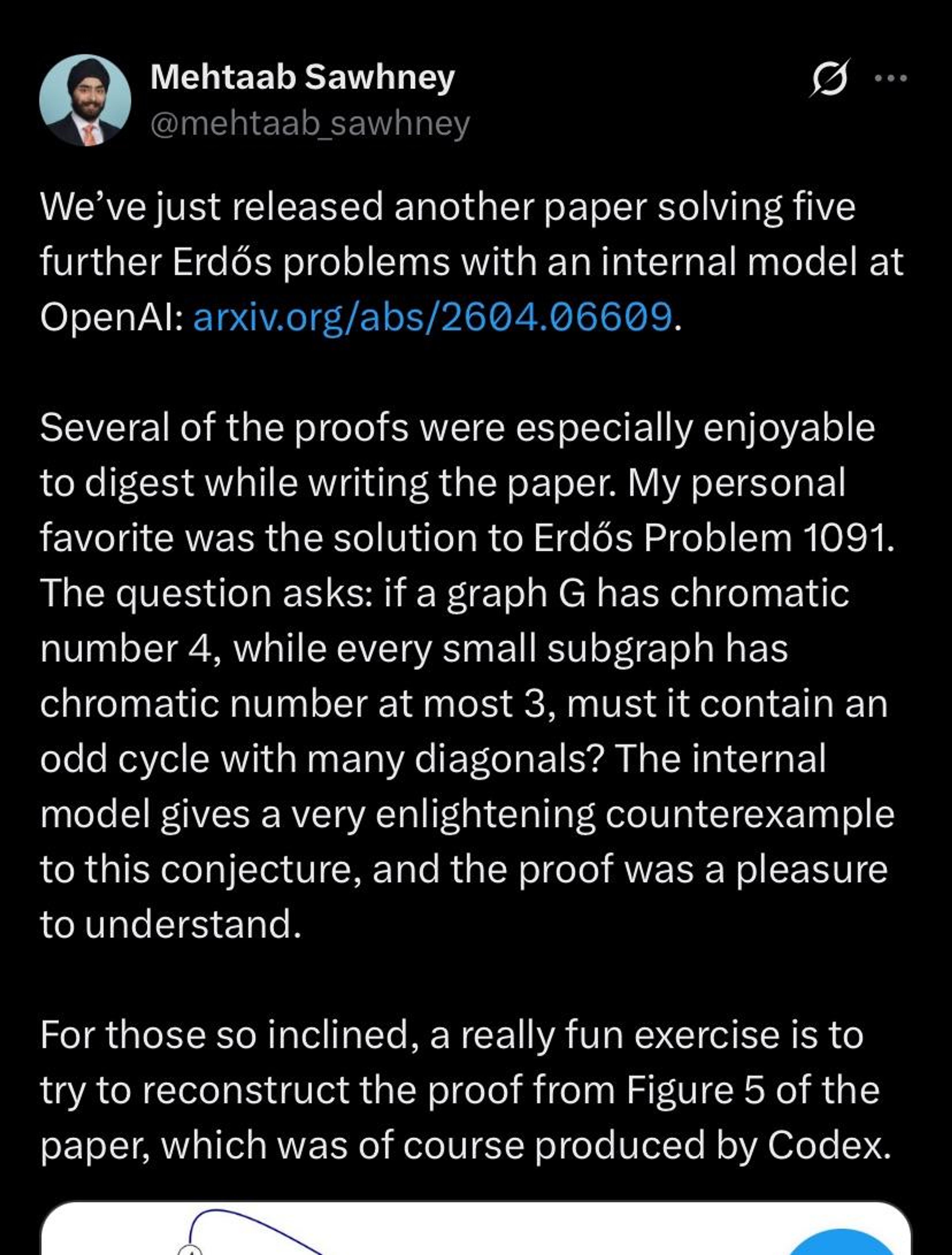
GPT-5.4 Erdős Problem Solved: What AI's Math Breakthrough Really Means for Research
The headline is hard to ignore: GPT-5.4 Erdős problem solved — not once, but across multiple open problems in combinatorics and number theory that stumped human mathematicians for decades. In early 2026, OpenAI's GPT-5.4 Pro contributed directly to resolving or partially advancing several entries from Paul Erdős's legendary problem list, marking a genuine inflection point in what large language models can accomplish in frontier mathematics.
But the story is more complicated than the breathless coverage suggests. Understanding what GPT-5.4 actually did — and what it decidedly did not do — is essential to separating AI's real research contribution from the hype cycle that surrounds every new benchmark. This is part of a broader shift in latest AI advancements and capabilities that demands careful, critical analysis rather than uncritical celebration.
What GPT-5.4 Actually Solved — and How
The documented record here is specific, and specificity matters. According to the official Erdős Problems discussion thread, GPT-5.4 Pro provided the key analytical estimate B_x = 1 + O(1/log x) that was instrumental in resolving Erdős Problem #1196 — a problem in analytic number theory that had remained open for years.
That is a concrete mathematical contribution, not a vague "assistance" claim.
The Erdős Problems GitHub wiki documenting AI contributions provides a fuller picture of the activity cluster around March 2026. GPT-5.4 Pro delivered what researchers described as a full solution to Erdős Problem #650 on March 6–7, 2026 — a result stronger than the existing literature result by Erdős and Selfridge from 1978. It contributed to partial results on Problem #25 in collaboration with mathematician Przemek Chojecki on March 19. GPT-5.4 Thinking, alongside Gemini 3.1 Pro and GPT-5.2 Thinking, derived explicit bounds for Problem #848 between March 5–10. And on March 13, GPT-5.4 Pro aided partial results on Problem #1095 in a multi-model collaboration with the researcher known as shtuka.
This is not cherry-picked performance on a toy benchmark. These are named, open problems in a canonical research list — with mathematical community verification.
The Forgotten Preprint Problem: How AI Finds What Humans Miss
One of the most telling data points came from Epoch AI's mathematical challenge suite. According to Computerworld's analysis of GPT-5.4's mathematical breakthroughs, GPT-5.4 Pro achieved a Tier 4 solve on an Epoch AI problem — the first model to reach that difficulty level — by leveraging a 2011 preprint that the problem's own author was unaware of.
Let that sink in. The model didn't invent a novel proof technique. It surfaced a relevant but obscure piece of prior work that had slipped through the cracks of human attention — and applied it correctly to a new context.
This is simultaneously the most impressive and the most sobering thing about the achievement. The AI's "breakthrough" was partly a retrieval and synthesis triumph, not pure mathematical creativity. It exposed a gap in human literature awareness rather than generating genuinely new mathematical structure from scratch.
GPT-5.2 Pro had already pushed the state of the art, achieving a 31% success rate on the Epoch AI benchmark suite — up from a prior best of 19%. GPT-5.4 broke through to Tier 4 entirely. The performance curve here is steep, and its trajectory is what researchers should be watching most closely.
Benchmark Performance vs. Real Research Impact: The Persistent Gap
The AI mathematical theorem proof story is easy to sensationalize, but the benchmark-to-reality gap remains a genuine analytical problem.
For years, performance on mathematical benchmarks like MATH, AIME, and Olympiad-style competitions has raced ahead of actual research utility. Models score impressively on structured, well-defined problems where the solution space is bounded and verification is mechanical. The Erdős problems represent something categorically different — open-ended, ill-defined success criteria, requiring judgment about which tools apply and which directions are worth pursuing.
The GPT-5.4 results are significant precisely because they cross from benchmark performance into genuine mathematical problem-solving AI territory. The contributions are documented, community-verified, and in some cases exceed prior published results. That's the threshold that matters.
But important caveats remain. Every documented GPT-5.4 contribution involved either human-AI collaboration or targeted the lower-difficulty end of the Erdős problem spectrum. The model did not autonomously identify a new research direction, write a complete paper, or produce a proof that required sustained chains of novel reasoning across multiple sessions. The partial results on Problems #25, #848, and #1095 were all collaborative — meaning human mathematicians directed the inquiry, evaluated outputs, and filtered errors.
Understanding how advanced AI systems like GPT-5.4 transform problem-solving requires this level of precision. The model is a powerful accelerant. It is not yet an independent mathematical researcher.
The Collaboration Architecture: Why Human-AI Teams Are Outperforming Both Alone
The most strategically important pattern in the Erdős problem data isn't any single solve. It's the collaboration architecture that produced results.
In the Problem #1095 case, the successful partial result involved GPT-5.4 Pro, Claude Opus 4.6, Gemini 3.1 Pro, and a human researcher. This is not accidental. Different frontier model capabilities appear to complement each other — one model might excel at identifying relevant structural analogies, another at generating and checking candidate proofs, and the human at directing research priorities and catching logical failures that all models miss.
This mirrors what's already emerging in AI applications across industries, where the most robust performance gains come from human-AI systems rather than AI-only pipelines. Mathematics is proving no different.
The frontier model capabilities question is therefore shifting. The benchmark leaderboard arms race — which model achieves the highest score on AIME? — is less important than understanding what collaboration protocols unlock for research teams. GPT-5.4's Erdős contributions suggest that a small number of researchers equipped with multi-model workflows can now tackle a class of problems previously requiring years of specialized focus.
That's a genuine productivity shift, and it's one that the broader academic mathematics community is only beginning to reckon with.
What This Reveals About LLM Reasoning — And Its Limits
The language models mathematics breakthrough narrative often skips past the mechanism. How is GPT-5.4 actually doing this?
The honest answer is that we don't fully know, and that epistemic humility should be in every analysis. What the Erdős problem results suggest is that large language model reasoning at the frontier now exhibits several capabilities that were absent or unreliable in earlier generations: sustained multi-step deduction across non-trivial mathematical structures, accurate retrieval and application of obscure but relevant prior work, and productive engagement with under-specified research questions where the "right" framing is not obvious.
The B_x = 1 + O(1/log x) estimate that resolved Problem #1196 is not the kind of output a system produces by pattern-matching to training data alone. That estimate required applying asymptotic analysis correctly in a novel context. Whether this constitutes "reasoning" in a philosophically meaningful sense is contested — but its functional utility is not.
The limits, however, are equally real. The 2011 preprint case illustrates that some GPT-5.4 "insights" are retrieval successes rather than generative breakthroughs. The model can fail silently on problems requiring sustained novel construction, producing plausible-sounding but incorrect arguments that require expert human review to catch. And there is no evidence yet that any frontier model has spontaneously identified a new class of mathematical problems worth investigating — the kind of creative research agenda-setting that defined Erdős's own contributions.
The gap between AI research contribution evaluation as it stands today and genuine mathematical creativity remains wide. The gap is narrowing. It has not closed.
The Broader Implications for Science and Research
The Erdős problem activity in March 2026 should be read as a signal flare for how AI will reshape research workflows across every domain where human expertise has historically been the bottleneck.
Mathematics has a unique advantage here: its outputs are formally verifiable. A claimed proof is either correct or it isn't, and the community has well-developed tools for checking. This makes mathematics an ideal proving ground for frontier AI research assistance — errors surface quickly, and genuine contributions are unambiguous.
The same dynamic will be harder to replicate in fields where ground truth is harder to establish. But the underlying capability — rapid synthesis of large prior-work corpora, generation of candidate solutions across a wide search space, and collaborative refinement with domain experts — transfers broadly. Consider AI applications across industries already emerging in drug discovery, materials science, and climate modeling.
What the Erdős results demonstrate is that this is no longer a theoretical future. The transition from "AI as autocomplete" to "AI as research collaborator" is documented, dated, and mathematically verified. The question for research institutions, funding agencies, and universities is whether their workflows, incentive structures, and publication norms are prepared for that transition.
Most are not.
Conclusion: A Milestone, Not a Finish Line
The GPT-5.4 Erdős contributions represent a genuine, documented milestone in AI mathematical reasoning. Multiple open problems advanced or resolved. A Tier 4 benchmark achievement. Collaborative workflows producing results stronger than decades-old published literature. These are not marketing claims — they are community-verified outcomes with specific timestamps and mathematical content.
But a milestone is not a destination. The model still requires expert human direction, cannot autonomously set research agendas, and produces errors that require specialist review. The future of AI research milestones will likely see these limitations erode — but the pace and nature of that erosion is genuinely uncertain.
What is certain is that the research community — in mathematics and beyond — needs to engage seriously with these tools now, while the collaboration norms, verification standards, and attribution frameworks are still being established. The 2026 Erdős breakthroughs are a case study in what's possible. They should also be a prompt for rigorous institutional reflection.
For ongoing coverage of AI capabilities, benchmark analysis, and the real-world research impact of frontier models, explore [TechCircleNow.com](https://techcirclenow.com) — where we cut through the hype to deliver the analysis that matters.
FAQ: GPT-5.4 and AI Mathematical Reasoning
Q1: What is Erdős Problem #1196, and why does solving it matter? Erdős Problem #1196 is an open problem from Paul Erdős's celebrated list of mathematical conjectures and questions, spanning combinatorics and number theory. Its resolution matters because Erdős problems are community-validated research benchmarks — not artificial puzzles — making GPT-5.4's contribution a genuine research-grade achievement rather than a performance on a controlled test.
Q2: Did GPT-5.4 solve these Erdős problems entirely on its own? No. The documented results range from solo contributions (Problem #1196, Problem #650) to collaborative partial results requiring human mathematicians and multiple AI models working together (Problems #25, #848, #1095). Human direction, error-checking, and research framing remain essential components of the workflow.
Q3: What is a Tier 4 solve on the Epoch AI benchmark, and why is it significant? Epoch AI's mathematical challenge suite is tiered by difficulty, with Tier 4 representing problems that require non-trivial mathematical insight rather than mechanical computation. GPT-5.4 Pro was the first AI model to achieve a Tier 4 solve, doing so by identifying and applying a 2011 preprint the problem's human author had overlooked.
Q4: Does GPT-5.4's performance mean AI has surpassed human mathematicians? Not in any meaningful general sense. GPT-5.4 has demonstrated the ability to contribute to specific open problems — but it cannot autonomously identify new research directions, sustain long multi-session proof development, or replicate the creative problem-selection instinct that defined researchers like Erdős. It is a powerful collaborative tool, not an independent mathematician.
Q5: What does this mean for the future of mathematical research and academic publishing? It signals an urgent need for the academic community to develop standards for AI attribution, collaborative authorship, and verification workflows. Mathematics is an early test case because proofs are formally checkable. The norms established here will likely influence how other research fields handle AI collaboration as the technology matures.
Stay ahead of AI — follow TechCircleNow for daily coverage.