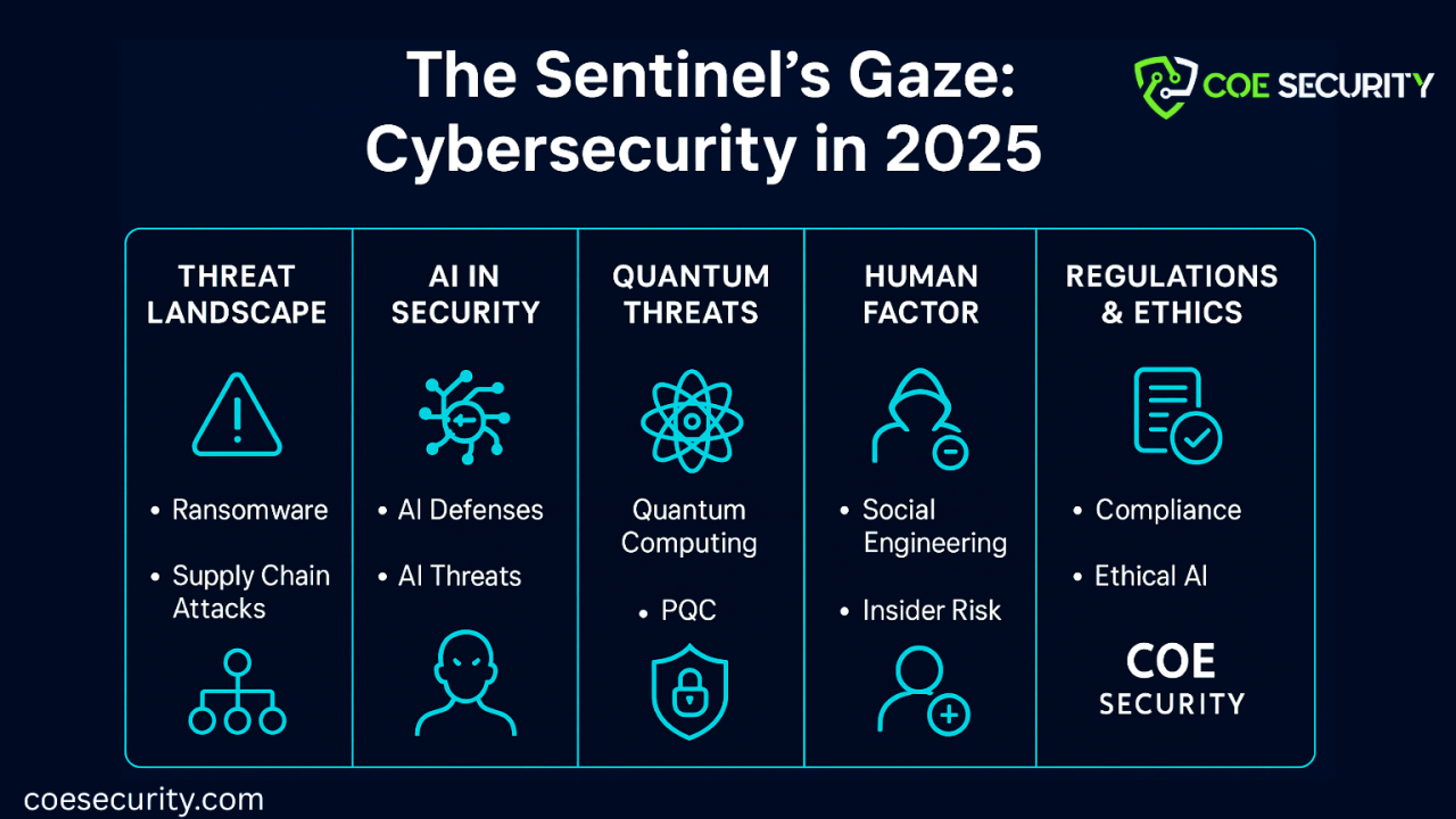
Top Cybersecurity Trends to Watch in 2025: Navigating Emerging Threats and Innovative Defenses
Estimated reading time: 15 minutes
Key Takeaways
- Cybersecurity trends are evolving rapidly, driven by advanced AI, cloud computing, and increasing digitization.
- Anticipate emerging cyber threats 2025 including AI-enhanced social engineering, ransomware evolution, and supply-chain compromises.
- Zero trust security is becoming the foundational defense model, replacing traditional perimeter approaches.
- Endpoint security solutions are vital to protect distributed, hybrid workforces and diverse devices.
- Increasingly strict data privacy regulations drive cybersecurity modernization and compliance.
- Successful defense requires integration of these trends into layered, proactive cybersecurity strategies.
Table of contents
- Introduction: Cybersecurity Trends in an Evolving Digital Landscape
- Overview of the Current Cybersecurity Landscape
- Emerging Cyber Threats in 2025
- Cybersecurity Trends Shaping Defense Strategies
- Zero Trust Security as a Core Cybersecurity Trend
- Role of Endpoint Security Solutions
- Data Privacy Regulations Impacting Cybersecurity
- Integrating Trends and Solutions to Mitigate 2025 Threats
- Conclusion
- Frequently Asked Questions
Introduction: Cybersecurity Trends in an Evolving Digital Landscape
Cybersecurity trends refer to the changing patterns in cyber threats, defense technologies, and strategies that shape how organizations protect their digital assets, people, and infrastructure. These trends highlight how attackers evolve, how defense measures adapt, and what lies ahead for securing the digital world. With advances in AI, cloud computing, and increased digitization, organizations face a growing attack surface while adversaries—ranging from cybercriminal gangs to nation-states—become more sophisticated and better resourced (IBM, WEF, Tech Circle Now).
Staying informed on cybersecurity trends is critical because it enables businesses to anticipate cyber threats 2025 such as AI-driven social engineering, ransomware advancements, and supply-chain compromises. The rise of zero trust security models is replacing old perimeter-based defenses, while evaluating modern endpoint security solutions is becoming essential in a remote and hybrid work environment. Meanwhile, evolving data privacy regulations continually influence how organizations must manage security and compliance.
This blog will provide:
- An overview of the current cybersecurity landscape.
- Insights into emerging cyber threats 2025.
- An analysis of cybersecurity trends shaping defense strategies.
- A deep dive into zero trust security as a core model.
- The role and evolution of endpoint security solutions.
- Impacts of data privacy regulations on cybersecurity.
- How integrating these trends protects organizations against future risks.
Overview of the Current Cybersecurity Landscape
The current cybersecurity trends reflect a complex threat and defense environment shaped by several dominant factors:
- Ransomware’s continued growth: Ransomware attacks keep rising in frequency and severity. Attackers now employ aggressive extortion tactics, including double and triple extortion, combining encryption with data theft and subsequent blackmail to pressure victims into paying (Deloitte, WEF).
- The dual role of AI: Artificial intelligence acts as a double-edged sword. On one hand, cybercriminals use AI to enhance phishing, create synthetic media, and execute coordinated intrusions. On the other, defenders leverage AI for automated detection, accelerated incident response, and continuous monitoring (Deloitte, IBM, Tech Circle Now).
- Supply-chain and third-party risks: Increasingly, threat actors exploit vulnerabilities within supply chains and vendor ecosystems. Complex, opaque vendor relationships create blind spots in security, with attackers targeting software providers and managed services to compromise multiple downstream organizations (Mayer Brown).
- Skills shortages and hybrid complexity: A shortage of qualified cybersecurity professionals and the rising complexity of hybrid on-premises/multicloud environments make risk management harder, requiring more automation and integration of security tools (IBM, WEF, Tech Circle Now).
In sum, cybercriminals are weaponizing new tech like AI and deepfakes, and leveraging ecosystem vulnerabilities, challenging defenders to modernize architecture and strategies beyond traditional perimeter defenses.
Sources: Deloitte, IBM, WEF
Emerging Cyber Threats in 2025
Looking ahead, major cyber threats 2025 identified by experts include:
AI-Enhanced Social Engineering and Deepfakes
- Generative AI enables cybercriminals to automate highly personalized phishing, vishing (voice phishing), and Business Email Compromise (BEC) campaigns at scale. Attacks are more convincing and successful due to realistic language, tone, and context (Deloitte, Mayer Brown, Tech Circle Now).
- Deepfake technology produces synthetic voice or video of executives to authorize fraudulent payments or manipulate staff into exposing credentials or installing malware (Mayer Brown).
Ransomware Evolution and Ransomware-as-a-Service (RaaS)
- RaaS platforms professionalize ransomware delivery, exploiting zero-day vulnerabilities and coupling file encryption with data exfiltration and harassment. Double and triple extortion schemes pressure victims from multiple angles (WEF, Deloitte).
- Critical infrastructure, governments, and large enterprises remain high-profile targets for sophisticated ransomware campaigns.
Supply-Chain and Cloud-Ecosystem Intrusions
- Attackers increasingly compromise software vendors, managed service providers, and cloud platforms to bypass direct defenses and infiltrate multiple downstream targets.
- This lateral movement across interconnected cloud-hosted environments facilitates large-scale credential theft and data exfiltration (Mayer Brown, Tech Circle Now).
Identity and Credential Attacks
- Identity is recognized as the “new perimeter.” Compromise of credentials underpins many intrusions.
- Attacks exploiting stolen or weak credentials are on the rise, necessitating stronger identity-centric controls and continuous verification (IBM).
GenAI, Shadow AI, and Model Exploitation
- Unsanctioned or “shadow AI” models introduced without governance cause new data leakage and privacy risks.
- Adversaries target AI models and APIs for poisoning, manipulation, or reconnaissance, exploiting these systems as attack vectors (IBM, Tech Circle Now).
These emerging threats make perimeter-centric defenses obsolete. Instead, continuous monitoring, identity-first approaches, and robust supply-chain and AI governance become essential.
Sources: IBM, WEF, JPMorgan Chase
Cybersecurity Trends Shaping Defense Strategies
To counteract escalating threats, the following cybersecurity trends are shaping modern defense postures:
AI-Driven Detection and Security Automation
- Security Orchestration, Automation, and Response (SOAR) platforms and AI-powered analytics are revolutionizing incident detection and response.
- These tools sift through enormous alert volumes and enable security teams to rapidly detect and contain threats, reducing response times drastically (IBM, Javelin Strategy, Tech Circle Now).
Identity-First and Zero Trust Architectures
- Recognizing identity as the core security perimeter, organizations adopt integrated identity fabrics including Identity and Access Management (IAM), Privileged Access Management (PAM), Single Sign-On (SSO), and Multi-Factor Authentication (MFA).
- These identity solutions protect access to sensitive applications, data, and AI systems in hybrid and multicloud environments (WEF).
Secure-by-Design and Resilience Focus
- Programs like CISA’s Secure by Design advocate embedding security into product development lifecycle stages.
- The focus is shifting from prevention only to resilience and rapid recovery in the event of compromise (IBM).
Collaboration and Threat Intelligence Sharing
- Cross-industry partnerships enable faster attribution of threat actors, detection of compromise patterns, and sharing of Indicators of Compromise (IoCs).
- This proactive intelligence exchange strengthens collective cyber defense (Javelin Strategy).
Together, these trends underscore a major shift from reactive perimeter defense to proactive, intelligence-driven, integrated cybersecurity strategies.
Sources: IBM, WEF, Javelin Strategy
Zero Trust Security as a Core Cybersecurity Trend
Zero trust security is emerging as a foundational cybersecurity model centered on the principle: “never trust, always verify.” It rejects default trust inside network boundaries and enforces continuous authentication, authorization, and least-privilege access for every user, device, and workload (IBM).
Core Principles of Zero Trust Security:
- Verify explicitly: Use strong, contextual authentication and authorization for every access request.
- Enforce least privilege: Limit access rights to the minimum needed, supported by micro-segmentation to reduce lateral movement.
- Assume breach: Design systems assuming attackers have penetrated defenses, enabling continuous monitoring to detect and respond swiftly.
Why Zero Trust Is Critical Now:
- Identity has replaced the traditional network perimeter as the main attack vector, requiring identity-first security approaches (WEF).
- Hybrid and multicloud environments dissolve old network boundaries, demanding granular, workload-based controls (IBM).
- The growing sophistication of ransomware, supply-chain, and insider threats means rapid detection and containment is essential (Deloitte).
Implementation Challenges:
- Legacy infrastructure often lacks segmentation capabilities, complicating zero trust adoption.
- Integrating multiple identity, endpoint, and network security tools into a cohesive zero trust framework is complex.
- Organizational change management and ensuring good user experience remain hurdles (JPMorgan Chase).
Benefits of Zero Trust Security:
- Significantly reduces breach impact through minimized access and segmentation.
- Enhances security for increasingly remote and hybrid workforces.
- Helps organizations comply with regulatory requirements related to access control and data protection (IBM).
Adopting zero trust security is no longer optional—it’s a vital part of modern defense in a landscape defined by identity risks and complex environments.
Sources: IBM, WEF, JPMorgan Chase
Role of Endpoint Security Solutions
Endpoint security solutions protect devices such as laptops, smartphones, servers, and Internet of Things (IoT) endpoints that connect to corporate or cloud environments. These solutions are crucial because endpoints often serve as the initial entry point for threats including phishing, malware, and credential theft (Deloitte, IBM, Tech Circle Now).
Key Capabilities of Endpoint Security Solutions:
- Threat prevention and detection: Use next-generation antivirus (NGAV), Endpoint Detection and Response (EDR), and Extended Detection and Response (XDR) systems with continuous behavioral monitoring to detect known and unknown threats (IBM).
- Support for remote and hybrid work: Enforce consistent security policies across devices and locations, vital as employees access sensitive data from home or on-the-go (WEF).
- IoT and Operational Technology (OT) protection: Extend endpoint-style monitoring and micro-segmentation to often unpatched and vulnerable IoT and OT devices, reducing the attack surface (Javelin Strategy).
Emerging Trends in Endpoint Security Technology:
- Leveraging AI and machine learning for behavioral anomaly detection to uncover stealthy fileless or zero-day attacks.
- Integration with zero trust frameworks to continuously assess device posture before granting access—enforcing compliant, secure connectivity.
- Increasing automation in threat containment and remediation minimizes human intervention and accelerates response times (IBM, Javelin Strategy).
Endpoint defense remains a pillar of modern cybersecurity, especially as workforces become distributed and device diversity increases.
Sources: Deloitte, IBM, WEF
Data Privacy Regulations Impacting Cybersecurity
Data privacy regulations such as the European Union’s GDPR, California’s CCPA/CPRA, and a growing number of global and sector-specific laws strongly influence cybersecurity strategies. These laws require organizations to protect personal data with robust technical and organizational controls (WEF, Tech Circle Now).
Common Regulatory Mandates:
- Implement adequate safeguards for personal data protection, including encryption, access controls, and regular audits.
- Conduct incident and breach notifications within specified timeframes to regulatory authorities and affected individuals.
- Enforce data minimization, purpose limitation, and uphold user rights such as access, deletion, and data portability.
The expanding global regulatory landscape poses challenges but also drives cybersecurity modernization through:
- Strengthened data governance, including systematic classification, encryption, and strict access management.
- Enhanced monitoring, logging, and incident response to meet fast notification requirements.
- Incorporation of privacy-by-design and security-by-design principles in emerging technologies such as AI and cloud-native applications (IBM).
Regulation and cybersecurity advances fuel each other in a cyclical way: high-profile breaches and new threat technologies prompt stricter laws, which push organizations to upgrade defenses.
Sources: WEF, IBM
Integrating Trends and Solutions to Mitigate 2025 Threats
To effectively mitigate cyber threats 2025, organizations must implement a unified, layered defense approach that leverages the latest cybersecurity trends:
Comprehensive Zero Trust Security Architectures
- Adopt identity-first security, combining Multi-Factor Authentication (MFA), least-privilege access, and micro-segmentation.
- Employ continuous monitoring of user behavior and device posture to detect suspicious activities early (JPMorgan Chase, Tech Circle Now).
Robust Endpoint Security Solutions
- Deploy AI-driven Endpoint Detection and Response (EDR) and Extended Detection and Response (XDR) tools across all devices, including BYOD and IoT.
- Enforce consistent patch management and device health assessment as a prerequisite for network access (Javelin Strategy).
Alignment with Data Privacy Regulations
- Map personal and sensitive data flows, applying encryption, tokenization, and strict access controls.
- Maintain incident detection, logging, and reporting capabilities to comply with GDPR, CCPA, and other regulations (WEF).
Best Practices to Strengthen Security Posture
- Develop strong AI governance frameworks to manage security risks of AI systems and shadow AI usage by employees (IBM, Tech Circle Now).
- Enhance supply-chain security through rigorous vendor assessments, contractual security clauses, and continuous ecosystem monitoring (Mayer Brown).
- Expand security awareness training focused on AI-powered phishing, deepfakes, and social engineering campaigns (Deloitte).
- Increase security automation and orchestration to reduce detection and response windows (Javelin Strategy).
- Address the cybersecurity skills shortage through targeted upskilling, recruitment, and managed security services (WEF).
By combining these strategies, organizations build resilient, agile defenses capable of withstanding the increasingly complex threat landscape of 2025.
Sources: JPMorgan Chase, WEF, Mayer Brown, IBM
Conclusion
Understanding and adapting to cybersecurity trends is vital for effectively countering escalating cyber threats 2025 such as AI-driven social engineering, ransomware evolution, and supply-chain attacks (IBM, Tech Circle Now).
Proactive adoption of zero trust security architectures, deployment of cutting-edge endpoint security solutions, and compliance with evolving data privacy regulations position organizations to build resilient, future-ready defenses capable of rapid detection and response (JPMorgan Chase).
As digital transformation and AI adoption accelerate, cybersecurity continues to be a moving target. Success demands ongoing adaptation, greater collaboration across industries, and a shift toward proactive, intelligence-driven defense strategies to protect critical digital assets and infrastructure.
For more information, explore:
- IBM Cybersecurity Predictions 2025: https://www.ibm.com/think/insights/cybersecurity-trends-ibm-predictions-2025
- World Economic Forum Global Cybersecurity Outlook 2025: https://www.weforum.org/publications/global-cybersecurity-outlook-2025/digest/
- Deloitte 2025 Cybersecurity Trends Report: https://www.deloitte.com/us/en/services/consulting/articles/cybersecurity-report-2025.html
- Mayer Brown Cyber Incident Trends 2025: https://www.mayerbrown.com/en/insights/publications/2025/10/2025-cyber-incident-trends-what-your-business-needs-to-know
- JPMorgan Chase Top Cybersecurity Trends 2025: https://www.jpmorganchase.com/about/technology/blog/top-cybersecurity-trends-to-watch-in-2025
- Javelin Strategy 2025 Cybersecurity Trends: https://javelinstrategy.com/research/2025-cybersecurity-trends
- Latest AI Trends in 2025: https://techcirclenow.com/latest-ai-trends-2025-updates
- Harnessing Generative AI Tools: https://techcirclenow.com/harnessing-generative-ai-tools-productivity
- AI Regulation Updates 2025: https://techcirclenow.com/ai-regulation-updates-2025
- Cloud Computing Trends: https://techcirclenow.com/cloud-computing-trends-aws-azure-google
Frequently Asked Questions
What are the main cybersecurity threats expected in 2025?
The primary threats include AI-enhanced social engineering, advanced ransomware and Ransomware-as-a-Service (RaaS) models, supply-chain intrusions, identity and credential attacks, and risks from unsanctioned or “shadow AI” models (IBM, WEF).
Why is zero trust security important?
Zero trust security eliminates implicit trust by enforcing strict identity verification, least-privilege access, and assumes breach scenarios, which is essential given the dissolution of traditional network perimeters and sophisticated attack techniques (IBM, WEF).
How do endpoint security solutions contribute to overall cybersecurity?
They protect endpoints that are often the initial vector for attacks by offering advanced prevention, detection, and automated response capabilities, especially critical for remote and hybrid workforces.
Examples include NGAV, EDR, and XDR tools integrated with zero trust frameworks (IBM, Javelin Strategy).
What impact do data privacy regulations have on cybersecurity?
They require organizations to implement rigorous data protection and breach notification controls, driving adoption of encryption, access governance, and privacy-by-design principles, thus modernizing cybersecurity postures (WEF, IBM).
How should organizations integrate these cybersecurity trends effectively?
By adopting layered defense strategies combining zero trust architectures, AI-driven endpoint security, strong data privacy compliance, supply-chain risk management, and ongoing security awareness training supported by automation and collaboration (JPMorgan Chase, Mayer Brown).