


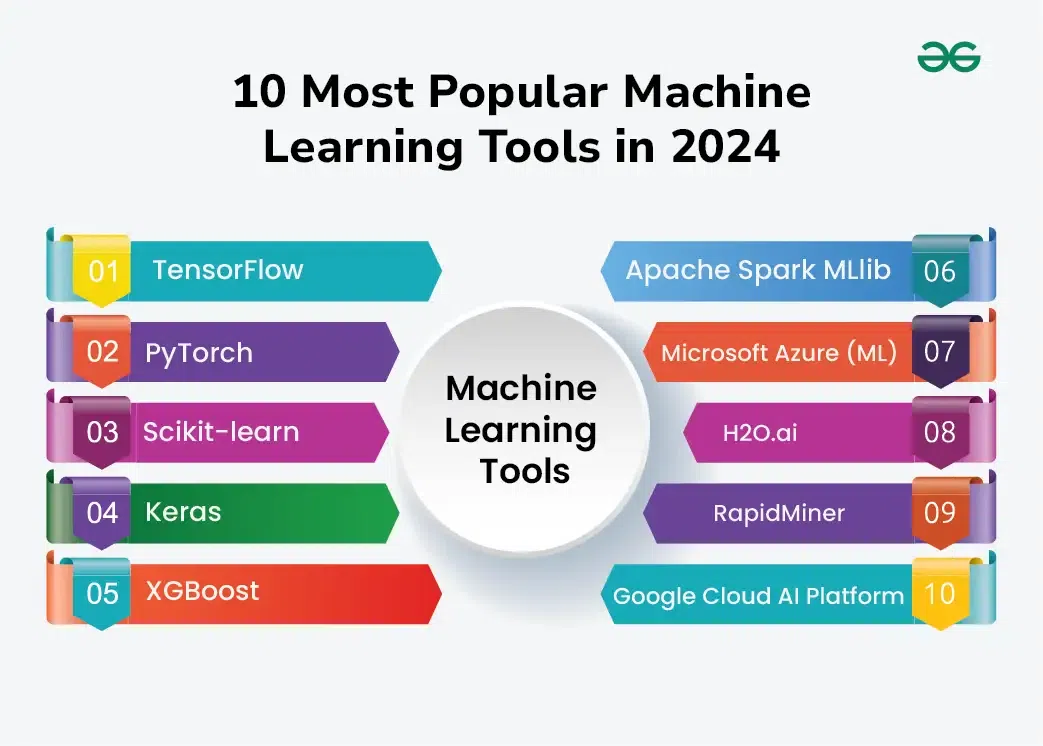
Best Machine Learning Tools 2026: Frameworks, AutoML, and Platforms for Developers and Businesses
Estimated reading time: 12 minutes
Key Takeaways
- Machine learning continues to transform industries through *predictive analytics*, automated decision-making, and AI innovations.
- Choosing the best machine learning tools 2026 is essential for developers and businesses to remain competitive and innovative.
- The landscape includes flexible open-source frameworks, sophisticated AutoML systems, and comprehensive enterprise platforms.
- Top frameworks like TensorFlow and PyTorch serve diverse needs from research to production.
- AutoML tools accelerate model development, making ML accessible even to non-experts.
- Business platforms deliver integrated environments for data prep, deployment, and governance to scale AI workflows.
Table of contents
Machine learning continues to reshape industries through predictive analytics, automated decision-making, and AI-powered innovations. Choosing the best machine learning tools 2026 is critical for developers and businesses aiming to stay competitive and accelerate their operations. These tools range from flexible open-source frameworks to sophisticated AutoML systems and comprehensive enterprise platforms.
In this post, we explore the top machine learning frameworks, AutoML tools, and business platforms in 2026. Whether you’re a data scientist looking for production-ready frameworks or a business leader searching for scalable ML solutions, this guide will help you evaluate and adopt the right technologies to achieve your goals.
Key topics include machine learning platforms for business, how to get started with ML, and detailed comparisons of leading frameworks and AutoML solutions to empower your ML journey.
Overview of Machine Learning Tools Landscape in 2026
Machine learning tools and platforms refer to software libraries, frameworks, and integrated environments designed to simplify tasks such as model building, training, deployment, and ongoing model management. These include everything from low-level coding libraries to full-featured cloud platforms.
In 2026, the ML tools ecosystem is shaped by several key trends:
- Rise of Automation through AutoML: Automated ML systems that significantly reduce manual workloads. Learn more
- Dominance of Open Source Frameworks: Popular frameworks like TensorFlow and PyTorch provide flexibility, community support, and zero licensing costs.
- Widespread Industry Adoption: Businesses demand scalable AI workflows blending development, deployment, and monitoring.
The landscape breaks down into three main categories:
- Development Frameworks: Libraries such as TensorFlow and PyTorch focused on building custom ML models.
- AutoML Tools: Systems enabling faster prototyping and model generation by automating feature engineering and hyperparameter tuning.
- Comprehensive Business Platforms: Enterprises prefer end-to-end platforms combining data prep, model training, deployment, and governance.
Understanding these categories and their roles helps businesses and developers choose the best machine learning tools 2026 has to offer.
Detailed Comparison: TensorFlow vs PyTorch
Two open-source ML frameworks lead the 2026 landscape: TensorFlow and PyTorch. Both facilitate deep learning but serve different user needs and project types. This TensorFlow vs PyTorch comparison highlights their key differences:
| Aspect | TensorFlow | PyTorch |
|---|---|---|
| Ease of Use | Uses static computational graphs (define-and-run), with a steeper learning curve. | Employs intuitive dynamic graphs (eager execution), enabling rapid iteration. |
| Flexibility | Highly scalable across CPUs and GPUs; integrates tightly with high-level APIs like Keras and visualization tools such as TensorBoard. | Superior GPU integration and extensive pretrained model repository via Torch Hub. |
| Community Support | Large, production-focused community with robust enterprise adoption. | Active research-driven community, popular in academia and prototyping. |
| Deployment | Strong mobile and embedded deployment options; optimized for production environments. | Deployment often requires manual optimization; fewer mobile/embedded targets. |
| Performance | Optimized for large-scale neural networks and distributed training. | Excels in research environments and GPU-intensive tasks with dynamic workflows. |
When to Use TensorFlow or PyTorch
- TensorFlow is best suited for production-level projects requiring scalability, mobile deployment, or integration with Google Cloud services.
- PyTorch is preferred for research, rapid experimentation, and projects emphasizing flexibility and custom architecture design.
Choosing between these frameworks depends on your project needs—TensorFlow’s stability and deployment options versus PyTorch’s ease of development and experimental capabilities.
AutoML Tools Explained
AutoML (Automated Machine Learning) automates repetitive tasks in the ML workflow—such as hyperparameter tuning, feature selection, and model validation—reducing the need for manual coding compared to traditional ML frameworks. Learn more
Key Benefits of AutoML:
- Accelerated Development Cycles: Automates time-consuming tasks to produce models faster.
- Accessibility for Non-experts: Enables those with limited ML knowledge to build high-quality models.
Top AutoML Tools in 2026:
- IBM Watson AutoAI: Provides end-to-end automation targeted at enterprise-scale problems, including data cleansing and model explanation.
- Amazon SageMaker AutoML: Cloud-based service integrating AutoML with scalable deployment on AWS infrastructure.
- Azure ML AutoML: Offers a user-friendly drag-and-drop interface combined with advanced AutoML capabilities for faster model development.
Use Cases for AutoML
AutoML tools excel when rapid prototyping is needed, expert ML resources are limited, or teams must optimize ML projects under resource constraints, making them especially valuable in business environments.
Exploring these AutoML platforms can dramatically reduce time-to-market while maintaining robust model performance.
Machine Learning Platforms for Business
Machine learning platforms deliver comprehensive ecosystems combining data preparation, model development, deployment, monitoring, and governance into unified solutions. This full-stack approach caters specifically to business needs.
Essential Features for Business ML Platforms
- Scalability: Support for growing datasets and concurrent workloads.
- Cloud Integrations: Seamless connectivity with cloud infrastructure and storage systems.
- Collaboration Tools: Facilitating teamwork across data scientists, developers, and stakeholders.
- Governance & Compliance: Tools for model auditing, reproducibility, and regulatory adherence.
Leading Business ML Platforms in 2026
- IBM Watson: Combines data modeling, deployment capabilities, and supports Python, R, and Scala, with integrated AutoAI for automation. Ideal for enterprises needing multi-language support and scalability.
- Amazon SageMaker: AWS-native platform featuring scalable compute, support for TensorFlow, PyTorch, Scikit-learn, and built-in AutoML to simplify workflows.
- Azure ML: Integrates with Power BI and Azure Data Lake, offers drag-and-drop UI and MLOps pipelines to streamline professional workflows.
- Google Vertex AI: Provides end-to-end ML workflows with AutoML and custom training optimized for TensorFlow, harnessing Google Cloud’s robust infrastructure.
These platforms integrate popular open-source frameworks and AutoML capabilities, delivering hybrid workflows that balance customization with operational simplicity, thus reducing infrastructure management overhead.
Open Source ML Frameworks Overview
Beyond TensorFlow and PyTorch, several other open-source frameworks fill specialized roles in 2026’s ML ecosystem:
- Scikit-learn: A classical machine learning library focused on tabular data. It offers uniform APIs for classification, regression, clustering, and dimensionality reduction. Ideal for prototyping but does not support deep learning.
- Apache Spark MLlib: Designed for large-scale distributed machine learning, MLlib enables processing of massive datasets with performance up to 100x faster than Hadoop for comparable tasks. Learn more
- JAX: A high-performance numerical computing library with automatic differentiation tailored for advanced research and rapid prototyping in ML and scientific computing.
Advantages of Open Source Frameworks
- Flexibility: High customization potential for research and application.
- Rapid Innovation: Continuous improvements driven by vibrant global communities.
- Zero Licensing Cost: Eliminates expensive software fees common in proprietary solutions.
Considerations When Choosing a Framework
- Project Scale: Scikit-learn suits small to medium projects, Spark MLlib excels at big data processing.
- Community Maturity: Consider the size and activeness of user and developer communities.
- Deployment Needs: Assess compatibility with target infrastructure for seamless integration.
Open source frameworks remain foundational in the best machine learning tools 2026 arsenal due to their adaptability and collaborative development model.
How to Get Started with Machine Learning in 2026
New developers and data scientists aiming to begin machine learning in 2026 can follow these step-by-step recommendations:
Step 1: Assess Your Skill Level and Goals
- Beginners: Focus on Scikit-learn and JupyterLab for exploratory data analysis (EDA) and basic prototyping.
- Intermediate/Experts: Transition to TensorFlow and PyTorch for building complex deep learning models.
Step 2: Install Core Tools
- Use Python package managers like pip or conda to install TensorFlow, PyTorch, and Scikit-learn.
- Set up interactive environments such as JupyterLab to experiment with data and models.
Step 3: Experiment Progressively
- Start with classical ML techniques in Scikit-learn.
- Advance to deep learning with TensorFlow or PyTorch.
- Explore AutoML solutions like Amazon SageMaker AutoML for faster turnaround.
Step 4: Evaluate and Select Tools According to Project Needs
- Prioritize ease of use and community support (PyTorch).
- Opt for production-ready frameworks and deployment options (TensorFlow).
- For big data contexts, consider Apache Spark MLlib.
Step 5: Hands-On Practice
- Engage with AutoML to quickly prototype without deep ML coding. Learn more
- Leverage open-source frameworks for cost-effective, customizable projects.
Starting with foundational tools and progressively experimenting builds a strong, practical ML skill set in 2026’s evolving landscape.
Conclusion
Selecting the best machine learning tools 2026 involves balancing production needs, research flexibility, and business scale. TensorFlow remains the backbone for scalable, production-grade deployments, while PyTorch leads innovation in research and prototyping. AutoML tools increasingly accelerate model development cycles, especially for teams with limited ML expertise. Meanwhile, open-source frameworks maintain their prominence by enabling customization, community-driven innovation, and cost efficiency.
Business platforms such as IBM Watson, Amazon SageMaker, Azure ML, and Google Vertex AI integrate these tools and automation capabilities into unified ecosystems, simplifying end-to-end machine learning workflows.
Make informed choices tailored to your skill set, business objectives, and project demands. To thrive in 2026, start exploring and experimenting today with these frameworks, AutoML solutions, and platforms—the future of machine learning awaits your innovation.
Frequently Asked Questions
- What is the difference between TensorFlow and PyTorch?
- TensorFlow uses static graphs making it suitable for production and deployment at scale, while PyTorch offers dynamic graphs favored for research and rapid prototyping.
- How does AutoML help with machine learning projects?
- AutoML automates tedious tasks like feature engineering and hyperparameter tuning, accelerating model development and enabling non-experts to build effective ML models.
- Which business ML platform is best for enterprises?
- Platforms like IBM Watson, Amazon SageMaker, Azure ML, and Google Vertex AI offer robust, scalable solutions with integrated AutoML. Choice depends on existing cloud infrastructure and specific business needs.
- Are open source ML frameworks free to use?
- Yes, open source frameworks such as TensorFlow, PyTorch, Scikit-learn, and JAX are free, providing high flexibility and benefiting from community-driven innovation.
- How can beginners get started with machine learning?
- Beginners should start with Scikit-learn and JupyterLab for basics, then progress to TensorFlow or PyTorch for more advanced models, while exploring AutoML tools to simplify workflows.
Ready to step into the future of machine learning? Begin your journey with the best machine learning tools 2026 and unlock the full potential of AI-driven innovation.