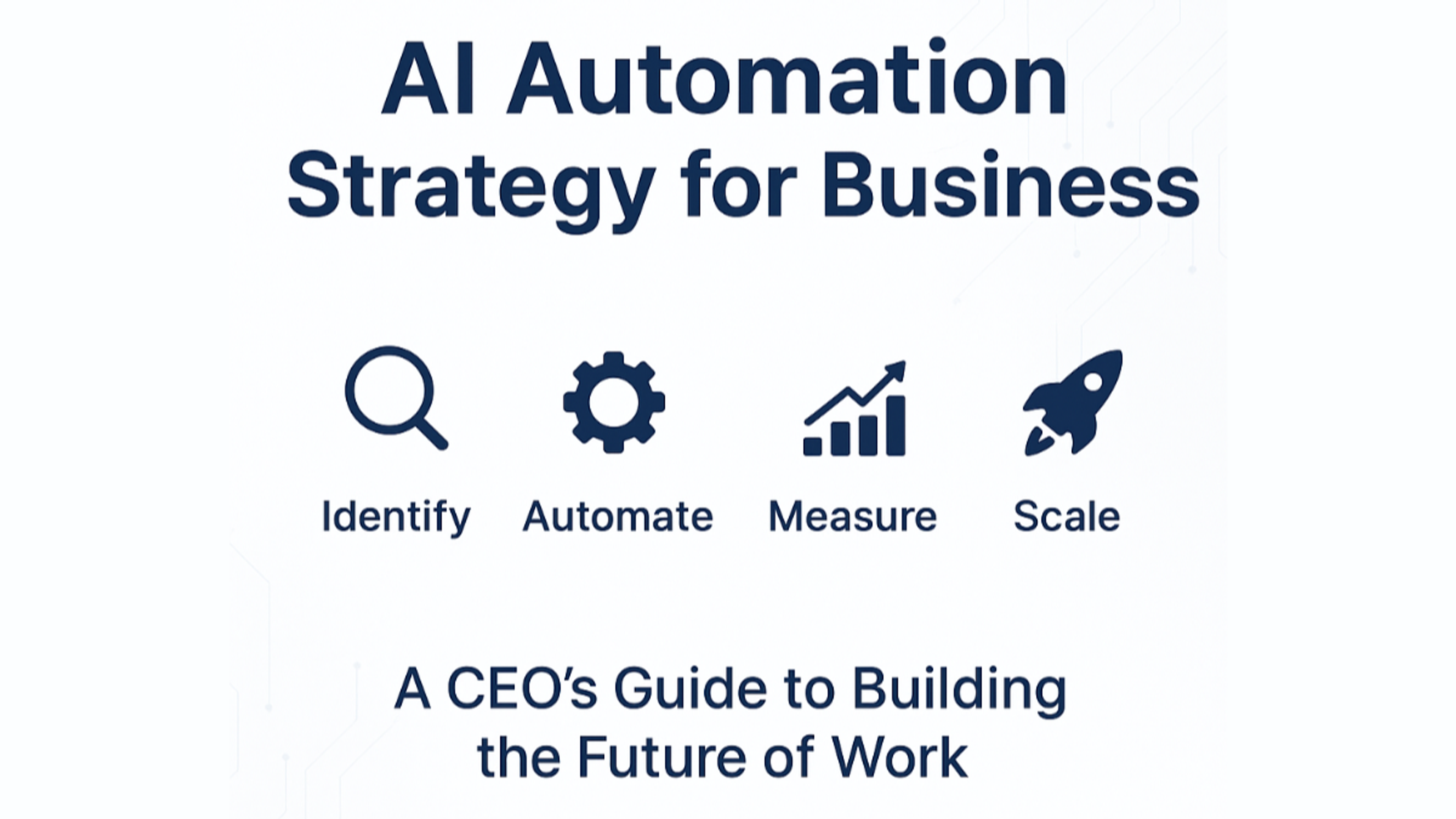
How to Automate Business with AI: A Complete Guide to AI Automation
Estimated reading time: 15 minutes
Key Takeaways
- How to automate business with AI is transforming industries by streamlining repetitive and complex tasks.
- Understanding AI automation benefits such as increased efficiency, cost savings, scalability, and improved decision-making is essential for growth.
- Small businesses can overcome unique challenges through affordable AI automation tools and practical implementations.
- A clear step-by-step guide helps businesses select, pilot, and scale AI-driven automation solutions successfully.
- Real-world use cases in customer service, inventory management, marketing, and manufacturing showcase AI automation’s impact.
- Selecting the right AI process automation tools requires aligning features with business needs, scalability, and integration capabilities.
Table of contents
- What is AI Automation? Understanding AI Automation Basics
- Benefits of AI Automation for Businesses: Why AI Automation Matters
- AI Automation for Small Businesses: Overcoming Common Challenges
- How to Automate Business with AI: Step-by-Step Guide
- AI Automation Examples for Business: Real-World Use Cases
- AI Process Automation Tools: Selecting the Right Solution
- Frequently Asked Questions
As businesses strive to stay competitive in today’s fast-paced market, how to automate business with AI has become a key question. AI automation is transforming industries by using artificial intelligence technologies to streamline repetitive and complex business tasks. This guide dives deep into what AI automation is, its benefits, and practical steps along with examples to help businesses, large or small, adopt AI-driven automation successfully.
What is AI Automation? Understanding AI Automation Basics
AI automation refers to integrating artificial intelligence technologies and algorithms into business processes to automate tasks autonomously. These systems analyze large volumes of data, learn continuously through machine learning, and optimize workflow execution with minimal human intervention.
Core Principles of AI Automation
- Machine Learning: AI models improve task performance over time by discovering data patterns without explicit reprogramming. Read more
- Autonomous Execution: Tasks such as data entry, customer support interactions, and inventory management happen automatically. Learn about AI platforms
- Process Optimization: AI continuously fine-tunes workflows to increase productivity and reduce errors. Explore productivity tools
Typical Application Areas for AI Automation
- Manufacturing: Predictive maintenance uses AI to foresee equipment failures, minimizing downtime. Industry insights
- Retail: AI automates inventory control and personalized product recommendations. Small business growth tools
- Customer Service: Chatbots powered by natural language processing (NLP) address customer queries instantly. See chatbot solutions
- Data Analytics: AI generates actionable business insights from big data to inform decision-making. Explore AI impact
This blend of technologies underpins the full scope of AI process automation tools, enabling smarter, automated business operations that evolve with changing data inputs.
Sources: ABBYY Blog, Heliosz
Benefits of AI Automation for Businesses: Why AI Automation Matters
Implementing AI automation delivers multiple tangible advantages for businesses regardless of size. Here’s a breakdown of the core benefits:
Increased Efficiency and Productivity
- Automates repetitive, manual tasks such as data entry and report generation. Learn more
- Frees employees to focus on strategic, high-value activities. Future of work trends
Cost Savings
- Reduces labor costs by performing routine tasks without additional hires.
- Minimizes human errors that cause expensive reworks or operational delays. Cybersecurity insights
- Prevents costly downtime with predictive maintenance. Healthcare transformation
Scalability
- Enables businesses to adapt to fluctuations in workload instantly without proportional increases in resources. Digital transformation guide
- Supports growth without requiring linear increases in manpower or infrastructure.
Enhanced Accuracy and Consistency
- Delivers data-driven task execution with minimal variance.
- Reduces risk from human oversight. Boost efficiency
Improved Decision-Making
- Provides real-time analytics and insights that uncover patterns beyond human capacity. Industry deep dives
- Allows businesses to react intelligently and swiftly to market trends.
Elevated Customer Experience
- Enables personalized interactions through AI chatbots and recommendation engines. AI platforms comparison
- Fast, accurate responses improve satisfaction and loyalty.
Specific Benefits for Small Businesses
- Lowers operational and maintenance costs. Small business AI tools
- Streamlines processes without the need to expand teams.
- Supports rapid adaptation and growth through affordable automation solutions.
By leveraging AI automation, businesses gain a competitive edge, optimizing resources and delighting customers.
Sources: Heliosz, ABBYY, Zendesk
AI Automation for Small Businesses: Overcoming Common Challenges
Small businesses face unique hurdles without AI automation, including:
- Limited Staff Capacity: Small teams struggle to keep up with repetitive tasks. Explore solutions
- Manual Errors: Higher rates of mistakes reduce productivity and customer satisfaction. Cybersecurity trends
- Scaling Difficulties: Meeting demand peaks is challenging without extra hires. Digital strategies
- Slow Data Analysis: Limited resources delay actionable insights. Industry deep dives
How AI Automation Helps Small Businesses
- Affordable Productivity Boost: Automates routine work without hiring. Learn more
- Reduced Retraining: Adaptive AI systems continuously learn, minimizing the need for frequent retraining.
- Fast Data-Driven Decisions: Enables quick analysis of sales trends, inventory, and customer behavior. Explore data insights
Practical AI Automation Examples for Small Businesses
- AI Chatbots: Provide 24/7 customer service without extra staff, enhancing response times and availability. See chatbot examples
- Automated Inventory Tracking: Prevent stockouts or excess inventory by automatically monitoring and adjusting stock levels. Inventory automation tools
- Simple Business Intelligence (BI) Tools: Analyze sales data to identify trends and forecast demand accurately. BI tools explained
Today, numerous low-cost AI platforms bring these capabilities within reach of small business budgets, leveling the playing field with larger enterprises.
Sources: ABBYY, Heliosz
How to Automate Business with AI: Step-by-Step Guide
Implementing AI automation successfully involves clear planning and incremental steps.
Step 1: Identify Suitable Processes for Automation
Look for tasks that are:
- Repetitive and rule-based (e.g., data entry, inventory updates) Learn about productivity tools
- High volume or time-consuming
- Error-prone or requiring consistent accuracy
Examples include customer interactions, marketing workflows, and predictive maintenance. Explore examples
Step 2: Assess Pain Points
Analyze where bottlenecks, delays, or mistakes occur. Understanding current challenges helps prioritize automation targets. Digital transformation strategies
Step 3: Research and Select AI Process Automation Tools
Consider tools that offer:
- Ease of integration with your existing systems (APIs, connectors) AI platform comparisons
- Scalability to grow with your business demands Digital strategies
- Machine learning capabilities for ongoing optimization Productivity boosts
- Cost-effectiveness and user-friendliness Affordable AI tools
Step 4: Test Tools via Pilot Projects
Run pilots or free trials focusing on 1-2 processes to evaluate fit and risk before wider rollout. Pilot projects
Step 5: Implement Automation
Integrate selected tools through APIs or built-in connectors. Minimal staff training is necessary as AI adapts seamlessly to workflows. Implementation insights
Step 6: Scale Up Gradually
Expand automation once early successes are confirmed, ensuring process stability and stakeholder buy-in. Scaling strategies
Step 7: Evaluate ROI and Success
Track key performance indicators (KPIs) such as:
- Time saved on tasks
- Reduction in operational costs
- Decreased error rates
- Productivity improvements
- Customer satisfaction scores
Regular reporting helps refine and justify further AI automation investments.
Following this structured approach enables sustainable and measurable AI automation adoption.
Sources: ABBYY, Camunda
AI Automation Examples for Business: Real-World Use Cases
Here are concrete examples demonstrating powerful AI automation examples for business across industries.
Customer Service Chatbots in Retail
- Use case: NLP-powered chatbots respond instantly to customer queries. Chatbot solutions
- Outcome: Faster response times, higher customer satisfaction, and reduced operational staffing costs. Zendesk case study
- Effect: Employees can focus on complex issues, improving service quality.
AI-Driven Inventory Management in E-Commerce
- Use case: Predictive algorithms forecast demand and automatically adjust stock levels. Inventory growth tools
- Outcome: Lower incidences of overstock or stockout, minimizing waste.
- Effect: Faster order fulfillment and better cash flow management.
Marketing Automation Platforms
- Use case: AI segments customers for targeted campaigns and analyzes predictive trends. Marketing tools
- Outcome: Improved campaign ROI through personalized microtargeting.
- Effect: Increased conversion rates and better marketing spend efficiency.
Sources: Heliosz, Online UC Blog
Manufacturing Quality Control and Maintenance
- Use case: Computer vision inspects products and schedules predictive maintenance. Healthcare transformation
- Outcome: Reduced downtime and defect-related costs.
- Effect: Higher product quality and equipment availability.
Source: Heliosz
Efficiency Gains
Across such applications, businesses report efficiency improvements between 20-50%, significant cost reductions, and improved scalability.
Sources: Heliosz, Camunda
AI Process Automation Tools: Selecting the Right Solution
Choosing the right AI process automation tool is critical to success.
Categories of Popular Tools
Tool Type
Key Features
Best-Suited For
Business Intelligence (BI) Platforms
Real-time analytics, trend forecasting
Mid to large businesses needing advanced insights (Online UC Blog)
Chatbots/Virtual Assistants
NLP-based customer support and interactions
Small businesses focusing on customer support (Heliosz, ABBYY)
Workflow Automation (e.g., ABBYY, Camunda)
Process optimization, self-learning machine learning
All business sizes, ideal for repetitive processes (ABBYY, Camunda, Creatio)
Tips for Selecting AI Automation Tools
- Align the tool’s capabilities with your business goals and current infrastructure.
- For small businesses, prioritize ease of use and smooth integration. Learn more
- Larger enterprises should focus on scalability and advanced analytics. Explore options
- Always test tools with free trials or pilot programs to evaluate ROI potential and maintenance demands before committing. Pilot testing
Making informed choices about tools accelerates AI automation success.
Sources: ABBYY, Camunda, Online UC Blog
Conclusion
Mastering how to automate business with AI is essential for companies aiming to boost efficiency, reduce costs, and embrace data-driven growth. AI automation streamlines workflows, enhances decision-making, and delivers superior customer experiences.
Starting small by identifying one repetitive process, selecting a user-friendly AI tool, and measuring early results paves the way for larger-scale automation. This methodical approach sets a foundation for ongoing operational excellence and competitive advantage in a digitally evolving marketplace.
AI automation is no longer optional—it’s a necessity for future-proofing your business.
Call to Action
Ready to take the next step in AI automation?
- Try free trials or demos of top AI process automation tools such as ABBYY, Camunda, or leading BI platforms to discover the best fit for your business. Explore platforms
- Explore trusted resources and blogs from industry leaders like Zendesk, Camunda, or Heliosz for practical guides and inspiring case studies. Read more
- Subscribe to newsletters and follow social media channels focused on AI in business to stay updated with the latest automation trends and insights. Stay informed
Unlock the full potential of AI automation and transform your business operations today!
Frequently Asked Questions
- What is AI automation and how can it benefit my business?
- Which business processes are best suited for AI automation?
- How do I choose the right AI automation tool?
- Can small businesses effectively implement AI automation?
- What are some real-world examples of AI automation?
What is AI automation and how can it benefit my business?
AI automation uses artificial intelligence to autonomously manage and execute repetitive or complex business tasks, increasing efficiency, reducing errors, and enabling data-driven decision-making. It can free staff to focus on higher-level strategies and significantly lower operational costs.
Which business processes are best suited for AI automation?
Tasks that are repetitive, rule-based, high volume, or error-prone — such as data entry, customer support via chatbots, inventory management, and predictive maintenance — are ideal candidates for AI automation.
How do I choose the right AI automation tool?
Evaluate tools based on integration ease, scalability, machine learning capabilities, cost, and user-friendliness. Pilot testing through free trials helps assess fit before full implementation. Align your choice with your business size and goals for optimal results.
Can small businesses effectively implement AI automation?
Absolutely. Many affordable, easy-to-use AI tools exist that help small businesses automate routine tasks, improve accuracy, and scale operations without heavy investment or expanding staff.
What are some real-world examples of AI automation?
Examples include customer service chatbots in retail, AI-driven inventory management in e-commerce, marketing automation platforms, and manufacturing quality control using computer vision and predictive maintenance.
This comprehensive guide brings together expert research and actionable steps to help businesses of all sizes harness AI automation effectively.