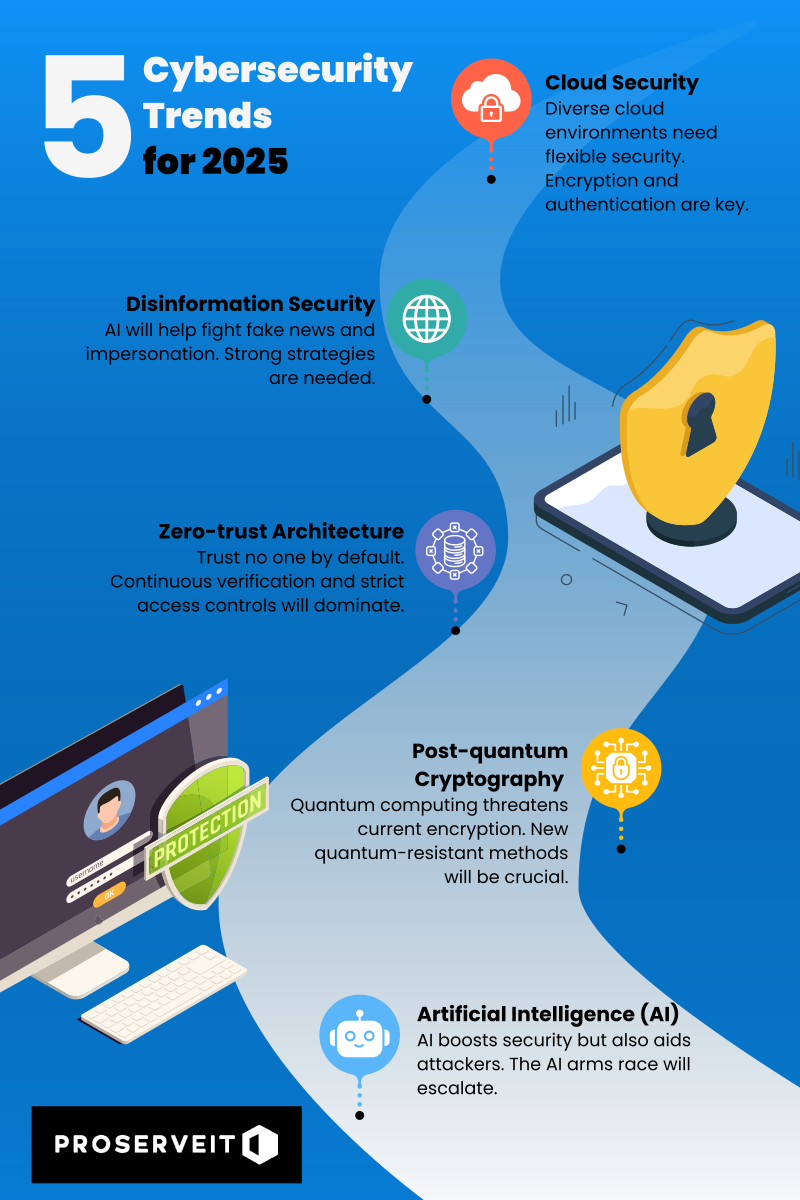
Cybersecurity Trends 2025: What Businesses and Individuals Need to Know
Estimated reading time: 12 minutes
Key Takeaways
- Cybersecurity trends 2025 reflect a rapidly evolving landscape shaped by AI, geopolitical tensions, and complex digital ecosystems.
- Cybercriminals deploy emerging cyber threats 2025, leveraging AI for sophisticated attacks including ransomware, phishing, and supply chain exploits.
- Businesses face costly breaches exacerbated by cybersecurity skill shortages, while individuals need to guard against credential theft and social engineering.
- Key areas to watch include AI-powered threats, identity-first security frameworks, and the convergence of IT and OT security.
- Automation, predictive analytics, and governance of shadow AI models are becoming central to effective cybersecurity strategy.
Table of contents
- Overview of Current Cybersecurity Landscape: Understanding Today’s Security Trends
- Key Cybersecurity Trends 2025 to Watch: Technological and Threat Evolutions
- Analysis of Major Cyber Threats 2025: Detailed Look at Looming Risks
- Shifting Enterprise Security Priorities in 2025: Strategic Focus Areas
- Integrating Security Trends into Business Strategy: Actionable Steps for Success
- Conclusion: Preparing for Cybersecurity Trends 2025
- Frequently Asked Questions
In an era marked by rapid technological innovation and geopolitical uncertainty, cybersecurity trends 2025 highlight the shifting landscape of digital defenses, emerging threats, and advanced technologies shaping how we protect data and systems. This post focuses on these evolving security trends, driven largely by the widespread adoption of artificial intelligence (AI) and the complexities introduced by global conflicts.
Staying informed about emerging cyber threats 2025 is vital. Cybercriminals increasingly harness AI to execute sophisticated ransomware campaigns, phishing schemes, and supply chain exploits. These attacks can trigger systemic failures in interconnected digital infrastructures, amplifying potential damage far beyond individual organizations.
Understanding broader security trends is crucial for both businesses and individuals. For companies, adapting to these threats helps mitigate costly breaches—such as the estimated average USD 1.76 million impact worsened by cybersecurity skills shortages. For individuals, awareness is key to safeguarding personal data against threats like credential theft and targeted social engineering attacks.
This comprehensive overview will equip readers with critical insights into the cybersecurity landscape shaping 2025, ensuring preparedness in an increasingly complex digital world.
Overview of Current Cybersecurity Landscape: Understanding Today’s Security Trends
The present cybersecurity environment is defined by rising complexity. Key drivers include:
- Geopolitical tensions, which introduce unpredictability and broaden threat actor motivations.
- Increasingly complex global supply chains, creating expansive attack surfaces.
- Rapid technological adoption, notably AI, which both aids defenses and introduces fresh vulnerabilities. (source)
These factors have intensified threats such as ransomware, phishing, and cloud intrusions. In 2024 alone:
- Credential theft attacks surged by 71%.
- There was a significant spike in cloud infrastructure intrusions.
- AI-enhanced social engineering exploits rose sharply, impacting 42% of organizations.
These developments set the foundation for anticipated cyber threats 2025, including risks from unmanaged shadow AI models and the emerging challenges posed by quantum computing’s impact on cryptography.
Understanding this landscape is essential to grasp the unfolding security trends and prepare effective countermeasures against evolving cyber risks.
Sources:
WEF Global Cybersecurity Outlook 2025
IBM Cybersecurity Trends 2025
Key Cybersecurity Trends 2025 to Watch: Technological and Threat Evolutions
Technological Advancements Driving Security Trends
- AI and Generative AI (GenAI):
AI technologies are dual-use tools powering both advanced defenses—such as automated threat detection—and sophisticated attacks like GenAI-generated phishing and deepfakes. (source) - Identity-First Security Frameworks:
Zero-trust models are evolving into more robust identity-first frameworks that emphasize verifying users’ identities before granting access, crucial in hybrid, multicloud environments. (source) - Convergence of IT and OT Security:
As operational technology (OT) integrates with IT systems through cloud and soon quantum computing platforms, security strategies are unifying to protect critical infrastructure.
Emerging Threat Vectors in 2025
- GenAI-Powered Personalized Phishing and Deepfake Attacks:
Attackers use AI to craft highly personalized and convincing scams, making phishing more effective and harder to detect. (source) - Vishing Combined with Business Email Compromise (BEC):
Voice phishing (vishing) attacks are combined with email fraud to trick victims into disclosing sensitive information or wiring funds. - Exploitation of Older Unpatched Vulnerabilities:
Despite advances, many systems remain vulnerable due to slow patching, providing ongoing opportunities for attackers. - Ransomware-as-a-Service (RaaS) and Zero-Day Exploits:
RaaS enables organized groups to deploy ransomware campaigns at scale, often targeting critical infrastructure through unknown vulnerabilities. (source)
Automation and Predictive Analytics in Security
- Increasingly, organizations leverage automation and AI-driven predictive analytics to detect threats faster and coordinate timely responses. (source)
- However, the rise of shadow AI—unapproved AI models used unofficially—introduces new data security challenges requiring robust governance frameworks. (source)
Understanding these groundbreaking security trends and evolving cyber threats 2025 is crucial for building resilient defenses amid a dynamically changing cyber environment.
Sources:
WEF Global Cybersecurity Outlook 2025
IBM Cybersecurity Trends 2025
Deloitte Cybersecurity Report 2025
Analysis of Major Cyber Threats 2025: Detailed Look at Looming Risks
Evolving Dominant Threats
- Ransomware Growth via RaaS:
Organized ransomware groups leverage RaaS business models, increasing attack precision and scale against critical sectors like healthcare, government, and manufacturing. (source) - Supply Chain Attacks:
These attacks exploit the interconnected nature of business ecosystems to induce cascading failures, targeting trusted third-party suppliers. (source) - IoT Vulnerabilities Amid OT Convergence:
The merging of IT and OT environments heightens risks in Internet of Things (IoT) devices, which often lack comprehensive security.
How Threat Actors Are Adapting
- Use of GenAI for Highly Personalized Campaigns:
Nearly 47% of organizations rank GenAI-enabled attacks as a top concern due to their scalability and accuracy. (source) - Nation-State Cyber Campaigns and Fraud:
Cyber espionage and state-sponsored fraud continue to escalate, focusing on geopolitical leverage and financial gain. - Exploiting Human Weakness: Vishing and Social Engineering:
Attackers increasingly utilize voice-based social manipulation to circumvent technical defenses.
Shifting Attack Focus to High-Value Targets
Governments and supply chains are particularly attractive, with 72% of surveyed organizations reporting rising cyber risks in these sectors.
Being aware of these evolving cyber threats 2025 helps businesses and individuals anticipate and mitigate potential breaches.
Sources:
Deloitte Cybersecurity Report 2025
WEF Global Cybersecurity Outlook 2025
JPMorgan Chase: Top Cybersecurity Trends to Watch in 2025
Shifting Enterprise Security Priorities in 2025: Strategic Focus Areas
Organizations are adjusting their cybersecurity investments and tactics to align with the changing threat landscape and technological advances.
Key Areas of Focus
Priority Area
Key Drivers and Actions
Cloud Security
Increasing cloud adoption brings more intrusion attempts. Identity-first strategies are critical for protection. (IBM source) (source)
Identity & Access
The traditional security perimeter disappears; building product-agnostic “identity fabrics” supports hybrid and multicloud usage. (IBM source)
Data Privacy & Compliance
Regulatory fragmentation challenges businesses. Harmonizing controls boosts legal compliance and security posture. (WEF source)
Workforce Development
Talent shortages are costly and limit breach responses. Prioritizing training and recruitment is essential. (WEF source, IBM source)
The Evolving Role of CISOs and Executives
- CISOs are transitioning from purely technical roles to embedding security into organizational culture. (source)
- Managing people-centric risks and establishing trust around AI deployment become critical leadership responsibilities.
By reorienting around these enterprise security priorities, organizations enhance resilience against 2025’s advanced cyber threats.
Sources:
WEF Global Cybersecurity Outlook 2025
IBM Cybersecurity Trends 2025
KPMG Cybersecurity Considerations 2025
Integrating Security Trends into Business Strategy: Actionable Steps for Success
To future-proof cybersecurity efforts, enterprises should align their strategies with the anticipated trends and challenges.
Recommended Actions
- Adopt Zero-Trust and Identity-First Architectures:
Minimize attack surfaces by validating every user and device continuously across environments. - Implement AI Governance Policies:
Control risks related to shadow AI use and ensure responsible deployment of AI in security workflows. (source) - Prioritize Continuous Monitoring and Proactive Patch Management:
Quickly detect threats and remediate vulnerabilities, especially zero-day exploits and legacy system gaps. - Embed Cybersecurity into Corporate Culture:
Leaders should champion Secure by Design principles and establish transparent incident reporting frameworks. (source) - Address Multicloud Complexities via Unified Security Strategies:
Consolidate risk management across diverse cloud platforms to avoid fracture and exposure. (source)
Aligning business frameworks with these security trends and enterprise security priorities will enable organizations to mitigate 2025’s evolving cyber risks effectively.
Sources:
Deloitte Cybersecurity Report 2025
IBM Cybersecurity Trends 2025
Conclusion: Preparing for Cybersecurity Trends 2025
The cybersecurity trends 2025 landscape is dominated by the interplay of AI advancements, identity-first security frameworks, and the integration of IT and OT protections. Key cyber threats 2025 include the evolution of ransomware via RaaS, GenAI-driven phishing and deepfakes, alongside systemic vulnerabilities in complex supply chains.
Organizations are shifting their enterprise security priorities towards cloud security, data privacy compliance, workforce development, and the readiness for quantum computing disruptions.
To navigate this multifaceted threat environment, businesses and individuals must proactively update their cybersecurity strategies by adopting AI governance, fostering security-centric cultures, and investing in resilient frameworks.
The time to act is now—implementing robust governance policies, engaging in continuous training, and building adaptive security infrastructures will ensure stronger defenses against the future’s dynamic digital threats.
Sources:
Deloitte Cybersecurity Report 2025
WEF Global Cybersecurity Outlook 2025
IBM Cybersecurity Trends 2025
Frequently Asked Questions
What are the top cybersecurity threats expected in 2025? Answer: The primary threats include AI-powered phishing and deepfake scams, ransomware-as-a-service campaigns, exploitation of unpatched vulnerabilities, supply chain attacks, and evolving social engineering techniques like vishing. How can businesses defend against AI-driven cyber attacks? Answer: Businesses should adopt AI-powered defense tools, enforce zero-trust and identity-first frameworks, implement robust AI governance policies, and prioritize continuous monitoring and employee awareness training. What does “identity-first security framework” mean? Answer: It’s a security approach that prioritizes verifying the identity of users and devices before granting access, rather than relying solely on network perimeter defenses—especially crucial in hybrid and multicloud environments. Why is managing shadow AI important for cybersecurity? Answer: Shadow AI refers to unauthorized or ungoverned AI usage within organizations, which can lead to data leaks, compliance violations, and security gaps. Proper governance ensures risks are mitigated effectively. What should individuals do to protect themselves from cyber threats in 2025? Answer: Individuals must remain vigilant against phishing and social engineering, use strong authentication methods, regularly update software, and limit personal data exposure online.