


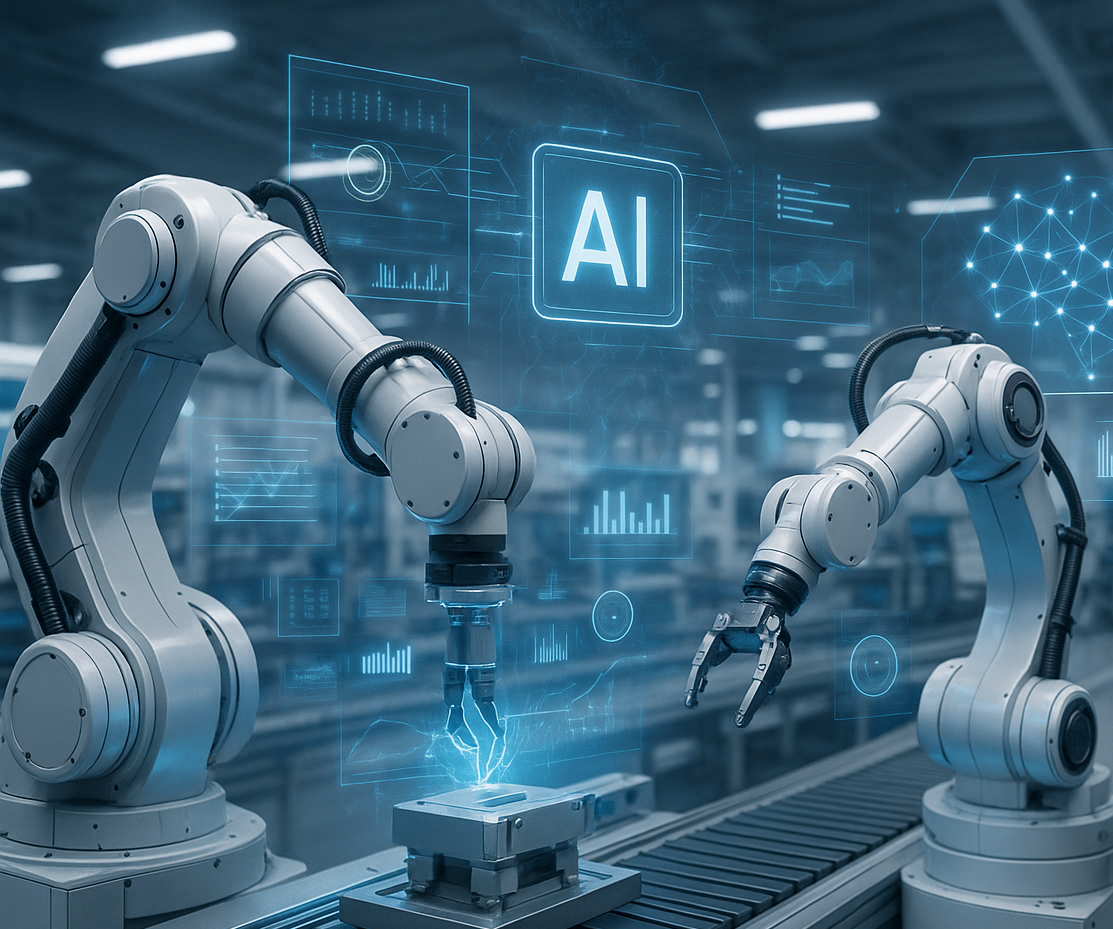
AI Robotics in Manufacturing: The Future of Efficiency and Innovation
Estimated reading time: 12 minutes
Key Takeaways
- AI robotics integrates artificial intelligence with robotic systems to transform industrial manufacturing processes.
- Employers recognize AI robotics as critical for digital transformation, with 86% citing it as essential for competitive advantage.
- From production optimization to healthcare robotics, AI robotics enhance efficiency, safety, and innovation.
- Advanced technologies such as digital twins, edge AI platforms, and collaborative robots are key drivers of scalable and flexible manufacturing.
- Cross-industry applications in warehouse automation, agriculture, logistics, and supply chain demonstrate broad strategic value and labor shortage solutions.
Table of contents
- AI Robotics in Manufacturing: The Future of Efficiency and Innovation
- AI Robotics in Manufacturing: Optimizing Production with Intelligent Automation
- AI in Warehouse Automation: Enhancing Accuracy and Speed
- Robots in Healthcare AI: Precision, Monitoring, and Rehabilitation
- AI Robotics in Agriculture: Advancing Productivity and Sustainability
- Robotics AI for Logistics: Streamlining Operations and Delivery
- AI-Powered Automation in Supply Chain: Driving End-to-End Efficiency
- Conclusion: Unlocking Competitive Edge with AI Robotics Across Industries
- Frequently Asked Questions
Artificial intelligence (AI) robotics combines AI with robotic systems to create machines capable of autonomous decision-making, adaptability, and real-time interaction in changing industrial environments. This integration is reshaping industries, especially manufacturing, by tackling pressing challenges like significant labor shortages—estimated at 425,000 unfilled jobs—and rising operational costs. Notably, 86% of employers recognize AI robotics as essential for digital transformation and sustained competitive advantage (source, source).
At the core of this revolution is AI robotics in manufacturing, a transformative force that drives efficiency, sparks innovation, and enhances workplace safety. By optimizing production lines, manufacturers are reducing costs, scaling operations, and improving product quality like never before.
This blog delves into the applications of AI robotics across several critical sectors: manufacturing, warehouse automation, healthcare, agriculture, logistics, and supply chain. We will uncover the strategic value AI robotics delivers across industries and how it shapes the future of work and production.
Keywords: AI robotics in manufacturing, AI robotics, AI in warehouse automation, robots in healthcare AI, AI robotics in agriculture, robotics AI for logistics, AI-powered automation in supply chain.
AI Robotics in Manufacturing: Optimizing Production with Intelligent Automation
AI robotics in manufacturing optimizes production lines with cutting-edge technologies that blend artificial intelligence and automation. Key implementations include:
- AI vision systems: These systems perform high-speed defect detection, inspecting up to 200 parts per minute with superior precision, ensuring that only quality products leave the line. Around 41% of manufacturers have adopted such AI vision to enhance quality control.
- Collaborative robots (cobots): Cobots equipped with adaptive path planning can seamlessly handle complex, high-mix assembly tasks. They reduce programming time and increase workforce flexibility by working alongside humans safely and efficiently.
Real-World Examples
- NVIDIA’s Jetson edge AI platform powers advanced industrial vision systems, enabling real-time defect detection and quality assurance at scale.
- FANUC’s force-control cobots are deployed in electronics manufacturing for precise press-fit operations, showcasing how AI robotics enhance accuracy and reduce human error.
- Foxconn leverages AI-powered digital twins to simulate manufacturing processes and optimize workforce deployment, effectively addressing labor shortages with a more agile production system (source1, source2, source3).
Strategic Benefits
- Cost Savings: Automating repetitive and complex tasks yields up to 50% cost reduction, freeing capital and reducing dependency on manual labor (source).
- Scalability: Software-defined robotic operations enable quick reprogramming and adaptation, with 35% of manufacturers showing keen interest in enhancing AI programming capabilities.
- Safety Improvements: Humanoid robots, capturing 13% interest, increase flexibility in logistics and support worker safety by handling physically demanding or hazardous tasks (source).
These improvements translate into a stronger competitive advantage and operational resilience for manufacturers aiming to thrive amid evolving market demands.
AI in Warehouse Automation: Enhancing Accuracy and Speed
In warehouses, AI robotics revolutionize inventory management, order picking, and sorting:
- Inventory Management: Robotic systems utilize dexterous manipulation techniques capable of handling delicate and flexible items like cables or soft textiles, ensuring accurate stock handling (source).
- Order Picking and Sorting: Humanoid robots designed for human-centric environments perform tasks typically reliant on manual labor, improving efficiency and safety.
Operational Impact
AI’s real-time adaptation to part variations accelerates operational speed and accuracy, critical in light of a 2.3 million job shortage faced by warehousing and logistics sectors. Such technology addresses labor gaps while optimizing throughput.
Integration Challenges and Solutions
- Latency: Timely command execution is vital. Edge computing adoption, currently at 21%, minimizes system latency by processing data near the physical location of robotic systems, enabling instantaneous decision-making (source).
- Simulation and Optimization: NVIDIA Omniverse digital twins simulate warehouse environments and robotic palletizing cells, allowing for rapid trajectory adjustments and process refinement before real-world deployment (source1, source2, source3).
These advancements collectively raise the standards of operational excellence in warehousing.
Robots in Healthcare AI: Precision, Monitoring, and Rehabilitation
AI robotics significantly enhance healthcare delivery dimensions including:
- Surgical Assistance: Precision force control allows robotic systems to perform delicate operations with extraordinary accuracy, reducing human error and improving surgical outcomes (source).
- Patient Monitoring: Edge AI inference models run on-site with sub-100ms latency, enabling rapid detection of patient status changes and immediate intervention.
- Rehabilitation Support: Adaptive cobots assist patients in mobility and recovery through personalized interaction tailored by AI algorithms.
Benefits and Considerations
- Improved patient outcomes derive from increased precision and timely responsiveness.
- Advanced technology in healthcare robotics attracts a younger workforce eager to work with innovative AI systems.
- Regulatory compliance demands that AI models undergo thorough validation, with a focus on ethical safeguards to maintain human oversight despite increasing automation (source).
Such considerations are vital in healthcare’s highly regulated environment (source1, source2).
AI Robotics in Agriculture: Advancing Productivity and Sustainability
AI robotics boost agricultural output by automating both monitoring and physical tasks:
- Crop Monitoring: AI vision systems analyze plant health and detect pests early, enabling targeted interventions that minimize crop loss.
- Automated Farming: Wheeled robotic platforms perform jobs like planting, harvesting, and pest control with precision and efficiency.
Sustainability and Labor
- Robotics promote sustainability by optimizing inputs such as water and pesticides, reducing their environmental footprint.
- With global agricultural labor shortages projected to reach millions, AI robotics act as strategic solutions to ensure food security (source).
Emerging Technologies
- AI-driven flexible manipulation tackles the inherent variability in crop handling.
- Small language models delivering vertical, crop-specific insights are nearing production readiness, enhancing decision-making at the field level (source1, source2, source3, source4).
Keywords: AI robotics in agriculture, AI robotics, AI-powered automation in supply chain.
Robotics AI for Logistics: Streamlining Operations and Delivery
Logistics benefits immensely from AI robotics through:
- Package Sorting: Robotic dogs and humanoid robots improve sorting speed and accuracy, with 22% of logistics firms planning adoption by 2027.
- Route Optimization: AI-generated world models help optimize delivery routes, with 7% of companies expressing interest.
- Autonomous Last-Mile Delivery: Physical AI technologies enable self-driving last-mile delivery, reducing human reliance and delivery times.
Strategic Advantages
- Cost savings emerge from reduced labor and operational inefficiencies.
- Faster cycle times are realized through extensive use of digital twin simulations that predict and streamline workflow.
- Scalability is critical as logistics experiences a 51% surge in orders from food and consumer goods sectors.
Future Trends
- Advances in edge AI processors offer 3x performance increases, boosting robotic capabilities.
- Nearshoring automation enhances supply chain resilience by localizing critical operations (source1, source2, source3, source4).
Keywords: robotics AI for logistics, AI robotics, AI-powered automation in supply chain.
AI-Powered Automation in Supply Chain: Driving End-to-End Efficiency
AI robotics enable full supply chain automation through:
- Comprehensive Process Control: Autonomous agentic AI systems manage supply chains from procurement to last-mile delivery, enabling seamless coordination and flexibility.
- Predictive Maintenance: Leveraging large language models (LLMs) growing at 35%, manufacturers predict equipment failures before they occur, significantly reducing downtime (source).
- Scenario Modeling: Combined cloud and edge computing platforms, with adoption rates between 19-21%, empower enhanced data analytics and rapid decision-making (source).
- Digital Twins: These virtual replicas offer global visibility into supply chain dynamics, facilitating leaner, more resilient operations as demonstrated in Caterpillar-NVIDIA collaborations (source1, source2, source3).
Business Impact
AI-powered automation strengthens business resilience against challenges like tariffs and labor shortages. Companies gain agility, reduce risk, and improve service levels.
Keywords: AI-powered automation in supply chain, AI robotics, AI in warehouse automation, robotics AI for logistics.
Conclusion: Unlocking Competitive Edge with AI Robotics Across Industries
AI robotics in manufacturing leads the charge for transforming industrial operations by delivering improved efficiency, substantial cost savings, scalable production, enhanced safety, and innovation-driven competitive advantage.
While manufacturing drives the highest adoption rates—86% of employers cite AI robotics as essential—tailored AI robotics applications in warehousing, healthcare, agriculture, logistics, and supply chain also unlock vast strategic value.
Industry professionals and business leaders should actively explore and invest in AI robotics technologies such as edge AI platforms, humanoid robots, and digital twin simulation. These tools help overcome operational constraints, future-proof businesses against labor shortages and market shifts, and realize unmatched performance gains (source, source).
Harnessing the full potential of AI robotics in manufacturing and its cross-sector applications establishes a foundation for resilience, agility, and sustained growth in today’s competitive landscape.
Keywords: AI robotics in manufacturing, AI robotics, AI-powered automation in supply chain, AI in warehouse automation, robots in healthcare AI, AI robotics in agriculture, robotics AI for logistics.
By integrating AI and robotics, industries can meet the challenges of tomorrow today, unlocking new frontiers in automation and smart manufacturing.
Frequently Asked Questions
- What is AI robotics and how does it differ from traditional robotics?
- AI robotics combines artificial intelligence algorithms with robotic systems, enabling machines not only to perform tasks but also to make autonomous decisions, adapt to changing environments, and interact intelligently in real time. Traditional robotics typically rely on preprogrammed actions without autonomous learning or flexibility.
- How do AI robotics improve efficiency in manufacturing?
- AI robotics streamline production by enabling rapid defect detection through AI vision systems, adaptive collaboration with human workers via cobots, and scalable automation of complex tasks. This results in cost savings, higher product quality, and faster throughput.
- What challenges do companies face when implementing AI robotics?
- Challenges include managing system latency, ensuring safety and regulatory compliance (especially in healthcare), integrating AI systems with existing infrastructure, and upskilling the workforce.
- Which industries benefit the most from AI robotics?
- Manufacturing leads adoption, but significant benefits are also realized in warehouse automation, healthcare, agriculture, logistics, and supply chain management, where AI robotics address labor shortages and operational complexities.
- What future trends will shape AI robotics?
- Advances in edge AI processing, digital twin simulations, AI-powered automation across supply chains, and adoption of humanoid robots will continue accelerating capabilities, leading to greater autonomy, adaptability, and strategic value.