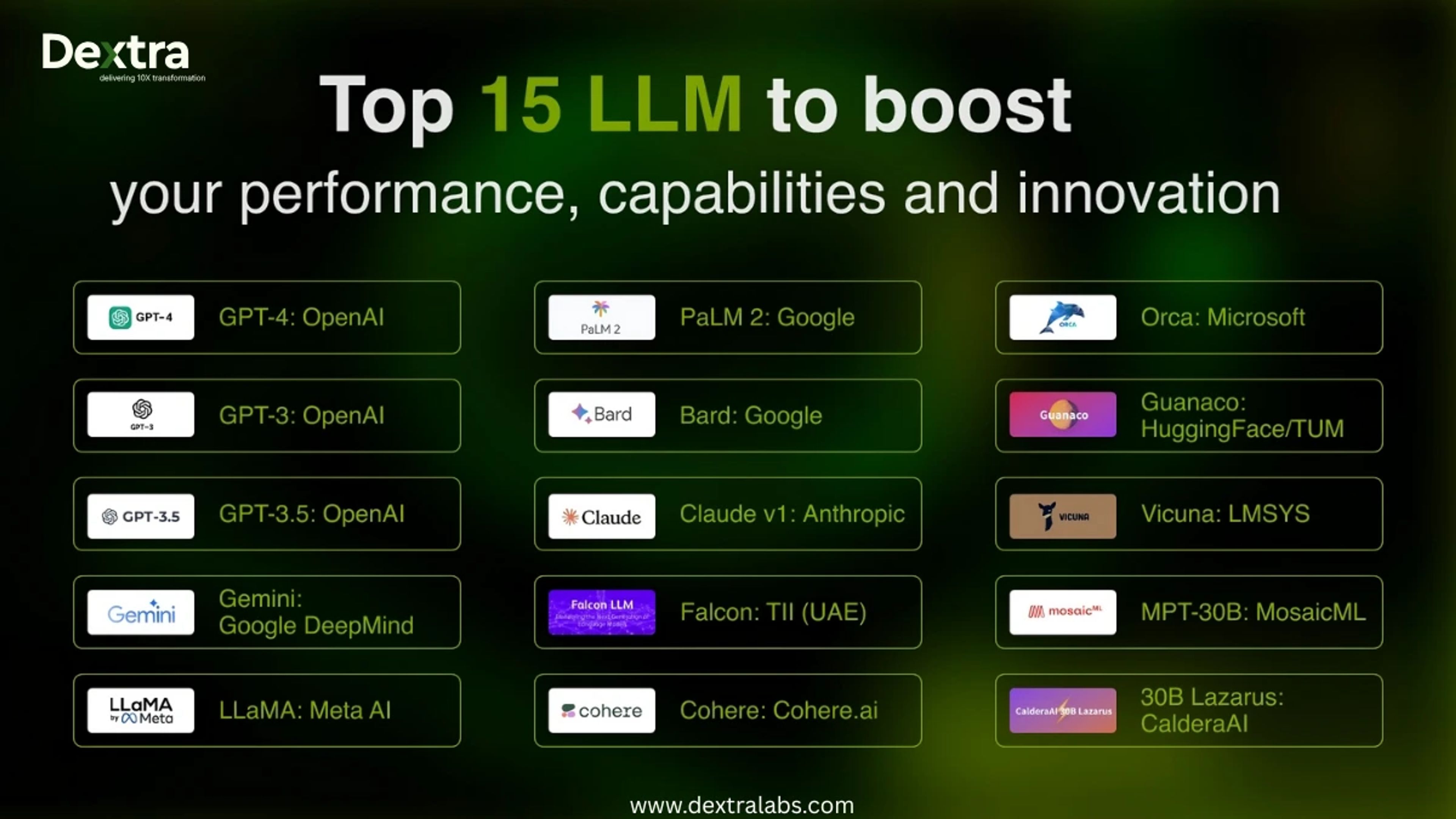

Best Large Language Models 2026: In-Depth Comparison and Guide
Estimated reading time: 15 minutes
Key Takeaways
- The rapid AI advancements make selecting the best large language models 2026 critical for diverse applications.
- GPT-4, Claude, Gemini, and other models are analyzed for strengths in performance, accessibility, and use cases.
- Understanding the trade-offs between open source LLMs vs closed source models is essential.
- Benchmark comparisons reveal GPT-5 leads expert knowledge, Gemini tops human preference, and open source LLMs like Llama offer customization advantages.
- Choosing the right LLM depends on your priorities: cost, transparency, performance, and intended application domain.
Table of contents
- Overview of Large Language Models Landscape in 2026
- GPT-4 vs Claude vs Gemini: Direct Comparison
- Llama vs GPT Comparison
- Open Source LLMs vs Closed Source LLMs
- Most Powerful LLMs Ranked & LLM Benchmark Comparison
- Key Considerations for Choosing the Best LLM in 2026
- Conclusion
- Frequently Asked Questions
Overview of Large Language Models Landscape in 2026
What Are Large Language Models (LLMs)?
Large language models are sophisticated AI systems trained on enormous datasets containing text from books, websites, and more. These models understand and generate human language with remarkable fluency, making them essential in the modern digital landscape. For a beginner-friendly explanation of what large language models are and how they work, see this article.
Industries Impacted by LLMs
LLMs have transformed numerous industries, such as:
- Software development: Code generation and debugging assistants.
- Content creation: Automated article writing, summarization, and translation.
- Finance: Analyzing financial documents and generating market reports.
- Scientific research: Interpreting complex papers and suggesting hypotheses.
For example, a software developer might use an LLM to write clean code, while a financial analyst leverages it to parse earnings reports quickly. For expanded insights on AI in fintech including fraud detection and credit scoring use cases, see this resource.
Leading LLMs in 2026
The key models discussed here include:
- GPT-4, GPT-5 — OpenAI’s flagship proprietary models.
- Claude (Opus 4.6, Sonnet 4.6) — Developed by Anthropic, focused on enterprise-grade coding and reasoning.
- Gemini 2.5 Pro — Google DeepMind’s versatile, human preference leader.
- Llama 4 family — Meta’s open-source contenders with multimodal and ultra-large context window capabilities.
Open Source LLMs vs Closed Source Models
A critical landscape distinction is between:
- Open source LLMs: Transparent, community-driven, and modifiable. Examples: Llama, gpt-oss-120b.
- Closed source LLMs: Proprietary models managed by corporations, typically accessed via API/subscription, e.g., GPT-5, Claude, Gemini.
This difference affects accessibility, customization potential, and cost. Open source models empower users with full control but often require more infrastructure, whereas closed source models deliver managed performance and support.
(Source: Zapier Blog, Ideas2IT)
GPT-4 vs Claude vs Gemini: Direct Comparison
Background of Each Model
- GPT-4 and GPT-5 (OpenAI):
– GPT-4o features ~175 billion parameters and supports a long context window of 128,000 tokens.
– GPT-5 serves as OpenAI’s flagship, boasting improved domain knowledge, multimodal capabilities, and advanced contextual understanding. - Claude (Opus 4.6, Sonnet 4.6) by Anthropic:
– Renowned for coding assistance and logical reasoning.
– Strong adoption by enterprises focused on ROI and stable, scalable AI solutions. - Gemini 2.5 Pro by Google DeepMind:
– Leads in human preference tests, indicating user satisfaction.
– Excels at multimodal tasks and versatile applications, balancing knowledge, reasoning, and conversational ability.
Performance Comparison Across Key Metrics
Metric
GPT-5
Gemini 2.5 Pro
Claude Opus 4.6
Expert Knowledge (GPQA)
Leader
Strong competitor
Solid, but slightly behind
Human Preference Ratings
High
#1 Leader
Moderate
Reasoning & Logic
Excellent
Very good
Strong with coding emphasis
Contextual Understanding
Very deep and wide
Balanced
Consistent
Multimodal Capabilities
Advanced
Innovative
Functional
Use Case Strengths and Weaknesses
- GPT-5: Best for expert-level problem solving, research, legal and medical inquiries needing deep knowledge.
- Claude Opus 4.6: Ideal for coding, logical workflows, and enterprise-level deployments requiring reliability.
- Gemini 2.5 Pro: Well-suited for consumer-facing applications prioritizing human-like conversational flow and balanced multitasking.
These distinctions underline the importance of aligning your LLM choice with specific application needs in 2026. For more insights on how to select the best AI chatbot platform including comparisons of ChatGPT, Claude, and Gemini, see this guide.
(Source: Zapier Blog, Pluralsight, Ideas2IT)
Llama vs GPT Comparison
Understanding Meta’s Llama Family
Llama is a series of open-source large language models released by Meta. The latest generation, Llama 4, includes variants like:
- Scout: With a massive 10 million token context window, ideal for extended conversations.
- Maverick: A multimodal powerhouse excelling in coding and image processing tasks.
- Behemoth: A preview model pushing parameter limits for specialized use cases.
How Llama Differs from GPT Models
Feature
Llama (Open Source)
GPT Models (Closed Source)
Accessibility
Fully open-source, downloadable, and customizable
Paid API or subscription-based access
Cost
Free after setup; no per-use fees
Ongoing subscription/API fees
Customization & Community
Strong developer community; modifiable
Enterprise-focused, limited end-user customization
Performance
Maverick beats GPT-4o in coding & image understanding
GPT-5 leads overall in expert knowledge benchmarks
Multimodal Capability
Supported in newer models
Advanced multimodal features built-in
Performance Highlights
Llama 4 Maverick outperforms GPT-4o in image recognition and coding benchmarks, closely rivaling certain Chinese open-source models in reasoning with significantly fewer parameters. This shows the power of efficient open-source engineering. GPT-5 remains the leader in broad expert knowledge and deep contextual tasks.
For a deep dive into open source LLMs including Llama and related models, visit this blog.
(Source: Zapier Blog, BentoML)
Open Source LLMs vs Closed Source LLMs
Defining the Terms
- Open Source LLMs: Models with publicly accessible architectures, training data descriptions, and weights. Users can modify, deploy locally, and contribute improvements.
- Closed Source LLMs: Proprietary models managed by organizations with restricted access, usually provided as API services with controlled updates and security measures.
Advantages of Open Source LLMs
- Full transparency into how models operate and are trained.
- Customization potential for niche applications.
- No recurring usage fees after initial deployment.
- Greater control over data privacy and security.
- Benefits from vibrant, collaborative communities accelerating improvements.
Limitations of Open Source LLMs
- Require significant infrastructure and technical know-how.
- Updates and security are self-managed.
- Cutting-edge feature releases may lag behind closed source counterparts.
Advantages of Closed Source LLMs
- State-of-the-art performance with continuous, managed improvements.
- Superior multimodal capabilities in vision, video, and language.
- Stable long-context processing at extreme scales.
- Managed services provide enterprise-level security, uptime, and support.
- Guaranteed support and service-level agreements (SLAs).
Limitations of Closed Source LLMs
- Ongoing costs can be expensive for heavy use.
- Transparency is limited; internal workings are proprietary.
- Dependency on vendor policies and infrastructure.
- Potential data privacy concerns as data is processed externally.
User Scenario Recommendations
- Researchers and developers valuing transparency, reproducibility, and cost-efficiency lean toward open source LLMs like Llama 4 or gpt-oss-120b.
- Enterprises prioritizing consistent performance, security, and support typically opt for closed source models such as Claude Opus 4.6 or Gemini 2.5 Pro.
Most Powerful LLMs Ranked & LLM Benchmark Comparison
Why Benchmarking Matters
Benchmarks provide objective ways to measure LLM capabilities across:
- Expert Knowledge (GPQA): Accuracy on domain-specific and general knowledge tests.
- Human Preference: User satisfaction and trustworthiness in conversational tasks.
- Multimodal Tasks: Handling images, video, and code efficiently.
- Long Context: Ability to understand and operate over tens of thousands of tokens.
- Reasoning: Solving complex problems requiring logic and inference.
Top Ranked Models in 2026
Rank
Model
Strengths
1
GPT-5
Expert knowledge leader, top multimodal
2
Gemini 2.5 Pro
Human preference leader, balanced all-rounder
3
Claude Opus 4.6
Strong in reasoning and enterprise uses
4
Grok 4
Advanced reasoning, extended 2 million token context
5
DeepSeek V3.1
Powerful reasoning; Chinese-developed, vast parameters
6
Llama 4 Maverick
Open-source multimodal and coding excellence
7
Kimi K2
Trillion parameters, largest context window (256,000 tokens)
8
gpt-oss-120b
Top open-source model, commercial friendly
Practical Takeaways
- For domain expertise and academic use, GPT-5 remains the top pick.
- Gemini leads for applications prioritizing user experience and broad contextual understanding.
- Open source contenders like Llama Maverick close the performance gap, promoting accessibility.
- Extended context models (Kimi K2, Grok 4) open new possibilities for handling massive documents.
(Source: Zapier Blog, Pluralsight, BentoML)
Key Considerations for Choosing the Best LLM in 2026
Core Decision Criteria
- Performance Needs:
– General chat or small-scale projects may be served well by open-source LLMs.
– Complex coding, multimodal, or long-document tasks benefit from closed-source, high-capacity models. - Cost Structure:
– Consider API fees versus infrastructure costs for self-hosting.
– Smaller proprietary models (e.g., Microsoft Phi-4) offer good performance-to-cost ratios. - Transparency and Ethics:
– Open source offers auditability and control, important for research and privacy-sensitive use cases.
– Closed source might provide better moderation and content control out-of-the-box. - Integration and Support:
– Enterprises often require guaranteed uptime and enterprise support.
– Individual developers and researchers may rely on community forums and self-service.
Guidance by User Type
- Researchers & Academics: Favour open source LLMs such as Llama 4 or gpt-oss-120b to ensure transparency and freedom.
- Enterprises: Prefer Claude Opus 4.6 or Gemini 2.5 Pro for reliability combined with professional support.
- Individual Developers: Consider more lightweight or mid-tier models like Microsoft’s Phi-4 or smaller Llama variants to balance cost and performance.
- Specialized Domains: Use fine-tuned models like BloombergGPT for finance or other domain-specific fine-tuned versions.
(Source: Zapier Blog, BentoML)
Conclusion
In 2026, the landscape of large language models is richer and more nuanced than ever. There is no single best large language model that fits every need. Instead:
- GPT-5 leads in expert knowledge and advanced multimodal capabilities.
- Gemini 2.5 Pro excels in human preference and balanced task handling.
- Claude Opus 4.6 remains a powerhouse for coding and enterprise applications.
- Open source models such as Llama 4 and gpt-oss-120b democratize access and offer unparalleled customization.
Choosing between open source LLMs vs closed source involves weighing accessibility, cost, support, and ethical priorities.
The rapid evolution in 2026 means that users should continuously reassess their LLM choices in light of emerging capabilities, budget constraints, and specific use cases. By understanding the strengths and trade-offs outlined here, you can confidently select the best large language models 2026 tailored to your context.
Start by clearly defining your use case, infrastructure, and ethical stance—then explore these models to leverage AI’s full potential in your field.
(Source: Zapier Blog, BentoML)
Frequently Asked Questions
- What is the best LLM for enterprise use?
Claude Opus 4.6 and Gemini 2.5 Pro are prominent choices due to their reliability, performance, and professional support offerings. - Are open source LLMs reliable for professional applications?
Yes, with proper infrastructure and expertise, open source LLMs like Llama 4 can be customized and deployed reliably, but may require more management effort. - How do I choose the right LLM for my project?
Consider your performance needs, budget, transparency preferences, and use case. Align these with the models’ strengths as detailed in this guide. - What are multimodal capabilities in LLMs?
Multimodal capabilities allow LLMs to process and generate not just text but also images, code, and sometimes video, enhancing versatility. - How important is context window size in choosing an LLM?
A larger context window enables the model to understand and generate responses based on longer documents or conversations, crucial for research or complex workflows.