
AI in Fintech: Revolutionizing Financial Services with Fraud Detection and Credit Scoring
Estimated reading time: 12 minutes
Key Takeaways
- AI in fintech is reshaping financial services with automation, improved decision-making, and enhanced efficiency.
- Critical fintech AI use cases include fraud detection AI and credit scoring AI, both driving security and fairness in finance.
- AI enables smarter workflows like payment automation, customer service chatbots, and predictive analytics that refine risk management.
- Emerging trends such as generative AI and federated learning promise to further revolutionize the industry.
- Challenges like data privacy, ethical AI design, and evolving regulations must be navigated responsibly to sustain trust and compliance.
Table of contents
- Introduction to AI in Fintech
- Overview of AI Integration in Fintech
- Detailed Fintech AI Use Cases
- Fraud Detection AI: Advanced Protection for Financial Security
- Credit Scoring AI: Fairer and Faster Loan Decisions
- Additional Use Cases and Future Trends in AI Fintech
- Challenges and Considerations in AI Fintech Deployment
- Conclusion
- Frequently Asked Questions
Introduction to AI in Fintech
AI in fintech involves integrating artificial intelligence technologies into financial technology platforms to automate processes, enhance decision-making, and boost operational efficiency.
Examples include machine learning models analyzing complex financial data patterns and natural language processing systems improving customer engagement.
Its growing importance centers on revolutionizing traditional financial functions such as:
- Automating credit assessments
- Detecting and preventing fraud in real time
- Personalizing financial products and services for users
These advances streamline operations and enable quick, accurate responses to new finance challenges.
This article focuses on key fintech AI use cases, especially fraud detection AI and credit scoring AI, alongside emerging innovations shaping the future.
Sources for Definitions and Importance:
WPI Financial Technology AI Fintech Explainer
Aisera AI in Fintech Blog
Overview of AI Integration in Fintech
Artificial intelligence has deeply penetrated fintech, enabling a broad range of innovative use cases critical to modern financial services.
Fintech AI Use Cases
Core areas where AI in fintech excels include:
- Payment Automation: AI enables automatic processing and reconciliation of transactions, minimizing manual errors and accelerating settlements.
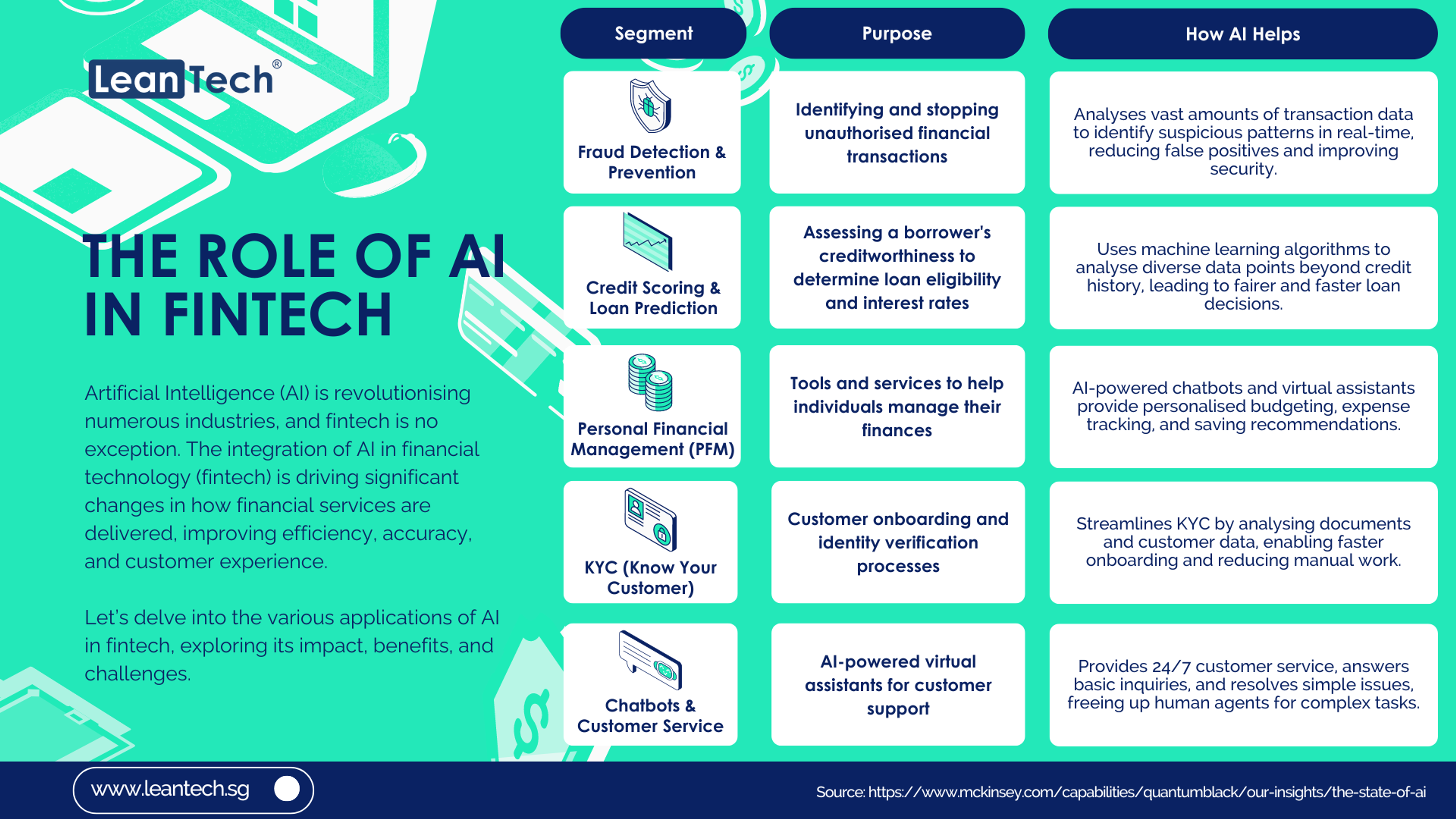
- Customer Service Chatbots: AI-powered chatbots leverage natural language processing (NLP) to provide 24/7 interaction, answering queries and guiding users effectively.
- Risk Management: AI analyzes extensive datasets to detect credit, market, and operational risks with improved accuracy.
- Predictive Analytics: Machine learning forecasts market trends, customer behaviors, and potential financial risks.
How AI Enables Better Financial Operations
AI empowers data-driven decision-making by quickly processing complex data beyond human capability. It also aids regulatory compliance by automatically monitoring transactions and flagging suspicious activity.
Benefits of AI in Fintech
- Efficiency: Automates repetitive tasks reducing operational costs; e.g., accelerating loan approvals.
- Accuracy: Enhances precision in financial predictions and anomaly detection, reducing false alerts.
- Customer Experience: Provides personalized advice and instant responses improving satisfaction.
Through smarter workflows and insights, AI keeps firms competitive and client-centric.
Supporting Sources:
Aisera AI in Fintech Blog
iTransition AI in Fintech Overview
AvidXchange AI in Fintech
Detailed Fintech AI Use Cases
Fraud Detection AI: Advanced Protection for Financial Security
Among the most impactful applications of AI in fintech is fraud detection AI. As cyber threats become more complex, AI provides dynamic fraud defense that traditional rule-based methods cannot match.
How Fraud Detection AI Works
- Utilizes machine learning algorithms and pattern recognition to analyze transactions in real time. (source)
- Detects anomalies and unusual behaviors such as unexpected account access or spending.
- Implements adaptive learning systems that evolve with new fraud tactics by processing vast datasets.
These AI-driven methods outperform traditional systems by:
- Reducing false negatives—fraud cases missed by older systems
- Proactively identifying emerging fraud variants
- Responding swiftly to real-time threats
Technologies Behind Fraud Detection AI
- Neural networks that analyze complex transaction patterns
- Behavioral analytics that examine user activity over time
- Automated alert systems that notify security teams instantly
Benefits of Fraud Detection AI
- Minimized financial losses from quick fraud identification
- Enhanced cybersecurity through continuous monitoring and adaptive learning
- Increased customer trust as users feel protected using AI-empowered safeguards
Robust fraud detection ensures the integrity of digital financial systems.
Sources:
Aisera AI in Fintech Blog
iTransition AI in Fintech
AvidXchange AI in Fintech
Credit Scoring AI: Fairer and Faster Loan Decisions
Credit scoring AI is disrupting traditional credit evaluation by expanding data sources and improving fairness.
What is Credit Scoring AI?
- Machine learning analyzes diverse inputs beyond traditional financial records, including:
- Spending behavior
- Online activity
- Alternative financial data (source)
- These models continuously learn to enhance borrower risk predictions.
Advantages Over Traditional Credit Scoring
- Reduced bias: Mitigates discrimination often inherent in manual scoring.
- Faster approvals: Automation speeds credit underwriting, facilitating quicker loans.
- Improved accuracy: Uses multidimensional data for better default risk prediction.
Impact on Financial Inclusion
By evaluating alternative data sources, credit scoring AI broadens lending to underserved populations lacking traditional credit histories, enabling financial inclusion.
Benefits for Lenders and Borrowers
- Improved underwriting precision reduces defaults.
- Enables smarter investment and portfolio decisions.
- Facilitates personalized and responsive lending experiences.
Credit scoring AI fosters more equitable and expansive credit markets.
Sources:
Aisera AI in Fintech Blog
Future Processing on AI in Fintech
iTransition AI in Fintech
Additional Use Cases and Future Trends in AI Fintech
Other Notable Applications
- AI Chatbots: Deliver 24/7 customer support using natural language processing to understand and address inquiries effectively.
- Personalized Financial Advice: AI recommends tailored investment and saving strategies based on predictive analytics of user data.
- Advanced Risk Management: Deep neural networks analyze complex risk factors for more accurate credit, market, and operational risk control.
Emerging Trends in AI in Fintech
- Generative AI: Automates generation of financial reports and documentation, optimizing productivity. (source)
- Federated Learning: Enables decentralized AI training on user data while preserving privacy, addressing security concerns.
- Cognitive Computing: Combines AI with human-like reasoning to improve market trend predictions.
Such innovations will boost fintech resilience, refine competitiveness, and spark ongoing transformation.
Sources:
Aisera AI in Fintech Blog
Future Processing AI Trends
IOT For All AI Fintech Insights
Challenges and Considerations in AI Fintech Deployment
Data Privacy Concerns
- AI systems handle vast amounts of sensitive financial data, increasing risks of breaches or unauthorized access.
- Robust encryption and data protection are vital to secure customer information.
- Balancing AI power with strict privacy regulations is essential to maintain consumer trust. (source)
Ethical Challenges in AI
- Algorithmic bias: AI models must avoid perpetuating discrimination in lending or fraud detection.
- Transparency: Clear explanations of AI decisions promote fairness and user understanding. (source)
- Ethical AI design upholds compliance and consumer confidence.
Regulatory Environment
- Regulations around AI in finance are evolving to emphasize accountability and consumer protection without hindering innovation.
- Ongoing monitoring and adaptation to new rules are necessary for compliance.
Addressing these factors is crucial for responsible, trustworthy AI fintech deployment.
Sources:
Aisera AI in Fintech Blog
iTransition AI in Fintech
Conclusion
AI in fintech is revolutionizing financial services by automating complex processes, improving accuracy, and promoting inclusive access to financial products.
Leading applications like fraud detection AI protect assets and foster trust, while credit scoring AI enables faster, fairer loan decisions empowering underserved populations.
These technologies reduce financial losses, sharpen underwriting, and promote smarter financial decision-making.
Financial professionals, fintech innovators, and users must stay abreast of AI advances to fully leverage its potential in an accelerating digital finance landscape.
Final Sources:
WPI Financial Technology AI Fintech Explainer
Aisera AI in Fintech Blog
AvidXchange AI in Fintech
Frequently Asked Questions
AI in fintech refers to the integration of artificial intelligence technologies such as machine learning and natural language processing into financial services to enhance automation, decision-making, and customer experience.
How does fraud detection AI work?
Fraud detection AI uses machine learning and pattern recognition to analyze transactions in real time, identifying anomalies and suspicious behaviors to prevent fraudulent activities.
What are the benefits of credit scoring AI?
Credit scoring AI offers faster, fairer, and more accurate loan decisions by analyzing diverse data sources beyond traditional financial metrics, thus promoting financial inclusion.
What are the main challenges with AI in fintech?
Key challenges include data privacy, algorithmic bias, ethical transparency, and adapting to evolving regulations to ensure responsible AI deployment.
What future trends are emerging in AI fintech?
Emerging trends include generative AI automating complex tasks, federated learning enhancing privacy, and cognitive computing improving market predictions.