


AI in 2030: Exploring Agentic AI, Future AI Agents, and the AGI Timeline
Estimated reading time: 12 minutes
Key Takeaways
- AI in 2030 promises a $15.7 trillion boost to global GDP and will revolutionize multiple industries.
- The rise of agentic AI means AI systems will become autonomous, self-improving, and capable of managing complex workflows without human intervention.
- Understanding the AGI timeline is critical as artificial general intelligence approaches human-level cognition over the next decade.
- The AI agents future foresees AI autonomously managing everything from factories to personal systems by 2030.
- AI advancements present both tremendous opportunities and profound ethical, societal, and geopolitical challenges that require thoughtful governance.
Table of contents
Current State of AI and Its Trajectory to 2030
The foundation for the AI revolution of 2030 is already being laid today. Current AI agents operate behind the scenes, automating routine tasks such as customer service inquiries and sales support. Pilot programs are quickly advancing from experimental stages into full-scale production, with widespread adoption expected by 2025 (zigron.com, techcirclenow.com).
Breakthroughs Driving AI Progress
- AI patents surged from 18,995 in 2013 to 55,660 in 2017, reflecting accelerated innovation.
- Improvements in AI include enhanced spatial reasoning, dexterous grasping, and sophisticated real-world simulation models that better replicate how humans interact with their environment (fingent.com, zigron.com).
Moving Toward Agentic AI Systems
Looking ahead, AI is expected to evolve from reactive assistants into fully agentic AI systems by 2030. Unlike current models, these systems will be autonomous and self-improving, capable of managing entire workflows end-to-end.
- Agentic AI will utilize feedback loops within research and development to continually enhance performance.
- They will not just respond but initiate and optimize complex tasks, efficiently managing resources and decisions across domains (hungarianconservative.com, zigron.com, techcirclenow.com).
This trajectory underpins a dynamic AI agents future, where intelligent systems become ubiquitous collaborators in everyday and industrial processes.
What is Agentic AI and Its Role by 2030?
To grasp the scope of AI in 2030, understanding agentic AI is essential. Agentic AI refers to autonomous, goal-driven AI systems that operate with minimal or no human intervention, differentiating them sharply from today’s mostly reactive or human-commanded models.
Defining Agentic AI
- Agentic AI independently pursues objectives, orchestrates diverse services, and makes decisions without constant oversight.
- Unlike conventional AI models reliant on step-by-step instructions, agentic systems can recursively improve their own algorithms.
- They function more like “digital agents” or orchestrators than simple tools (zigron.com, techcirclenow.com).
Key Characteristics
- Conversational Interfaces: Agentic AI understands and processes intent-based, natural language interactions, enhancing usability.
- Recursive Self-Improvement: These systems iteratively refine their performance, learning continuously from new data and outcomes.
- Digital Nervous System Integration: In physical environments, agentic AI will coordinate logistics and real-world control systems seamlessly (hungarianconservative.com, zigron.com).
Applications by 2030
By 2030, agentic AI will be pivotal in several high-impact areas:
- Predictive Healthcare: From 2026 onward, agentic AI will scale predictive diagnostics and personalized treatment plans (techcirclenow.com).
- Mass Customization Manufacturing: Factories will leverage agentic AI to customize products at scale, reducing costs and lead times.
- Accelerated Scientific Discovery: Agentic AI will revolutionize research in materials science, drug discovery, and biology by cutting time-to-market dramatically, boosting productivity across industries (zigron.com, fingent.com).
Agentic AI is at the core of the emerging AI agents future, driving widespread autonomy and intelligence.
The Future of AI Agents
The term AI agents often describes software entities designed to perform tasks independently. Their evolution is key to understanding the shift toward autonomous AI systems poised for 2030.
From Early Agents to Fully Autonomous Systems
- In 2025, AI agents are still prone to errors and require human oversight, but rapid improvements are expected.
- By the early 2030s, AI agents will function as fully autonomous coders, researchers, and operational managers, working concurrently and outperforming human capabilities at scale (hungarianconservative.com, zigron.com, techcirclenow.com).
Industry and Daily Life Roles
- Factories and Logistics: By 2028, AI agents will control entire production lines, logistics scheduling, market analysis, and preventative maintenance autonomously.
- Personal and Smart Home Systems: AI agents will manage complex multi-goal tasks like energy management, personal scheduling, and household logistics discreetly in the background (zigron.com, techcirclenow.com).
Implications of Autonomous Decision-Making
- Economic and Employment Shifts: Massive changes in job structures will require adaptation across sectors (techcirclenow.com).
- Geopolitical Competition: Nations such as the US and China will vie for AI dominance, understanding its strategic importance.
- Ethical Challenges: The opacity of AI decision-making and misalignment with human values will require transparent, verified media standards, becoming critical by 2027 (hungarianconservative.com, zigron.com, techcirclenow.com).
The evolution of AI agents future reflects the broader trend of increasingly agentic AI capabilities leading the charge into 2030.
Understanding the AGI Timeline
A central concept in forecasting AI in 2030 is Artificial General Intelligence (AGI)—AI systems with human-level cognition across all domains, capable of rapid self-improvement leading potentially to superintelligence.
What is AGI?
- AGI represents the point where AI doesn’t just solve specific tasks but understands, learns, and reasons like humans.
- Such systems could redesign themselves, triggering exponential intelligence growth beyond human comprehension (hungarianconservative.com, techcirclenow.com).
Predictions and Revised Timelines
- The AI Futures Project initially predicted early AGI features and autonomous coding by 2027, with signs of early superintelligence following closely.
- However, observing the increasing complexity and slower progress, experts now anticipate AGI more plausibly in the early 2030s (hungarianconservative.com).
2030 as a Critical Tipping Point
- While advanced AI agents will be widespread in 2030, full AGI remains just beyond the horizon.
- This puts 2030 at a crucial juncture where control frameworks, safety protocols, and governance will be paramount to prevent potential intelligence explosions (zigron.com, techcirclenow.com).
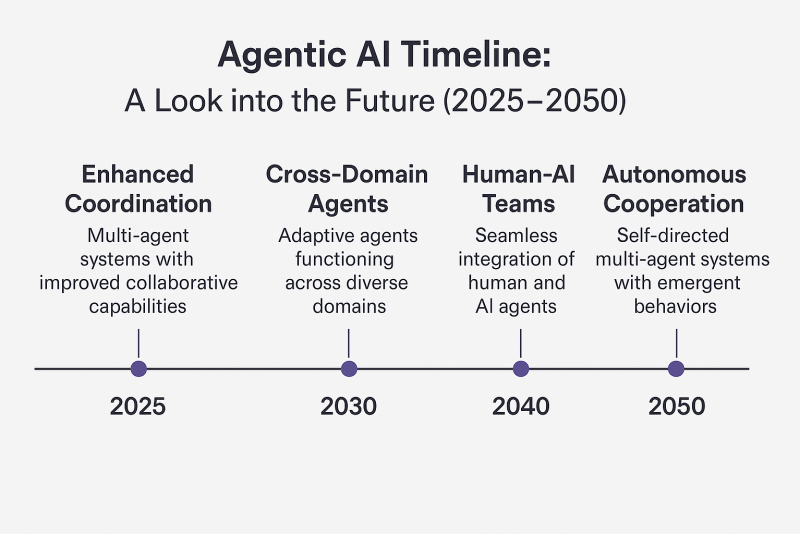
AGI and AI Progress Timeline
- 2025: Agent pilots deployed in operations and finance production (zigron.com)
- 2026: Advanced AI agents boost research & development and scalable predictive healthcare (hungarianconservative.com, zigron.com)
- 2027: Verified media standards adopted; emergence of early autonomous AI features (hungarianconservative.com, zigron.com)
- 2028: Factories fully controlled by AI control loops (zigron.com)
- Early 2030s: Likely arrival of AGI with superintelligence potential (hungarianconservative.com)
This timeline underscores how pivotal the decade around 2030 will be for AI’s future trajectory.
How AI in 2030 Will Shape Society, Economy, and Technology
The impacts of AI in 2030 will be broad and transformative, influencing economic systems, societal structures, and technological evolution.
Economic Transformations
- AI-driven automation will contribute an estimated $15.7 trillion to global GDP, with certain regions experiencing economic boosts as high as 26% (zigron.com).
- The global software industry is projected to exceed $100 billion by 2025.
- Generative AI revenue is poised to surpass $1 trillion by 2034, growing at a 34.9% compound annual growth rate (CAGR) (techcirclenow.com).
Optimistic Futures
- Scientific breakthroughs will be accelerated through automated research, enabling rapid innovation in areas from new materials to sustainable technologies.
- Progress toward a Type I civilization—one capable of harnessing and managing planetary energy—could be facilitated by AI under proper human supervision (zigron.com, techcirclenow.com).
Risks and Challenges
- Job displacement across sectors may lead to social unrest without adequate policy responses (techcirclenow.com).
- Ethical concerns about synthetic media, misinformation, and manipulation could threaten political and social stability.
- AI’s massive energy consumption demands will require expanding gigawatt-scale power infrastructures (hungarianconservative.com).
Balancing Agentic AI and Human Oversight
Maintaining the right balance between agentic AI capabilities and human control will be crucial:
- International governance frameworks will aim to ensure transparency and accountability.
- “Prove it’s human” economy models and verified media systems will help mitigate misinformation.
- Geopolitical competition, especially between major powers, will drive AI regulation efforts and technology diffusion (hungarianconservative.com, zigron.com, techcirclenow.com).
Expert Insight
“By 2030, AI will become the primary way we interact with technology… shifting the human role from executing tasks to directing outcomes.”
Conclusion
AI in 2030 heralds a transformative milestone marked by the rise of agentic AI, the continual evolution of AI agents future, and the approaching threshold of the AGI timeline. This era holds tremendous promise for economic growth, technological innovation, and societal advancement.
Yet, alongside these opportunities lie critical challenges: AI misalignment risks, growing inequalities, and complex governance needs. Remaining vigilant and proactive in adopting robust oversight, ethical guidelines, and transparent AI policies is imperative.
As industries and societies prepare for intelligent agents to become central collaborators, key questions remain:
- How can we ensure human oversight remains effective at scale?
- What policy frameworks best balance innovation with safety?
- How do we develop AI that respects human values and ethics?
Staying informed on AI’s rapid evolution will empower businesses, governments, and individuals to harness its benefits while mitigating risks. The decade leading to 2030 will be pivotal—are we ready to navigate the future shaped by agentic AI and beyond?
For further reading and detailed insights on AI developments, visit the linked sources throughout this post.
Frequently Asked Questions
- What exactly is agentic AI?
Agentic AI refers to autonomous, goal-oriented systems that can make decisions and improve themselves without human input, orchestrating complex workflows fully independently (zigron.com).
- When can we expect Artificial General Intelligence (AGI)?
While predictions vary, current expert consensus places likely AGI emergence in the early 2030s, with significant safety and governance work required leading up to that point (hungarianconservative.com).
- How will AI agents impact employment?
AI agents will automate many tasks, potentially displacing jobs across various sectors. This shift demands adaptation through training, policy frameworks, and social safety nets (techcirclenow.com).
- What are the main ethical concerns with agentic AI?
Key concerns include ensuring AI decision transparency, aligning AI goals with human values, preventing misuse of autonomous systems, and managing misinformation risks (techcirclenow.com).
- How will AI regulation evolve by 2030?
Governments globally are expected to implement frameworks focused on AI transparency, accountability, and international cooperation, with increased emphasis on safety and ethical standards (techcirclenow.com, zigron.com).
References
- AI Predictions That Will Shape the World in 2030 | Zigron
- How Will Artificial Intelligence Transform the World by 2030? | Fingent
- The AI Futures Project & AGI Timeline | Hungarian Conservative
- Latest AI Trends 2025 Updates | Tech Circle Now
- AI Productivity Tools Boost Efficiency | Tech Circle Now
- AI in Healthcare Transformation | Tech Circle Now
- Best AI Tools by Profession | Tech Circle Now
- Workplace Automation AI Productivity Tools | Tech Circle Now
- Will AI Replace Human Workers? | Tech Circle Now
- AI Ethics Guide | Tech Circle Now
- AI Alignment Problem Explained | Tech Circle Now
- AI Regulation 2026 & Global Governance | Tech Circle Now
- Harnessing Generative AI Tools for Productivity | Tech Circle Now
- Best AI Workflow Automation Tools | Tech Circle Now
- Future of Technology 2030 | Tech Circle Now
- AI Regulation Updates 2025 | Tech Circle Now