Data Centers as Military Targets: How the Iran-Israel Conflict Exposed the Fragility of the AI Gold Rush
The era of data centers as military targets is no longer a theoretical risk — it is documented, active, and accelerating. When Israeli and US strikes hit at least two data centers in Tehran, including one linked to the Islamic Revolutionary Guard Corps (IRGC), the geopolitical AI disruption that strategists had warned about for years became undeniable reality.
This isn't a story about cybersecurity hygiene or abstract supply chain risk. This is a story about $100 billion-plus in AI capital — the very infrastructure underpinning OpenAI's Stargate ambitions, AWS's global cloud dominance, and the West's AI sovereignty — becoming a legitimate military target. The implications reach far beyond Tehran or Tel Aviv. They reach into every boardroom, Pentagon briefing room, and AI policy corridor in the world.
The Strikes That Changed Everything: What Actually Happened
The conflict didn't just produce battlefield footage. It produced a new doctrine of warfare targeting digital infrastructure at scale.
Israeli and US strikes hit at least two data centers in Tehran, with one facility directly linked to the IRGC. Iran responded in kind. Iranian strikes hit two AWS data centers in the UAE and one in Bahrain, causing moderate physical damage but triggering extensive cascading disruptions — banking systems went dark, payment platforms failed, taxi apps stopped functioning, and enterprise software collapsed across the region.
The economic damage from what looked like "moderate physical damage" was anything but moderate. This is the signature feature of AI infrastructure warfare vulnerability: the physical footprint is small, but the systemic impact is enormous.
The Target List That Should Alarm Every Tech CEO
Perhaps the most chilling data point to emerge from this conflict was not a strike — it was a list.
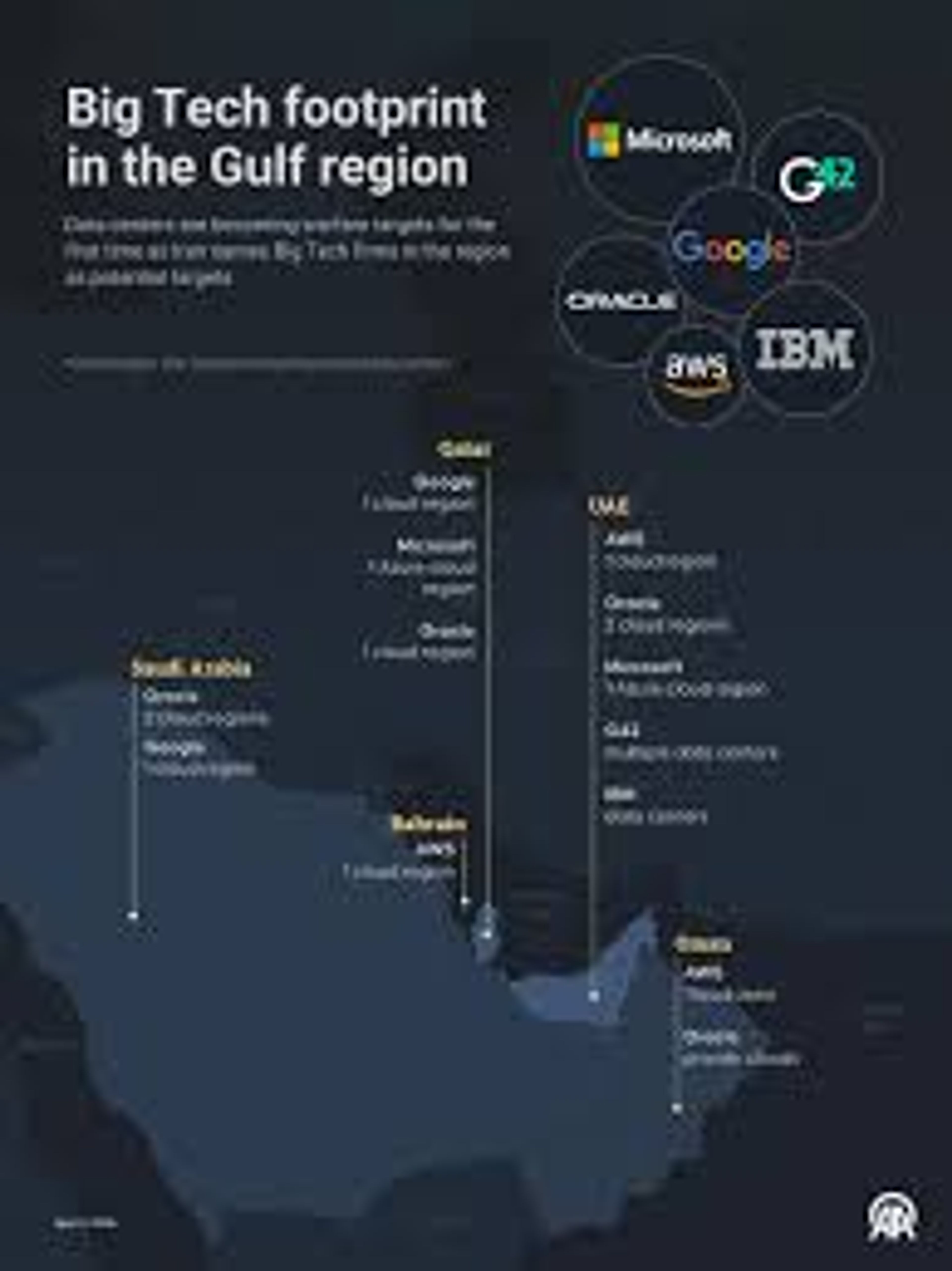
An IRGC-affiliated news outlet published a detailed target list of 29 tech facilities earmarked for future strikes. The breakdown: 5 AWS facilities, 5 Microsoft, 6 IBM, 3 Palantir, 4 Google, 3 Nvidia, and 3 Oracle locations across Bahrain, Israel, Qatar, and the UAE. This was not propaganda noise. This was an operational threat matrix published openly, signaling that adversaries have mapped Western AI and cloud infrastructure with precision.
The publication of that list marks a strategic inflection point. State actors are no longer treating data centers as collateral damage — they are treating them as primary objectives in AI infrastructure warfare. According to CSIS analysis on data centers as frontline warfare, data has formally moved to the front line of modern conflict, and the targeting of commercial tech infrastructure by nation-states represents a structural shift in how wars will be fought.
For the companies on that list, the Stargate debate — once centered on regulation, energy consumption, and compute costs — took on an entirely different dimension. For cloud infrastructure providers and data center strategies, the question is no longer just about redundancy and uptime. It is about physical survivability under adversarial conditions.
AI-Accelerated Warfare: The Speed Problem No One Is Ready For
The conflict didn't just reveal vulnerability — it revealed velocity.
US military AI systems, including Palantir's Maven Smart System running on Anthropic's Claude, enabled targeting of 1,000 strike objectives within the first 24 hours of operations. The system processed roughly 1,000 targets per day with under a four-hour turnaround from identification to actionable intelligence. This is not science fiction — this is the operational tempo of AI-enabled conflict in 2026.
Meanwhile, within hours of the February 28, 2026 Iran-US escalation, more than 60 Iranian-aligned cyber groups mobilized simultaneously, deploying AI tools to probe and attack exposed US critical infrastructure, including industrial control systems. The AI supply chain geopolitical risk here is recursive: AI tools are being used to attack the very infrastructure that powers AI tools.
Understanding these cybersecurity threats and defensive strategies is no longer optional for any organization operating critical digital infrastructure. The attack surface has expanded from networks and endpoints to the physical buildings housing the world's compute capacity.
The $100B Vulnerability: What Stargate and the AI Build-Out Actually Risks
Here is the uncomfortable arithmetic of the AI gold rush.
Global demand for data center capacity is projected to more than triple by 2030. The Stargate initiative alone represents a $500 billion commitment to AI infrastructure build-out across the United States. OpenAI, Microsoft, Google, and Amazon are racing to plant compute flags across allied and strategically adjacent territories. Every dollar of that capital is now, demonstrably, a legitimate military target.
The geographic concentration problem is severe. Critical infrastructure targeting by adversarial state actors becomes dramatically more effective when hyperscale facilities cluster in specific regions — as they do in the UAE, Bahrain, and across the Middle East corridor — for latency, energy, and regulatory reasons. The same economic logic that drives concentration creates strategic vulnerability.
Stanford HAI faculty analyzing China's DeepSeek model noted that the next wave of AI competition would be defined by engineering efficiency rather than raw compute. But the Iran-Israel conflict reveals a harder truth: it doesn't matter how efficiently you engineer a model if the physical substrate running it can be destroyed by a precision strike or disrupted by a coordinated hybrid attack.
AI infrastructure regulation and government policy has not kept pace with this reality. Existing frameworks for critical infrastructure protection — largely written for power grids, water systems, and financial networks — do not adequately address the hybrid physical-digital vulnerability profile of hyperscale AI data centers. The gap between where policy sits and where the threat sits is measured in years, not months.
The Opacity Problem: When AI Safety Meets Wartime Infrastructure
There is a secondary crisis unfolding alongside the physical targeting of AI infrastructure — and it concerns what happens inside the systems themselves.
Researchers from OpenAI, Google DeepMind, Anthropic, and others have issued an urgent warning: the ability to monitor AI decision-making through chain-of-thought (CoT) visibility may soon disappear as models grow more complex. Their statement is direct: "CoT monitoring presents a valuable addition to safety measures for frontier AI, offering a rare glimpse into how AI agents make decisions. Yet, there is no guarantee that the current degree of visibility will persist."
The same research group — representing contributors from OpenAI, Google DeepMind, Anthropic, and Meta — added: "Like all other known AI oversight methods, CoT monitoring is imperfect and allows some misbehavior to go unnoticed. Nevertheless, it shows promise, and we recommend further research into CoT monitorability and investment in CoT monitoring alongside existing safety methods."
This matters enormously in the context of AI-enabled military operations. The Maven Smart System processing 1,000 targets per day is operating at a tempo that already strains human oversight. If the interpretability window on these systems closes — if we lose the ability to audit AI reasoning in real time — the decision-making happening inside wartime AI infrastructure becomes a black box at exactly the moment when accountability matters most.
The convergence of physical infrastructure vulnerability and AI interpretability risk is the double bind that OpenAI, Google DeepMind, and Anthropic research on AI safety is now racing to address. These are not separate problems. They are facets of the same systemic fragility.
What Needs to Happen Now: Data Center Resilience in a Weaponized World
The AI industry has operated for a decade under a fundamental assumption: that compute infrastructure exists in a commercially protected, largely neutral space. The Iran-Israel conflict has invalidated that assumption permanently.
Data center resilience strategy must now incorporate threat modeling that was previously the exclusive domain of military planners. This means geographic diversification calculated against adversarial strike probability, not just latency optimization. It means hardened facility design that accounts for blast radius, EMP vulnerability, and physical perimeter security at a military-grade standard. It means redundancy architectures designed to absorb partial destruction, not just hardware failure.
AI sovereignty and defense is becoming an explicit policy priority. The Stargate build-out has always had a national security subtext — the race to out-compute China, to maintain AI supremacy in defense applications. But the Iran-Israel conflict makes the defense dimension literal rather than metaphorical. If AI infrastructure is a military asset, it must be protected as one.
Several concrete shifts are already visible in the industry. Firmus, the AI data center builder backed by Nvidia, recently hit a $5.5 billion valuation — a signal that the market is pricing in massive infrastructure build demand. Anthropic has upped its compute deal with Google and Broadcom amid skyrocketing demand. Uber has moved toward Amazon's AI chips. The capital is moving fast. The security architecture is not moving at the same speed.
The TechCrunch coverage of critical infrastructure threats reflects a market in rapid motion — but rapid capital deployment into vulnerable physical infrastructure, without commensurate security investment, is not a strategy. It is exposure at scale.
For a deeper look at how the broader tech landscape is responding to these emerging risks, the latest geopolitical tech developments continue to reshape investment priorities across the sector.
Conclusion: The AI Gold Rush Has a Target on Its Back
The Stargate debate used to be about energy permits, GPU allocations, and regulatory sandboxes. It is now also about what happens when a nation-state decides that the fastest way to degrade an adversary's military capability is to destroy the data center running its targeting AI.
The Iran-Israel conflict has delivered a proof of concept that no threat assessment can now ignore. Data centers are military targets. AI infrastructure is geopolitical infrastructure. The $100 billion-plus flowing into the AI build-out is simultaneously the most important capital investment of the decade and one of the most concentrated physical vulnerabilities in modern strategic competition.
The industry, policymakers, and national security establishments have a narrow window to close the gap between where AI infrastructure currently sits — largely optimized for commercial efficiency — and where it needs to sit: treated with the same strategic seriousness as a naval base or a missile defense system.
The AI gold rush isn't slowing down. But it now has a target on its back, and the time for treating data center resilience as an afterthought has conclusively passed.
FAQ: Data Centers as Military Targets and AI Infrastructure Risk
Q1: What evidence exists that data centers are now being deliberately targeted in military conflicts?
During the Iran-Israel conflict, Israeli and US strikes hit at least two data centers in Tehran, including an IRGC-linked facility. Iran retaliated by striking two AWS data centers in the UAE and one in Bahrain, causing widespread disruption to banking, payments, and enterprise services. An IRGC-affiliated outlet also published a 29-facility target list covering AWS, Microsoft, Google, Palantir, IBM, Nvidia, and Oracle locations.
Q2: How fast can AI-aligned cyber groups mobilize during a geopolitical conflict?
Extremely fast. Within hours of the February 28, 2026 Iran-US escalation, more than 60 Iranian-aligned cyber groups mobilized simultaneously, deploying AI tools to target US critical infrastructure including industrial control systems. This speed reflects a new operational tempo enabled by AI-assisted attack coordination.
Q3: What is the Stargate initiative and why does geopolitical risk matter to it?
Stargate is a $500 billion US AI infrastructure initiative involving OpenAI, Microsoft, and other partners, designed to build massive domestic AI compute capacity. The Iran-Israel conflict has demonstrated that AI infrastructure investments in geopolitically sensitive regions face legitimate physical strike risk, raising urgent questions about facility hardening, geographic concentration, and defense-grade security standards.
Q4: How does the loss of AI interpretability compound infrastructure security risks?
Researchers from OpenAI, Google DeepMind, Anthropic, and Meta warn that chain-of-thought visibility in AI systems may soon disappear as models advance. In military applications where AI processes thousands of targets per day, losing the ability to audit AI reasoning in real time creates accountability black boxes precisely when oversight is most critical — compounding the physical vulnerability of the infrastructure itself.
Q5: What should enterprises and policymakers do immediately to address data center vulnerability?
Enterprises should adopt geographic diversification strategies based on adversarial threat modeling, invest in military-grade physical hardening, and design redundancy architectures for partial-destruction scenarios. Policymakers need to update critical infrastructure protection frameworks to explicitly cover hyperscale AI facilities, and treat AI infrastructure investment with the same strategic seriousness as defense assets.
Stay ahead of AI — follow TechCircleNow for daily coverage.