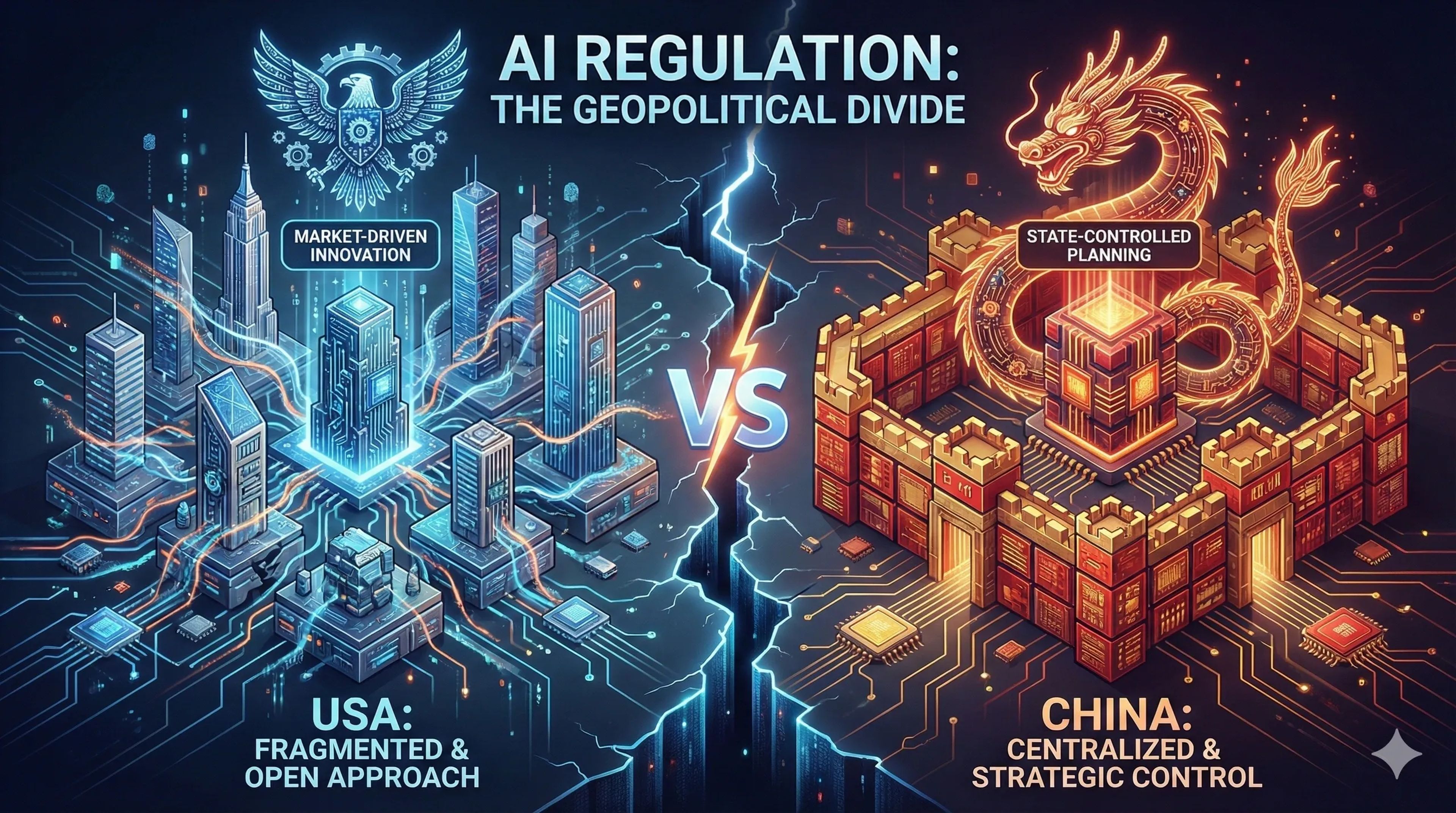
China's Digital Humans Law and AI Regulation: The Geopolitical Governance Divide Reshaping Global AI Standards
China's sweeping China digital humans law regulation children agenda is forcing a reckoning across the global tech industry. While Washington debates voluntary frameworks and Silicon Valley pitches self-regulatory "New Deals," Beijing is writing hard law — banning addictive AI services for minors, controlling synthetic media creation, and building a comprehensive state-directed AI governance architecture.
The divergence is no longer theoretical. It is structural, accelerating, and consequential for every company, regulator, and user caught between two competing visions of how artificial intelligence should be governed. Understanding the depth of that split is now essential for anyone tracking AI regulation and government policies in 2025 and beyond.
Two Philosophies, One Technology: The Core Divide
Western AI governance — particularly in the United States — has largely followed a libertarian innovation-first logic. Regulate cautiously, defer to industry expertise, and prioritize competitiveness over precaution.
China's approach is the structural inverse. The state sets direction, defines acceptable outputs, and uses regulation as an instrument of both social control and industrial policy simultaneously.
This is not simply authoritarianism versus openness. It reflects genuinely different theories about who bears responsibility when AI causes harm, and who gets to define what "harm" means in the first place. That philosophical gap is now producing incompatible regulatory frameworks — a fragmentation that threatens any serious effort at global AI governance harmonization.
China's Hard Law Playbook: From Generative AI to Digital Humans
China has moved with unusual legislative speed. The Interim Measures for the Management of Generative Artificial Intelligence Services took effect on 15 August 2023, marking China's first administrative regulation on generative AI. Additional national standards became effective from 1 November 2025, covering security governance and deployment accountability.
Then came the cybersecurity update. On 28 October 2025, China's top legislature passed major amendments to the Cybersecurity Law (CSL), introducing AI-specific provisions for the first time. The amendments explicitly address algorithm research and development, training data infrastructure, and AI ethics rulemaking — embedding AI governance directly into China's foundational digital law. You can review China's AI governance framework and cybersecurity law amendments in detail through IAPP's comprehensive analysis.
The digital humans regulations are particularly significant. China's rules on synthetic media — including AI-generated avatars, voice clones, and virtual influencers — require explicit consent, clear labeling, and prohibit the use of such technology to deceive, manipulate, or create harmful content targeting vulnerable groups, especially children. These restrictions on synthetic media represent some of the most detailed "digital ethics regulatory frameworks" anywhere in the world.
Seven government departments, including the Cyberspace Administration of China and the Ministry of Public Security, share oversight responsibilities for generative AI under a fragmented but overlapping supervisory model. Critics note this creates compliance complexity. Defenders argue it ensures no single vector of harm goes unwatched.
Protecting Children, Controlling Minds: The Youth Protection Dimension
China's youth protection AI services rules go further than almost any Western equivalent. Draft regulations would ban AI systems designed to maximize engagement time among minors — effectively outlawing the core business model of recommendation algorithms targeting children.
This is not a small carve-out. It strikes at the design philosophy of systems built around behavioral prediction and retention optimization. The regulations target AI services that exploit psychological vulnerabilities, create dependency loops, or substitute for human social development — framing these as safety hazards equivalent to physical product defects.
The Artificial Intelligence Safety Standard System (V1.0), circulated for consultation in February 2025 by the National Information Security Standardisation Technical Committee, categorizes seven types of AI risks across two domains: inherent risks (model algorithm, data, and system security) and application risks (network, reality, cognitive, and ethical domains). The inclusion of "cognitive" and "ethical" risk categories — targeting manipulation, value distortion, and social influence — reflects how broadly China defines AI harm.
For context on how these rules fit into broader global tech regulation and data protection trends, the contrast with U.S. policy is stark. America has no federal equivalent to China's algorithmic addiction prohibitions for children — only a patchwork of state laws and industry pledges.
The "AI+" Industrial Ambition Behind the Regulation
None of this regulation exists in a vacuum. China's hard rules on AI safety coexist with aggressive state-backed expansion targets that would be extraordinary anywhere else.
Under the 2025 Opinions of the State Council on Deepening the Implementation of the 'Artificial Intelligence+' Initiative, China aims for the penetration rate of next-generation intelligent terminals and intelligent agents to exceed 90% by 2030. The interim target is 70% AI penetration in key sectors by 2027. China's State Council's vision for AI+ Initiative and intelligent agent deployment is explicit: AI is not just a technology sector, it is the backbone of a fully restructured national economy.
This creates a paradox that Western analysts often misread. China is not regulating AI despite wanting to dominate it — it is regulating AI because it wants to dominate it. State control over outputs, standards, and permissible applications allows Beijing to shape the industry's trajectory rather than react to it.
The regulatory architecture is simultaneously a safety system, an industrial policy tool, and a geopolitical instrument. Rules that look like restrictions from the outside can function as competitive moats, locking in Chinese technical standards before international norms solidify.
The Western Counter-Narrative: OpenAI's "New Deal" and the Transparency Problem
As China codifies, Silicon Valley philosophizes. OpenAI's recent "New Deal" pitch — offering AI access and economic benefits in exchange for regulatory forbearance — exemplifies the Western approach: voluntary commitments, multi-stakeholder dialogue, and self-policing dressed up as partnership.
The transparency problem cuts deep into this model's credibility. A position paper signed by 40 researchers — including contributors from OpenAI, Google DeepMind, Anthropic, and Meta — recently warned that the primary tool for understanding how advanced AI makes decisions may not survive the next generation of model development.
Their warning was direct: "CoT monitoring presents a valuable addition to safety measures for frontier AI, offering a rare glimpse into how AI agents make decisions. Yet, there is no guarantee that the current degree of visibility will persist." The researchers, whose findings were endorsed by OpenAI co-founder Ilya Sutskever, called for urgent investment in chain-of-thought research before opacity becomes permanent.
The same group acknowledged the imperfection of existing tools: "Like all other known AI oversight methods, CoT monitoring is imperfect and allows some misbehavior to go unnoticed. Nevertheless, it shows promise, and we recommend further research into CoT monitorability and investment in CoT monitoring alongside existing safety methods."
Meanwhile, Stanford HAI researchers found that all six leading U.S. AI firms — including Anthropic, Google, and OpenAI — harvest user conversations for model training, with what researchers described as "murky opt-outs and retention periods stretching to infinity." The voluntary trust model requires trusting companies that are, by their own researchers' admission, not fully transparent about how their models work or what they do with user data.
This is not a minor credibility gap. It is the structural vulnerability that China's state-directed approach — whatever its own failings — does not share in the same way. Chinese users may have less freedom, but the regulatory apparatus at least nominates a responsible party when things go wrong.
What the Divergence Means for Global AI Governance Harmonization
The deepening AI safety policy divergence between East and West has concrete consequences. Companies operating globally must now comply with incompatible requirements — and the gap is widening faster than any multilateral body is moving to close it.
The latest AI trends and market growth data shows that AI is embedding into critical infrastructure, healthcare, finance, and education simultaneously across both regulatory blocs. Every week of governance divergence locks in technical and legal incompatibilities that become harder to reconcile later.
There are three plausible trajectories. First, regulatory fragmentation: companies maintain separate product versions for Chinese and non-Chinese markets, similar to current data localization arrangements. Second, de facto standardization by dominance: whichever bloc's AI systems achieve broader global deployment sets functional standards by market penetration — regardless of formal treaty. Third, negotiated convergence: multilateral bodies like the OECD or G20 broker minimum common standards on issues like synthetic media labeling, youth protection, and accountability frameworks.
The third path is the most desirable and currently the least likely. China's digital ethics regulatory frameworks and the West's innovation-first posture don't just differ on implementation — they differ on foundational questions about whether the state or the market should arbitrate AI's social role.
For businesses deploying generative AI tools and LLM applications, the practical implication is clear: compliance strategy is now geopolitical strategy. Building AI systems that can meet China's hard requirements without violating U.S. export controls or EU AI Act obligations requires legal and technical architecture that few companies have yet built.
Conclusion: The Governance Gap Is Now a Strategic Risk
The story of China's digital humans law and AI regulation is not just a story about children and synthetic avatars. It is a story about who gets to define what safe, accountable, and legitimate AI looks like — and whether that question will be answered by negotiation or by dominance.
China is writing law. The West is writing white papers. That asymmetry has consequences.
The AI safety policy divergence between Beijing and Washington now represents one of the most significant risks to coherent global AI governance harmonization — not because either system is obviously correct, but because incompatible frameworks, once embedded in law and infrastructure, are extraordinarily difficult to reconcile.
Businesses, policymakers, and civil society groups need to engage with both systems on their own terms, rather than assuming one will simply displace the other. The geopolitical AI governance divide is here. Planning around it is no longer optional.
For continuous coverage of international regulatory developments, China AI policy restrictions, and synthetic media restrictions, visit TechCircleNow.com — where we track the policies shaping the AI industry before they shape you.
FAQ: China's AI Regulation and the Global Governance Divide
1. What is China's digital humans law, and what does it regulate? China's digital humans regulations govern the creation, deployment, and labeling of AI-generated synthetic media — including virtual avatars, voice clones, and digital influencers. The rules require explicit consent from individuals whose likeness is used, mandate clear disclosure labels, and prohibit deployment in ways designed to deceive or manipulate users, particularly children and other vulnerable groups.
2. How does China's approach to AI regulation differ from the United States? China uses hard law — mandatory statutes, administrative regulations, and state enforcement — to govern AI development and deployment. The U.S. has relied primarily on voluntary commitments, industry self-regulation, and sector-specific guidance. China's model specifies prohibited behaviors and assigns state responsibility; the U.S. model largely defers to market actors and legal liability after harm occurs.
3. What are China's AI penetration targets, and why do they matter? China's State Council has set targets of 70% AI penetration in key economic sectors by 2027 and over 90% penetration of intelligent terminals and agents by 2030. These targets matter because they demonstrate that China's regulatory framework is designed to accelerate AI adoption, not restrain it — the regulations serve as a quality-control system for a state-directed expansion, not a brake on innovation.
4. Why are AI researchers warning about the loss of model transparency? A coalition of 40 researchers from OpenAI, Google DeepMind, Anthropic, and other institutions has warned that chain-of-thought monitoring — currently one of the only tools for observing AI decision-making — may not persist as models become more advanced. If this transparency disappears, regulators and safety researchers lose a critical window into how AI systems reach their outputs, making oversight significantly harder.
5. What does the China-West regulatory divergence mean for global companies? Companies operating in both markets must navigate incompatible legal requirements — China's mandatory labeling, consent rules, and content restrictions may conflict with U.S. product architectures or business models. Compliance is increasingly a geopolitical exercise, requiring legal teams, technical teams, and policy teams to coordinate across jurisdictions with fundamentally different philosophies about AI's social role.
Stay ahead of AI — follow TechCircleNow for daily coverage.