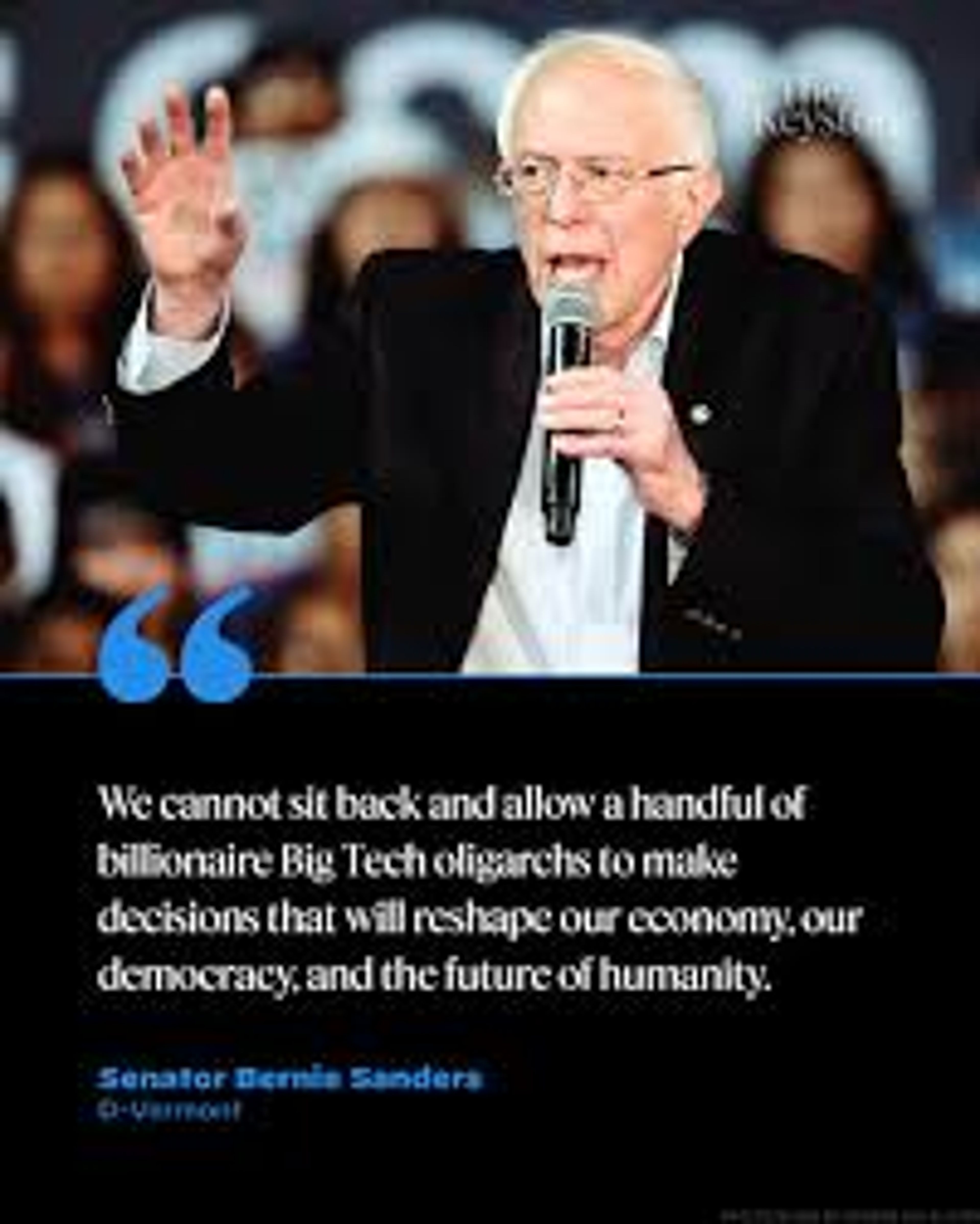
Bernie Sanders Congress AI Regulation Billionaires: Is America Heading Toward Democratic Control or Tech Oligarchy?
The debate over Bernie Sanders Congress AI regulation billionaires has exploded from Senate hearing rooms onto main street America — and the stakes couldn't be higher. Sanders isn't talking about fine-tuning disclosure rules or tweaking algorithmic audits; he's framing AI governance as a civilizational choice between democratic accountability and unchecked billionaire power.
This isn't safety theater. It's a direct confrontation between two incompatible visions: Silicon Valley's acceleration narrative, where speed and scale are self-justifying virtues, and a democratic AI policy framework that insists society — not shareholders — should decide who benefits from machine intelligence. According to a Quinnipiac University poll on AI public sentiment, 55% of Americans, including a majority of Republicans, believe AI will do more harm than good in their lives. Only 34% feel the benefits outweigh the costs. That's not a fringe position. That's a political majority waiting for leadership.
The Case Sanders Is Actually Making (And Why It Goes Deeper Than You Think)
Sanders' argument isn't anti-technology. It's anti-concentration. His central thesis is that AI, as currently deployed, functions as an accelerant for wealth consolidation — transferring economic power from workers and communities to a small number of billionaires who control the infrastructure, the models, and the policy conversation.
His Sanders' report on AI job elimination warns that AI and automation could eliminate nearly 100 million American jobs over the next decade. That's not a fringe projection — it tracks with McKinsey, Goldman Sachs, and IMF forecasts on labor displacement at scale.
The billionaire framing lands because it's structurally accurate. OpenAI, Google DeepMind, Anthropic, Meta AI, and Amazon Web Services are controlled or heavily funded by a handful of individuals whose net worth has grown in direct proportion to AI investment cycles. When Sanders talks about an AI oligarchy, he's describing a real governance deficit — one where the people building the most consequential technology in human history answer primarily to capital markets, not democratic institutions.
Data for Progress research reinforces the economic anxiety: a growing percentage of Democrats, independents, and Republicans say AI is likely to hurt the economy and increase the unemployment rate. The bipartisan nature of this concern is politically significant, and Sanders knows it.
The $185 Million Problem: How Industry Captured the Regulatory Conversation
Here's the number that explains why congressional AI oversight has moved so slowly: $185 million. That's what the AI industry has spent to ensure government does nothing substantive to regulate it, according to reporting from Common Dreams — a lobbying and campaign spending blitz designed to intimidate lawmakers before coherent legislation could take shape.
For context, that's more than the pharmaceutical industry spent opposing drug pricing legislation in some comparable periods. It's an investment in regulatory paralysis, and it has worked. Congress has held dozens of AI hearings, invited CEOs to testify, and produced a stream of white papers — but no binding AI regulatory framework has passed.
The lobbying machine operates on multiple vectors simultaneously. Direct campaign contributions create dependency. Revolving-door hiring pulls talent from regulatory agencies. Think tank funding shapes the Overton window on what "reasonable" regulation looks like. And the constant invocation of "competitiveness with China" functions as an emergency override on almost any oversight proposal.
For a deeper look at how these dynamics are playing out across Washington, our ongoing coverage of AI regulation and government policies tracks the legislative landscape in real time.
What Sanders and AOC Are Actually Proposing
Sanders and Representative Alexandria Ocasio-Cortez have moved beyond rhetoric. They introduced legislation calling for a nationwide moratorium on AI data center construction until comprehensive safeguards are established to protect workers, consumers, privacy, civil rights, and the environment.
That's a maximalist opening position — and it's deliberate. Moratoriums create negotiating leverage. They force the industry to engage with specific safeguard criteria rather than vague promises of "responsible AI." The bill's five pillars — workers, consumers, privacy, civil rights, environment — represent a democratic AI control framework that covers the full surface area of AI's social impact.
The data center focus is strategically smart. AI infrastructure is physical, localized, and politically legible in ways that algorithmic governance is not. Communities understand water usage, power grid strain, and zoning impacts. Local opposition has already demonstrated results: communities in red and blue states alike have stalled or blocked AI data centers, and Maine is on track to pass the first statewide ban on new AI data center construction. That's not progressive coastal politics — that's a cross-ideological infrastructure revolt.
The moratorium framing also exposes a contradiction in the tech industry's position. If AI is as beneficial as its boosters claim, companies should be able to demonstrate those benefits clearly enough to satisfy worker, consumer, privacy, civil rights, and environmental standards. The resistance to articulating those standards is itself revealing.
The Left-Right Stall: Why Congressional AI Governance Is Stuck
The AI regulation debate in Congress is gridlocked for reasons that go beyond typical partisan dysfunction. The stall is structural — a collision between incompatible political coalitions with no natural resolution mechanism.
On the left, Sanders-aligned progressives want robust worker protections, algorithmic accountability, and wealth redistribution through AI taxation or profit-sharing mandates. On the right, a faction of tech-aligned libertarians treats any federal AI intervention as government overreach, while a separate nationalist faction wants aggressive AI development funded and directed by the state to counter China. Neither coalition maps cleanly onto traditional party lines.
The result is a legislative purgatory where everyone agrees "something should be done" and nobody agrees on what. Meanwhile, the AI governance models being tested in the EU — particularly the EU AI Act's risk-tiered framework — are gaining traction as a default reference point for multinational companies operating in multiple jurisdictions.
There's also a technical comprehension gap in Congress that the industry actively exploits. When lawmakers struggle to understand the difference between a large language model and a reinforcement learning system, companies can frame almost any safeguard proposal as technologically naive. Sanders' moratorium approach sidesteps this problem by focusing on infrastructure and outcomes rather than model architecture — a politically pragmatic move.
For broader context on how these regulatory tensions are playing out globally, our coverage of antitrust and tech regulation tracks developments across the EU, UK, and Asia-Pacific.
The Transparency Crisis the Industry Doesn't Want You to Focus On
While the political debate rages, a quieter technical alarm is sounding inside the AI labs themselves. Researchers from OpenAI, Google DeepMind, Anthropic, and other frontier labs have issued a pointed warning about losing visibility into how advanced AI models make decisions.
Their finding deserves to be quoted directly: "CoT monitoring presents a valuable addition to safety measures for frontier AI, offering a rare glimpse into how AI agents make decisions. Yet, there is no guarantee that the current degree of visibility will persist."
Read that carefully. The people building these systems are telling you they may soon lose the ability to understand what those systems are doing. That's not a theoretical risk — it's a near-term engineering trajectory. And it makes democratic AI control not just a political preference but a technical necessity. You cannot regulate what you cannot observe. You cannot govern what even the builders cannot explain.
This transparency crisis directly undermines the industry's core argument against regulation: that companies should be trusted to self-govern because they understand the technology better than Congress does. If the companies themselves are warning about impending opacity, that argument collapses.
Stanford HAI's analysis of China's DeepSeek model adds another dimension. Nine scholars noted that DeepSeek "democratizes innovation through open weights and transparency, slashing costs while shortening America's frontier AI lead via clever engineering over brute compute." Open-weights models create a fundamentally different governance environment — one where the locus of AI power is distributed rather than concentrated, which has profound implications for the AI oligarchy governance debate.
What Democratic AI Policy Actually Needs to Accomplish
If progressive AI governance is going to be more than a protest position, it needs to solve four concrete problems that the current regulatory vacuum has created.
First, labor transition infrastructure. Sanders is right that 100 million jobs is a plausible displacement scenario. But a moratorium without a parallel investment in retraining, portable benefits, and sectoral bargaining rights is incomplete. The policy needs both a brake and an accelerator — slowing harmful deployment while building the social infrastructure that makes the transition survivable.
Second, algorithmic accountability with teeth. The EU AI Act's risk tiering is a start, but it relies on corporate self-classification. Effective democratic AI policy requires independent audit rights, mandatory incident reporting, and regulatory bodies with technical staff capable of evaluating what companies submit.
Third, public AI infrastructure. One underexplored element of the Sanders framework is the implicit argument for publicly-owned AI capacity. If private AI concentration is the problem, publicly funded models, compute access, and data commons are part of the solution. Anthropic's own global user study found that one academic described Claude as "like having a faculty colleague who knows a lot, is never bored or tired, and is available 24/7" — a vivid illustration of the productivity and educational value at stake. That value shouldn't accrue exclusively to private shareholders.
Fourth, data center accountability now. Whatever happens at the federal level, state and local data center legislation is moving. Maine's likely statewide ban signals that communities won't wait for Washington. Federal legislation that sets minimum national standards — rather than preempting stricter state rules — would be politically achievable and substantively meaningful.
Understanding the full scope of what's being built, and what's at stake, requires tracking the latest AI industry developments alongside the regulatory conversation.
Conclusion: The Window Is Narrowing
The Bernie Sanders Congress AI regulation billionaires confrontation is not a sideshow. It's a preview of the defining governance question of the next decade: who controls the infrastructure of intelligence, and in whose interest does it operate?
Silicon Valley's bet is that speed forecloses the question — that by the time democratic institutions catch up, the structural facts on the ground will be irreversible. Sanders' bet is that democratic pressure, coalition-building, and concrete legislative targets can create accountability before that window closes.
The $185 million lobbying spend suggests the industry is more worried about that second scenario than its public confidence implies.
Effective AI governance models exist. The EU is stress-testing them. States are improvising them. The technical community is demanding them from the inside. What's missing is federal political will — and that's a solvable problem, if the public majority that already believes AI needs oversight finds its legislative voice.
Whether you're concerned about AI tools and business impact on your industry, or the broader governance architecture being built around these systems, the decisions being made in Washington right now will shape the landscape for years to come. Don't look away.
FAQ: Bernie Sanders, AI Regulation, and Congressional Oversight
Q1: What specific legislation has Bernie Sanders introduced on AI regulation? Sanders, alongside Rep. Alexandria Ocasio-Cortez, introduced a bill calling for a nationwide moratorium on AI data center construction until safeguards protecting workers, consumers, privacy, civil rights, and the environment are established. He has also released a comprehensive report on what he calls Big Tech oligarchs' war against workers, warning of potential elimination of nearly 100 million American jobs.
Q2: How much has the AI industry spent lobbying against regulation? According to reporting from Common Dreams, the AI industry has spent more than $185 million to prevent meaningful government regulation. This spending spans direct campaign contributions, think tank funding, and revolving-door hiring from regulatory agencies.
Q3: Is concern about AI regulation a partisan issue? No — and that's politically important. A Quinnipiac University poll found 55% of Americans, including a majority of Republicans, believe AI will do more harm than good. Data for Progress similarly reports growing skepticism about AI's economic impact across Democrats, independents, and Republicans alike. The data center opposition movement has also emerged in both red and blue states.
Q4: Why are AI researchers themselves calling for more oversight? Researchers from OpenAI, Google DeepMind, and Anthropic have warned that as AI models become more advanced, the ability to monitor and understand their decision-making may diminish. This "transparency crisis" undermines the industry's self-governance argument and provides a technical rationale for external regulatory oversight before models become ungovernable.
Q5: What would effective congressional AI oversight actually look like? Effective oversight would combine risk-tiered accountability standards (similar to the EU AI Act), independent audit rights with technically capable regulators, mandatory incident reporting, labor transition infrastructure for displaced workers, and minimum national data center standards. The moratorium approach Sanders is pushing creates negotiating leverage to establish these standards rather than accepting industry self-regulation indefinitely.
Stay ahead of AI — follow TechCircleNow for daily coverage.