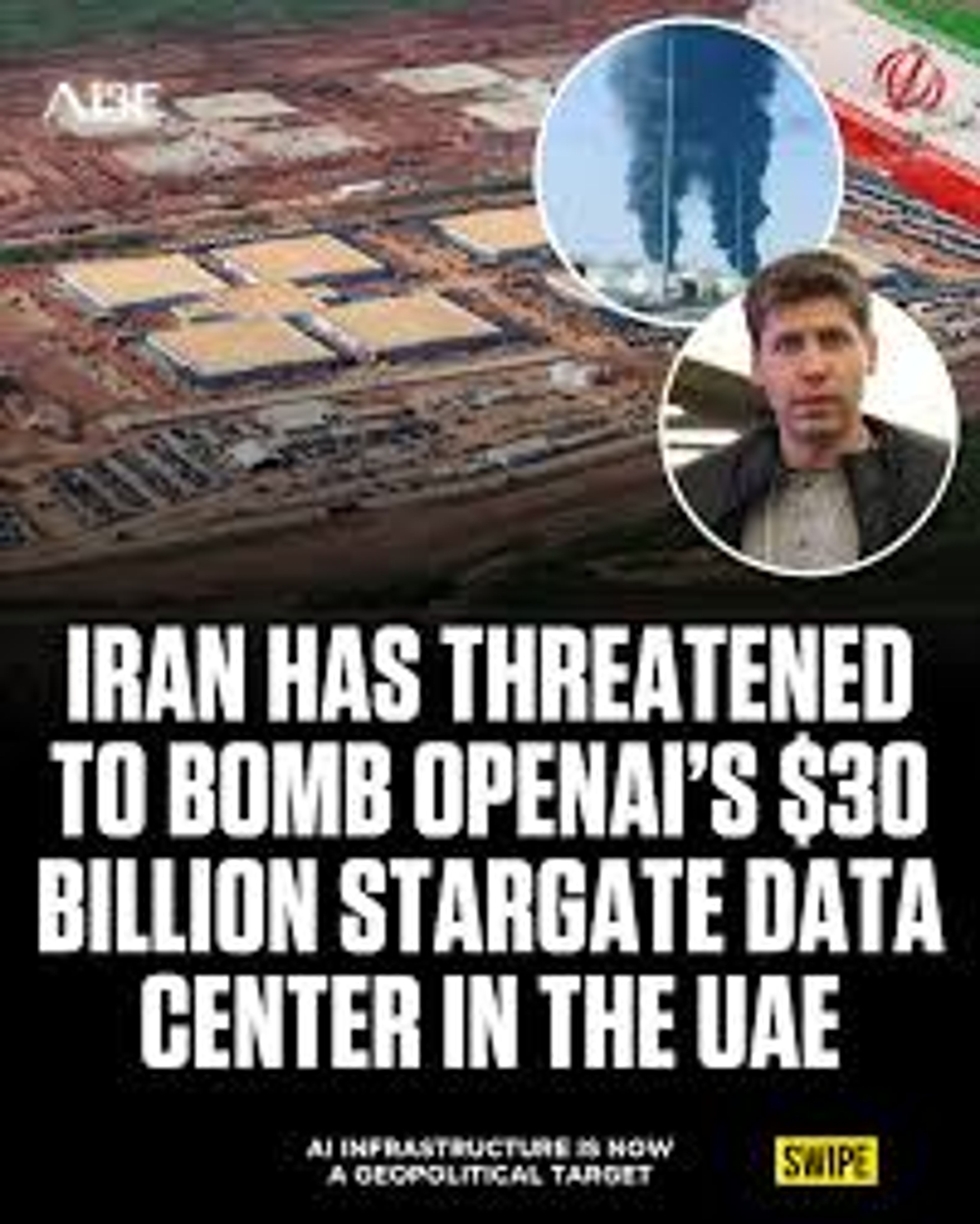
Iran's Stargate Threat: How the Iran OpenAI Stargate Data Center Standoff Signals a New Era of AI Infrastructure Warfare
The Iran OpenAI Stargate data center threat isn't just a regional geopolitical flash point — it's a defining moment for how nation-states will weaponize AI infrastructure in the decades ahead. On April 3, 2026, Iran's Islamic Revolutionary Guard Corps released a chilling video threatening the "complete and utter annihilation" of OpenAI's $30 billion Stargate facility in Abu Dhabi, fundamentally reframing what counts as a high-value military target in the modern era.
This is no longer a story about server farms and cloud contracts. It's about the $30 billion Stargate AI infrastructure vulnerability exposing a gaping blind spot in how frontier AI companies, investors, and host governments have approached physical security. The AI arms race has acquired a physical battlefield — and no one was fully prepared for it.
The Threat: What Iran Actually Did and Why It Matters
Iran's IRGC released the threat video on April 3, 2026, pairing satellite imagery of the Stargate construction site with explicit language about destruction. The timing was deliberate: the regime framed the threat as retaliation contingent on potential US strikes against Iranian power infrastructure.
That framing is strategically significant. By treating a private AI data center as a legitimate retaliatory target against American geopolitical actions, Iran has established a precedent — AI infrastructure is now a proxy for national power. The implicit logic: hurt America's AI capacity, hurt America's strategic future.
The facility targeted is no footnote. The Abu Dhabi Stargate data center carries a 1GW power capacity — a scale of compute that dwarfs most sovereign nation's entire national grid allocations for technology. It's part of a broader $500 billion Stargate initiative backed by OpenAI, SoftBank, and Oracle, making it arguably the most capital-intensive AI infrastructure project in human history.
As TechCrunch reported, Iran threatens 'Stargate' AI data centers in a move that rattled investors, policymakers, and AI executives simultaneously. This wasn't a vague rhetorical gesture — it was a targeted, intelligence-informed signal.
Computational Infrastructure Attacks: A Precedent Already Forming
Here's what makes this threat more alarming than analysts initially acknowledged: Iran may have already tested this playbook. Reports indicate that Iranian rocket strikes have previously inflicted damage on Amazon AWS data centers in the UAE and Bahrain, disrupting operations. That context transforms the IRGC's Stargate threat from bluster into a credible operational signal backed by demonstrated willingness to act.
Iran's threat video targeting OpenAI's Stargate facility included satellite imagery precision that indicates active intelligence collection on the site. This isn't improvised saber-rattling — it reflects a deliberate doctrine of targeting computational infrastructure attacks as a coercive tool.
The AWS incidents, while less publicized, established that civilian cloud infrastructure in the Gulf isn't shielded by the implicit norms that once protected neutral commercial assets. Nation-state AI targeting is evolving rapidly, and the rules of engagement haven't caught up. For the global AI infrastructure market — projected to exceed $400 billion — this is existential risk calculus that boards and insurers are only beginning to price in.
The Geopolitical Logic: Why AI Facilities Are Now Military Assets
To understand why Iran selected this target, you have to understand how adversarial states now read the AI landscape. Advanced AI systems represent compounding strategic advantages: superior battlefield intelligence, autonomous logistics, accelerated weapons development, economic optimization at scale, and cryptographic superiority.
Disrupting an adversary's AI infrastructure — even temporarily — is asymmetrically valuable. A nation that cannot process data at frontier scale loses decision-making speed. Destroy the hardware, and you don't just break a product — you set back an entire national AI capability by years.
The AI regulation and geopolitical risks conversation has largely focused on algorithmic harms and data privacy. Physical infrastructure security has been a secondary concern. Iran's threat forces a reckoning: AI data centers must now be treated with the same national security seriousness as nuclear plants, financial clearinghouses, and communication satellites.
For host governments like the UAE, this creates acute political complexity. Abu Dhabi signed on to host the Stargate facility as an economic and geopolitical prestige play. It now inherits a security obligation — and a target designation — that no commercial real estate deal fully contemplated. The AI facility vulnerability calculus extends from the boardroom straight into the defense ministry.
The $500 Billion Question: Can Stargate's Infrastructure Be Adequately Protected?
The sheer scale of the Stargate project creates security paradoxes that smaller facilities don't face. A 1GW data center isn't a building — it's a small city of power infrastructure, cooling systems, networking hardware, and GPU clusters. Hardening it against kinetic attack requires military-grade perimeter defense, not just cybersecurity protocols.
The latest AI infrastructure developments have focused on compute scaling, energy efficiency, and chip supply chains. Physical hardening against nation-state threats has been conspicuously absent from the public roadmap of any major AI infrastructure operator. That gap is now dangerously visible.
There are compounding vulnerabilities to consider. Power infrastructure feeding a 1GW facility represents a soft target even without direct strikes on the data center itself. Cooling infrastructure — critical in Gulf climates — presents another attack surface. And the supply chains for replacement GPU hardware, dominated by TSMC manufacturing in Taiwan, create restoration timelines measured in months, not days.
The global tech regulation and infrastructure security frameworks don't currently mandate military-grade physical hardening for private AI operators. That regulatory gap may need urgent attention as the geopolitical threat environment escalates. The question of who bears security responsibility — the AI company, the host government, or allied military forces — remains unanswered and urgently needs resolution.
The Broader AI Arms Race: Nation-State Competition for Computational Dominance
Iran's threat doesn't exist in isolation. It's one data point in a rapidly accelerating AI arms race that encompasses hardware acquisition, talent competition, and — now explicitly — the physical security of AI infrastructure. China, Russia, and Iran have all demonstrated willingness to treat Western AI advancement as a direct strategic threat requiring active countermeasures.
The IRGC's use of satellite imagery in the threat video also signals something underappreciated: adversarial intelligence services are conducting systematic reconnaissance on AI infrastructure globally. They know where the facilities are, what their power draws are, and how critical they are to the broader AI capability stack.
This intelligence picture suggests that the Stargate threat is not an isolated incident but an opening move. As frontier AI companies expand globally — pursuing cheaper land, energy, and favorable regulatory environments — they're dispersing high-value assets into complex geopolitical terrain. Each new data center becomes a potential pressure point in future confrontations.
The AI arms race has moved decisively beyond the software layer. The nation that controls the compute wins. And the nation that can threaten an adversary's compute has acquired a new category of strategic leverage. OpenAI, SoftBank, and Oracle built Stargate to win the AI future — Iran just confirmed that their adversaries understand exactly what's at stake.
What This Means for AI Companies, Investors, and Policymakers
The immediate practical implications span multiple domains. For AI companies considering international data center deployments, the Iran-Stargate incident constitutes a material risk disclosure event. Investors in AI infrastructure — including sovereign wealth funds, pension funds, and private equity — need updated threat models that incorporate geopolitical risk alongside traditional operational and market risks.
The critical infrastructure cybersecurity threats landscape has always included physical attack vectors, but the AI sector has historically treated these as remote edge cases. That assumption is no longer defensible. Insurance markets for AI infrastructure will need to develop entirely new product categories — effectively treating hyperscale data centers as critical national infrastructure with corresponding coverage structures.
For policymakers, the path forward requires uncomfortable conversations about the intersection of private commercial AI investment and national security obligations. Should allied governments provide active defense guarantees for strategically important AI infrastructure? Should AI companies deploying in geopolitically sensitive regions be required to meet minimum hardening standards? These questions don't have established answers yet — but they urgently need them.
The AI regulation and geopolitical risks debate must expand beyond algorithmic governance to encompass physical infrastructure security as a first-order policy concern. The Iran-Stargate episode has made that expansion not just advisable but necessary.
OpenAI and its Stargate partners have not yet issued comprehensive public statements on security protocols in response to the threat. That silence — understandable from an operational security perspective — nonetheless leaves stakeholders without reassurance in a moment that demands transparency about the resilience of the world's most ambitious AI infrastructure project.
Conclusion: The New Geography of AI Risk
The Iran OpenAI Stargate data center confrontation has permanently altered the risk map for AI infrastructure investment. What was once considered a straightforward equation — build big, build fast, scale compute — now carries a geopolitical premium that the industry hasn't fully priced.
The AI data center national security conversation starts now, not after the next incident. Frontier AI companies are no longer operating in the purely commercial sphere. They're building assets that adversarial nation-states explicitly identify as strategic targets. The responsibility that comes with that designation — for security, for resilience, for transparency with investors and governments — cannot be delegated or deferred.
The $30 billion Stargate facility in Abu Dhabi represents humanity's most concentrated bet on AI's transformative potential. Iran just reminded the world that some actors are willing to destroy that bet rather than fall behind in the race it represents. The AI era's infrastructure wars have begun.
Stay ahead of AI — follow TechCircleNow for daily coverage.
Frequently Asked Questions
1. What exactly did Iran threaten regarding the OpenAI Stargate data center?
On April 3, 2026, Iran's IRGC released a video threatening the "complete and utter annihilation" of OpenAI's Stargate data center in Abu Dhabi. The video included satellite imagery of the facility and framed the threat as retaliatory action contingent on potential US military strikes against Iranian power infrastructure.
2. How large and significant is the Stargate facility in Abu Dhabi?
The Abu Dhabi Stargate facility carries a 1GW power capacity and is valued at approximately $30 billion. It's part of a broader $500 billion Stargate initiative backed by OpenAI, SoftBank, and Oracle — making it the most capital-intensive AI infrastructure project ever undertaken.
3. Has Iran previously attacked AI or cloud infrastructure in the region?
Reports indicate that Iranian rocket strikes have previously caused damage to Amazon AWS data centers in the UAE and Bahrain, disrupting operations. This precedent transforms the Stargate threat from rhetoric into a credible operational signal backed by demonstrated intent and capability.
4. What does this mean for companies investing in AI data centers in the Gulf region?
The Iran-Stargate incident constitutes a material geopolitical risk event for AI infrastructure investors globally. It indicates that AI data centers in geopolitically sensitive regions may require military-grade physical hardening, active defense partnerships with host governments, and significantly revised insurance and risk disclosure frameworks.
5. How should governments and regulators respond to AI infrastructure being targeted as military assets?
Policymakers need to urgently address several questions: whether allied governments should extend defense guarantees to strategically critical private AI infrastructure, whether minimum physical hardening standards should be mandated for large-scale AI deployments in sensitive regions, and how existing critical infrastructure protection frameworks should be updated to explicitly include hyperscale AI facilities. Current regulatory frameworks do not adequately address these physical security dimensions.