Demis Hassabis Hedge Fund DeepMind: Inside the Secret AI Trading Operation Google Killed Before It Could Beat Jim Simons
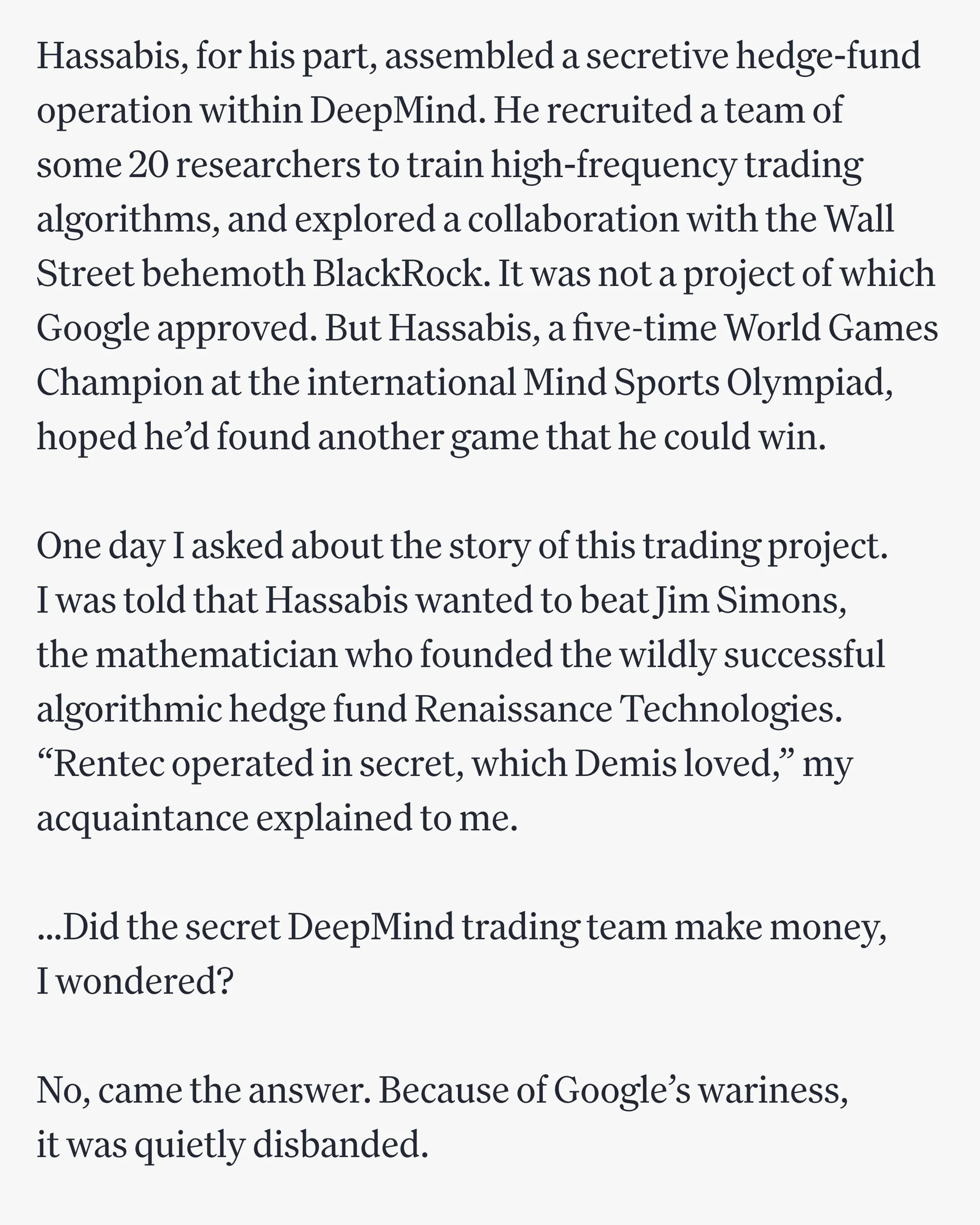
The story of the Demis Hassabis hedge fund DeepMind operation is one of the most revealing—and least understood—episodes in modern AI history. A clandestine internal project, allegedly designed to deploy DeepMind's most advanced AI against global financial markets, was quietly shut down by Google before the world ever knew it existed.
What happened, why Google pulled the plug, and what it tells us about the true capabilities of AI trading systems is a story that cuts to the heart of the biggest unresolved tension in the AI industry: who controls the most powerful AI tools ever built, and for what purpose?
The Ambition: Beating Jim Simons at His Own Game
To understand the scale of what DeepMind allegedly attempted, you first need to understand who Jim Simons was. The late founder of Renaissance Technologies ran the most successful quantitative hedge fund in history. His Medallion Fund returned an average of 66% annually before fees over three decades—a record no human trader or conventional quant system has come close to matching. Simons is the gold standard. The benchmark. The Everest of Jim Simons AI competition.
DeepMind, under Hassabis, reportedly believed they could build systems capable of competing at that level. The reasoning was seductive: DeepMind had already cracked protein folding with AlphaFold, mastered Go, chess, and Starcraft, and was pushing hard into scientific discovery. If reinforcement learning could beat every human at strategy games, why couldn't a sufficiently trained system detect and exploit market inefficiencies in real time?
The intellectual leap from DeepMind's existing capabilities to DeepMind financial trading AI was not as large as it might seem. Pattern recognition across vast data sets, adaptive strategy under uncertainty, real-time recalibration—these are precisely the core competencies DeepMind had spent fifteen years developing.
The Architecture of the Operation: How DeepMind Would Have Done It
The alleged internal project was not simply a matter of plugging a language model into a Bloomberg terminal. The approach, according to sources familiar with DeepMind's internal research culture, would have been rooted in quantitative trading AI systems far more sophisticated than anything publicly deployed.
DeepMind's methodology centers on deep reinforcement learning—agents that learn optimal behavior through millions of simulated trials and failures. Applied to markets, this means an agent that could simulate trading scenarios across decades of historical data, identify non-obvious correlations, and develop strategies that no human discretionary trader or even conventional quant fund would have conceived.
The edge would not come from speed (high-frequency trading is already commoditized). It would come from depth—the ability to model second and third-order market dynamics, anticipate regime changes, and adapt positioning in real time as market microstructure shifted. This is the kind of AI financial markets advantage that, if real, would represent a category-defining leap over existing hedge fund AI strategies.
The question of whether DeepMind actually built functional trading models—or merely researched the theoretical viability—remains unresolved. But the shutdown itself is the more important data point.
Why Google Pulled the Plug: The Commercialization Trap
Google's decision to shut down the operation reveals something critical about the Google AI monetization conflicts baked into the structure of the DeepMind acquisition from day one.
When Google acquired DeepMind in 2014 for a reported $500 million, there were explicit contractual protections designed to prevent DeepMind's research from being exploited in ways that conflicted with its ethics board's oversight. One of the most sensitive domains was financial services. The concern, even then, was that deploying AI of DeepMind's caliber in financial markets could constitute a form of informational asymmetry so extreme as to be destabilizing—not just competitively unfair, but potentially systemic.
There is also a more prosaic explanation rooted in DeepMind commercialization pressure and regulatory exposure. Running a proprietary hedge fund—even an internal one—would have required Google to navigate securities law, fiduciary obligations, and financial regulatory regimes in multiple jurisdictions. The compliance burden alone would have been substantial. The reputational risk, if the operation became public while regulators and governments worldwide were already scrutinizing AI's societal impacts, would have been enormous.
And then there is the question of talent and focus. DeepMind's value to Google is not financial returns from trading. It is the acceleration of Google's core AI capabilities, the prestige of publishing breakthrough research, and the long-term strategic positioning that comes from being the world's most credible fundamental AI research lab. A hedge fund sideline—however profitable—would have been a distraction from that mission and a potential source of internal conflict about where DeepMind's best researchers should be spending their time.
For broader context on how this fits into shifting corporate AI strategies, see our coverage of major tech news and corporate restructuring shaping the industry in 2025.
Hassabis's Calculus: Why He Would Have Pursued This
The more provocative question is not why Google killed the project. It is why Hassabis would have initiated it.
The answer likely has multiple layers. The first is intellectual curiosity. Hassabis is, above all, a scientist motivated by the hardest unsolved problems. Financial markets represent one of the most complex adaptive systems in existence—a real-world environment where the opponent is not a fixed game with known rules but millions of intelligent agents continuously updating their behavior. For a researcher who has spent his career pushing AI into increasingly complex domains, markets represent an irresistible frontier.
The second layer is proof of capability. If DeepMind could demonstrate—even internally—that its systems could generate consistent alpha in live financial markets, it would constitute perhaps the most powerful real-world validation of general AI capability ever achieved. Not a benchmark. Not a game. Actual predictive superiority over the most sophisticated human and algorithmic traders in the world.
The third layer, and the most uncomfortable one, involves DeepMind corporate governance. Hassabis has always operated DeepMind with a degree of autonomy that has periodically created friction with Google's parent structure, Alphabet. A secret internal trading operation—one that Hassabis may have believed could be contained, studied, and eventually shelved without public disclosure—fits a pattern of pushing boundaries within the corporate relationship.
Understanding the full arc of AI's intersection with financial power requires grounding in the latest AI industry developments reshaping both technology and capital markets in 2026.
What This Reveals About AI's Actual Trading Capabilities
The shutdown, paradoxically, may be the strongest signal we have that the capability was real—or at least real enough to worry people.
Google does not shut down internal research projects because they are failing. It shuts them down because of consequences. A trading AI that was clearly underperforming, generating no meaningful alpha, and struggling to compete with existing hedge fund AI strategies would have been quietly defunded and forgotten. The kind of intervention that apparently occurred—a deliberate, governance-level decision to terminate the operation—suggests the system was working, or credibly threatening to work, in ways that triggered concern.
This is consistent with what we know about AI's trajectory in quantitative finance more broadly. The major quant funds—Renaissance, Two Sigma, D.E. Shaw, Citadel—have been integrating machine learning into their strategies for over a decade. But they have done so with proprietary data advantages, regulatory compliance frameworks, and carefully managed risk controls. A DeepMind system deployed with access to Google's data infrastructure—search trends, Maps location data, YouTube consumption patterns, Gmail sentiment (however anonymized)—would represent an informational advantage that existing funds simply cannot replicate.
That is where the real danger lies. Not in the AI itself, but in the data moat it could exploit.
DeepMind's own commitment to responsible AI development is documented extensively through DeepMind's official research publications, which offer a window into how the lab publicly frames the boundary between research capability and deployment risk.
The implications for AI regulation and policy developments are significant. If an AI system can demonstrably outperform all human traders when given access to sufficient proprietary data, the regulatory question is no longer theoretical. It becomes an urgent policy problem about market integrity, competitive fairness, and systemic financial stability. Follow our dedicated coverage of AI regulation and policy developments as governments begin grappling with exactly this scenario.
The Broader Warning: AI Research Labs Are Not Neutral Actors
The deeper story here is not really about hedge funds. It is about what happens when the most powerful AI research organizations in the world begin exploring the full scope of what their systems can do—and when those explorations happen in secret, governed by the internal ethics of people who are not elected, not regulated, and not fully accountable to the public.
DeepMind has done genuinely important work. AlphaFold's protein structure predictions have accelerated drug discovery in ways that will save lives. Its energy optimization work has reduced Google's data center cooling costs significantly. These are legitimate contributions to human welfare.
But DeepMind also operates inside one of the most powerful corporations on Earth, with access to data and compute resources that no independent researcher, no government lab, and no academic institution can match. When an organization with that profile begins experimenting with using AI to capture financial markets—even as an internal research exercise—the line between scientific inquiry and the accumulation of structural power becomes uncomfortably thin.
TechCrunch coverage of AI and tech leadership has tracked the broader pattern of AI labs expanding their operational footprints beyond their stated research missions, and the DeepMind trading story fits squarely into that trend.
The venture capital trends and funding landscape for AI in 2026 only amplifies these dynamics. With AI startups attracting record investment (Q1 2025 saw startup funding shatter all previous records), the competitive pressure on established labs to demonstrate commercial viability—not just research excellence—is intense. For context on how capital is reshaping AI's commercial direction, see our analysis of venture capital trends and funding landscape in the current cycle.
Conclusion: The Shutdown Is the Story
The termination of the alleged DeepMind internal trading operation is not a story about failure. It is a story about capability being weaponized, recognized as dangerous, and—for now—contained.
But contained is not eliminated. The researchers who built those systems still work at DeepMind. The architectural insights still exist. The data advantages are, if anything, larger than they were when the project was active. The only thing that changed is the decision about whether to deploy them in this particular context.
The question of DeepMind financial trading AI and its suppression forces us to confront something the AI industry would prefer to defer: the most capable AI systems are not neutral research tools. They are instruments of competitive advantage so powerful that even their builders are occasionally forced to decide that deploying them would be wrong.
That Google made that call correctly—this time—is worth acknowledging. That we only know about it through leaks and inference, rather than transparent governance, is the part that should concern all of us.
Frequently Asked Questions
Q: Did Demis Hassabis actually run a hedge fund inside DeepMind? A: Reports suggest an internal AI-driven trading research operation existed within DeepMind, though the precise structure—whether it constituted a formal hedge fund or a research program with live market testing—remains unconfirmed. Google has not publicly commented.
Q: Why would Google shut down a profitable AI trading operation? A: Regulatory exposure, reputational risk, potential conflicts with DeepMind's foundational ethics commitments, and strategic focus on core AI research all provide plausible explanations. A proprietary trading operation would also have created significant compliance obligations under securities law across multiple jurisdictions.
Q: Could DeepMind's AI actually beat Jim Simons's Renaissance Technologies? A: In theory, a sufficiently capable reinforcement learning system with access to unique proprietary data—particularly Google's vast behavioral data sets—could identify market signals unavailable to any other fund. Whether DeepMind's systems reached that level of effectiveness is unknown. The nature of the shutdown suggests the capability was at least credible.
Q: What data advantages would DeepMind have had over traditional hedge funds? A: Google's ecosystem gives DeepMind potential access to search trend data, location data from Maps, consumer behavior signals from YouTube, and broader internet traffic patterns. These data sets, combined with advanced AI modeling, could surface market-predictive signals that conventional quant funds lack the data to discover.
Q: What does this mean for AI regulation in financial markets? A: It strongly suggests that existing financial regulation was not designed to address AI systems operating with the kind of informational and computational advantages that major tech-affiliated AI labs possess. Regulators in the US, EU, and UK are increasingly aware of this gap, but specific AI trading regulations remain underdeveloped.
Stay ahead of AI — follow TechCircleNow for daily coverage.