Anthropic AGI Timeline: What the '6–12 Month' Internal Claim Really Tells Us
Anthropic's AGI timeline is the hottest topic in frontier AI right now — and for good reason. At the 2026 Davos World Economic Forum, Anthropic CEO Dario Amodei dropped a claim that sent shockwaves through the industry: AI models are 6 to 12 months away from doing most, if not all, of what software engineers do end-to-end. But before we treat this as a straightforward AGI prediction, we need to ask a harder question: what does Anthropic actually mean by "AGI," and are they describing a capability milestone or managing a narrative?
This isn't just semantic pedantry. The gap between Amodei's internal framing and the public's understanding of artificial general intelligence is enormous — and that gap is precisely where hype, incentive structures, and genuine scientific uncertainty collide. We're tracking the latest AI trends and advances shaping 2025 closely, and nothing demands more rigorous scrutiny than frontier lab CEOs making civilization-scale predictions from the stage at Davos.
What Amodei Actually Said — And What He Didn't
Let's start with the precise claim. In the Davos World Economic Forum fireside chat, Amodei stated: "We might be 6 to 12 months away from when the model is doing most, maybe all, of what SWEs do end-to-end." That's a software engineering (SWE) capability claim — not a general intelligence claim.
He also noted that Anthropic engineers rarely write code by hand anymore. Instead, they act as "product managers or architects," reviewing and directing AI-generated code rather than authoring it themselves. This is a real and significant shift in how elite engineering teams operate.
But here's the critical distinction: automating software engineering tasks, even comprehensively, is not equivalent to AGI by most rigorous definitions. AGI definitions and metrics in academic and policy circles typically require generalized problem-solving, robust transfer learning across novel domains, and autonomous goal-setting — none of which are demonstrated by a system that excels at code generation within structured, human-supervised workflows.
The Definition Problem at the Heart of Every AGI Prediction
The AGI 2024 predictions cycle taught us one lesson above all others: the word "AGI" means something different to every lab that uses it. OpenAI defines it loosely as "highly autonomous systems that outperform humans at most economically valuable work." DeepMind uses "human-level performance across a wide range of tasks." Neither of these definitions carries a formal benchmark that can be tested and falsified.
Amodei's framing appears to use a narrower, more operationalized version. When he forecasts AI models reaching "Nobel-level" intelligence in many fields by 2026 or 2027, he's describing domain-specific superhuman performance in research tasks — not a unified general intelligence. That's a real capability milestone, but it's closer to what researchers call "narrow superintelligence" in specific verticals than the philosophical concept of AGI.
This definitional slippage matters enormously for public understanding, investor expectations, and policy. When a CEO conflates "AI that replaces SWEs" with proximity to AGI, it inflates the perceived timeline without necessarily being dishonest — because they've quietly adopted a lower threshold for what AGI means.
AI Capability Milestones: What's Real, What's Extrapolated
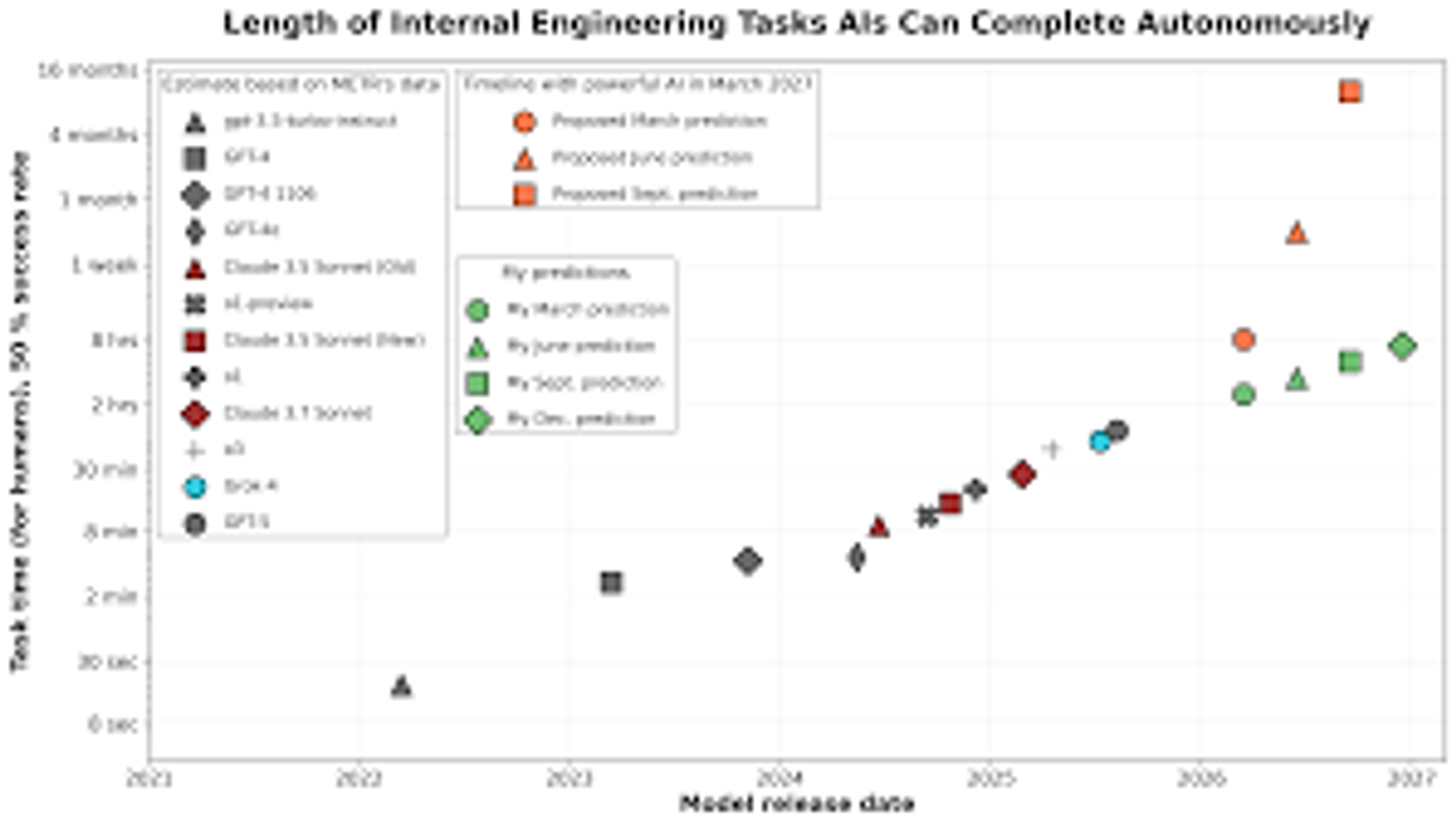
Amodei's most provocative claim is the self-iterative loop: AI writes code, conducts research, and evolves its own capabilities exponentially. This positive feedback accelerating R&D, he argues, will push AI capability milestones beyond current expectations by 2026 or 2027.
There's legitimate signal here. The AI productivity tools and code generation capabilities emerging from frontier labs are genuinely transforming software development pipelines. But Sydney Von Arx, a technical staff member at METR — an organization that evaluates models from Anthropic and others — urges caution about extrapolating too aggressively from progress charts: "There are a bunch of ways that people are reading too much into the graph," emphasizing nuances in task measures that affect predictions of economic impact and development pace.
The self-iterating loop narrative is particularly vulnerable to this critique. Capability gains in code generation don't necessarily transfer to novel scientific reasoning. An AI that dramatically accelerates software development may hit hard limits when applied to the kind of cross-domain synthesis that characterizes genuine general intelligence. The emergence signals we're seeing in code are real — but they're not proof of an imminent general capability jump.
Comparing Frontier Lab Timelines: Anthropic, OpenAI, and DeepMind
Amodei did offer one statistic that places his views in a broader competitive context. He stated a 50% probability of achieving AGI by the end of the decade — before 2030 — a timeline that aligns closely with Google DeepMind CEO Demis Hassabis's public view. Both leaders emphasize scaling models, multimodality, and agent autonomy as the primary drivers toward artificial general intelligence capabilities.
OpenAI has been more aggressive in its informal signaling, with some internal figures suggesting superintelligence predictions in the 2027–2028 range. But all of these timelines share the same structural weakness: they're built on extrapolation from current scaling curves without accounting for potential capability plateaus, compute bottlenecks, or the emergent safety problems that arise as models grow more autonomous.
For context on where these predictions sit against longer-horizon forecasts, see our analysis of expert tech predictions for 2030. The pattern is consistent: labs with the most to gain from AGI hype tend to publish the most aggressive timelines. That's not a conspiracy — it's incentive physics.
The Safety Paradox: Anthropic's Internal Contradiction
Here is where Anthropic's position becomes genuinely uncomfortable. The company was founded explicitly on AI safety concerns, positioning itself as the "responsible" frontier lab. Yet its CEO is making public pronouncements about AI replacing software engineers within a year while simultaneously, its own researchers are co-authoring papers warning about losing oversight of AI systems.
A position paper signed by 40 researchers — including contributors from OpenAI, Google DeepMind, Anthropic, and Meta — warns that chain-of-thought (CoT) visibility in advanced models may not persist, calling for urgent investment in this transparency mechanism. According to Fortune's coverage of AI safety research from OpenAI, Google DeepMind, and Anthropic, the paper states: "CoT monitoring presents a valuable addition to safety measures for frontier AI, offering a rare glimpse into how AI agents make decisions. Yet, there is no guarantee that the current degree of visibility will persist."
Dan Hendrycks, xAI safety advisor and paper co-author, endorses CoT monitoring for detecting "intent to misbehave," but acknowledges it is "imperfect and allows some misbehavior to go unnoticed." The paper is endorsed by OpenAI co-founder Ilya Sutskever — a significant endorsement from someone who left OpenAI partly over safety concerns.
The contradiction is stark: Anthropic's CEO is describing a 6–12 month runway to AI taking over software engineering, while Anthropic-affiliated researchers are warning that we're already losing the ability to understand what advanced models are actually doing. These two narratives need to be read together, not in isolation.
The AI safety and regulatory implications of this gap are profound, and policymakers are watching. The AI safety and regulatory implications of deploying increasingly autonomous agents while oversight mechanisms degrade aren't hypothetical — they're happening now.
Incentive Structures: Why These Claims Get Made at Davos
We should be honest about what Davos is. It's not a scientific conference. It's a stage for leaders to project vision, attract capital, and shape narratives. Amodei's "6–12 month" SWE claim wasn't published in a peer-reviewed journal — it was delivered to an audience of investors, policymakers, and global business leaders.
The incentive to make bold claims at Davos is structural. Frontier AI labs are in a capital-intensive race. Anthropic has raised billions in funding and needs to continue demonstrating that it's at the cutting edge — not just of capability, but of vision. A CEO who says "we're making steady progress" loses the room. A CEO who says "we're 6 months from replacing software engineers" gets the headlines.
Sue Anne Teo, technology and human rights fellow at Harvard Kennedy School, describes a related dynamic she calls "intimacy capitalism" in anthropomorphic AI: "the more human-like it is, the more people will come to these chatbots... you are volunteering all this data to the company by yourself — because it is so human-like, because your attachment is being monetized. Not just engagement, but attachment." The same logic applies at the institutional level. The more companies believe AGI is imminent and inevitable, the more they commit capital and partnerships to the labs projecting that future.
None of this means Amodei is lying. He may genuinely believe the 6–12 month SWE timeline. But the incentive environment means we should apply extra scrutiny to any claim made on that particular stage, by those particular actors, at this particular moment in AI investment history.
Conclusion: Precision Matters More Than Ever
The Anthropic AGI timeline debate ultimately reveals three overlapping problems: definitional ambiguity that allows labs to set their own goalposts; incentive structures that reward bold public claims over careful calibration; and a genuine, racing capability curve that makes even cautious observers uncertain about what's possible.
Here's what we can say with reasonable confidence: AI is transforming software engineering workflows faster than most predicted. Domain-specific superhuman performance in research tasks is plausible within the decade. And the internal practices at top labs — where engineers review rather than write code — are a real leading indicator of displacement dynamics.
What we cannot say with confidence is that any of this maps cleanly onto AGI definitions and metrics that have philosophical coherence or policy utility. Amodei's 6–12 month window is a capability milestone claim dressed in AGI language, delivered in a setting that rewards spectacle over precision. That's worth understanding clearly — especially as governments begin to legislate around AI safety timelines and the gap between what labs say publicly and what their own researchers warn privately grows wider.
For daily analysis of frontier AI developments, benchmark claims, and the evolving race between labs, stay connected with TechCircleNow.com — where we cut through the noise so you don't have to.
FAQ: Anthropic AGI Timeline and What It Means
Q1: What exactly did Dario Amodei say about AGI at Davos 2026? Amodei stated that AI could be doing "most, maybe all" of what software engineers do end-to-end within 6 to 12 months. He also cited a 50% probability of achieving AGI before 2030, aligning with Demis Hassabis of Google DeepMind. Importantly, his near-term claim was specifically about software engineering automation, not AGI in the broader philosophical sense.
Q2: Is replacing software engineers the same as achieving AGI? No. Automating software engineering tasks — even comprehensively — represents a narrow capability milestone, not artificial general intelligence. AGI definitions and metrics in serious academic and policy circles require generalized reasoning, cross-domain transfer, and autonomous goal-setting that code generation systems don't currently demonstrate.
Q3: How does Anthropic's AGI timeline compare to OpenAI and DeepMind? All three major frontier labs are converging around a "before 2030" window with 50%+ probability. OpenAI's informal signals have been slightly more aggressive, while DeepMind's Hassabis explicitly aligned with Amodei's framing at Davos. None of these timelines are attached to formal, falsifiable benchmarks.
Q4: What is the chain-of-thought safety concern, and why does it matter for AGI timelines? Forty researchers from labs including Anthropic, OpenAI, and DeepMind warned that as models grow more capable, the chain-of-thought visibility that currently allows safety monitoring may disappear. This means we could reach the AI capability milestones labs are predicting while simultaneously losing the ability to understand or verify what those models are actually doing — a critical safety gap.
Q5: What incentives might shape how Anthropic communicates about AGI timelines? Frontier labs operate in an intensely capital-competitive environment. Bold public claims made at venues like Davos attract investment, strategic partnerships, and regulatory influence. While this doesn't mean claims are dishonest, it does mean they should be evaluated with awareness of the structural incentives that reward visionary framing over conservative calibration.
Stay ahead of AI — follow TechCircleNow for daily coverage.