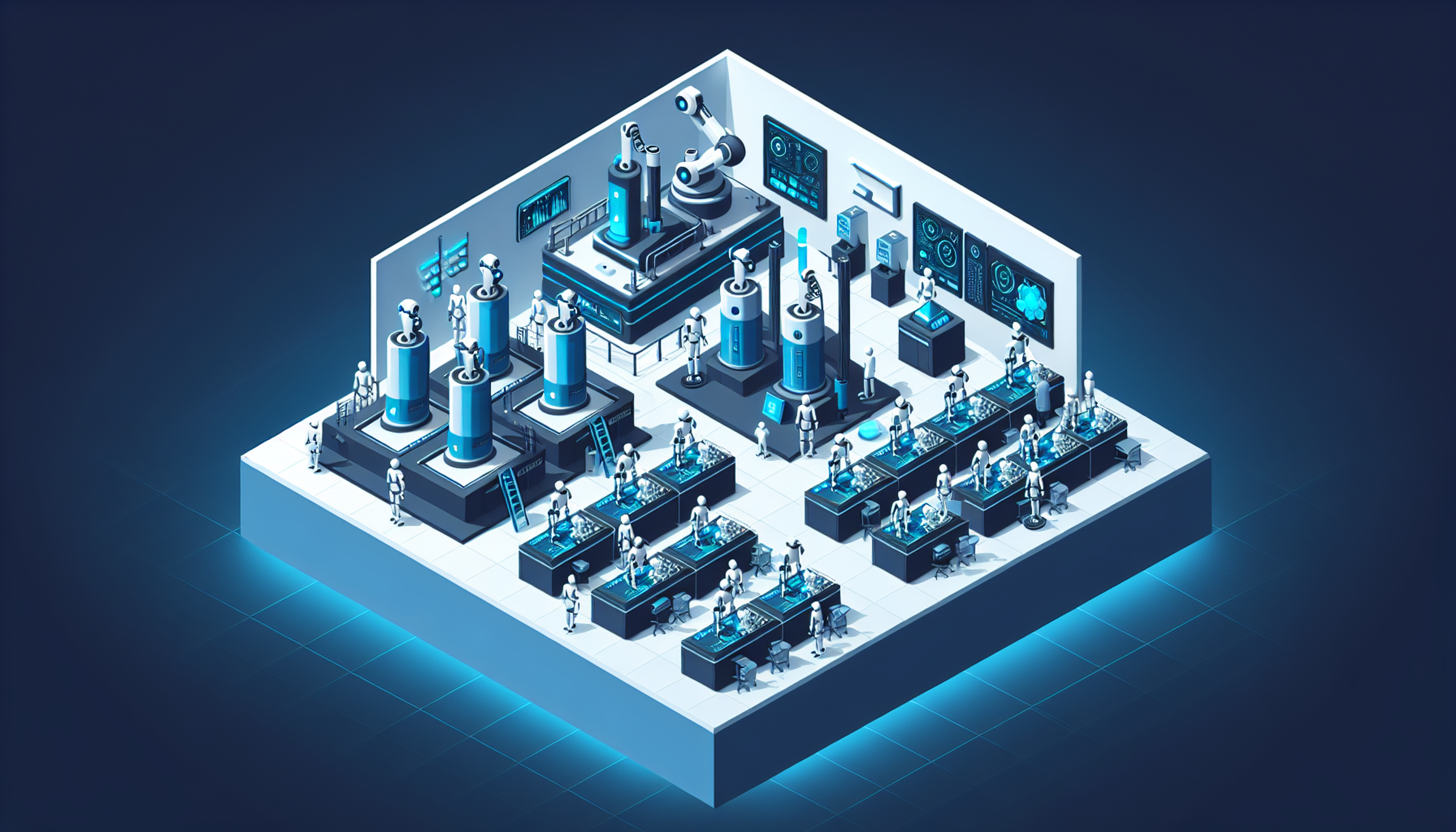
China's Humanoid Robot Factory Is Producing One Robot Every 30 Minutes — Here's Why That Changes Everything
China's China humanoid robot factory ambitions just got a concrete deadline. A fully automated production line capable of churning out 10,000 humanoid robots per year — one unit every 30 minutes — isn't a concept render or a five-year roadmap. It's operational infrastructure being built right now, and it's forcing a fundamental reassessment of where the global robotics race is actually headed.
This matters far beyond the headline number. To understand the stakes, you need to look at what a 30-minute robot production cycle actually means for global manufacturing competition — and how China's industrial scale-up compares to what Boston Dynamics and Figure AI are producing right now. If you've been tracking the latest AI and automation trends reshaping manufacturing, this story is the one that ties every thread together.
The 30-Minute Cycle: What It Actually Means for Automated Robot Production
Most people read "10,000 robots per year" and think about volume. That's the wrong lens.
The more important metric is cycle time. A 30-minute production cycle for a humanoid robot — a machine with dozens of articulated joints, onboard AI inference hardware, sensor arrays, and complex wiring — represents a manufacturing engineering achievement that would have been implausible three years ago.
For comparison, Tesla's Optimus robot has been assembled in small batches using semi-manual processes. Figure AI, which raised over $675 million in early 2024, has focused on capability demonstrations rather than production throughput. Boston Dynamics, despite decades of robotics pedigree, has never publicly committed to humanoid robot volume timelines anywhere near this scale. China's automated robot production line approach — using robots to build robots — compresses the gap between prototype and product in ways that Western competitors haven't yet matched at scale.
This is humanoid robot mass production as an industrial doctrine, not a product launch.
China's Robotics Industry Is Already Operating at a Different Scale
The numbers from China's robotics sector aren't projections. They're reported outputs.
China's robotics industry revenue hit nearly 240 billion yuan ($35 billion USD) in 2024. In the first half of 2025 alone, the sector posted 27.8% year-on-year growth, producing 370,000 industrial robot units in that period. This is the infrastructure base — the supply chains, the component manufacturers, the precision machining networks — on which humanoid robot manufacturing is being built. China's industrial robot production and global market dominance didn't emerge from nowhere. It's the result of deliberate, decade-long industrial policy compounding into structural advantage.
The Chinese robotics industry now counts over 140 humanoid robot manufacturers and more than 330 distinct humanoid robot models unveiled in the past year alone, as of January 2026. That's not a market. That's an ecosystem running at full velocity.
What makes this particularly significant is the vertical integration. Chinese firms aren't just assembling robots — they're manufacturing the actuators, the harmonic drives, the vision systems, and increasingly the AI chips that power them. That supply chain depth is what makes a 30-minute cycle time credible.
AgiBot, Unitree, and the Market Share Story Western Media Is Missing
When analysts talk about the humanoid robot market, they often frame it around Tesla, Figure, and Agility Robotics. That framing is increasingly disconnected from where units are actually shipping.
Shanghai-based AgiBot shipped over 5,168 humanoid robot units in 2025, commanding a 39% global market share. AgiBot's 39% global humanoid robot market share in 2025 is the kind of data point that reframes the entire competitive narrative. Unitree Robotics holds approximately 32% of the market. UBTECH accounts for another 7%. Combined, Chinese firms control nearly 80% of the global humanoid robot market based on 2025 shipments.
An estimated 16,000 humanoid robots were sold globally in 2025. Chinese firms produced the overwhelming majority. The industrial robot output figures from China aren't hypothetical — they reflect realized production capacity that already dwarfs what American startups have demonstrated.
This isn't about one company building one impressive factory. It's about a coordinated national industrial posture where humanoid robot manufacturing is being treated with the same strategic urgency that China applied to electric vehicles, solar panels, and lithium batteries — all sectors where it now holds dominant global positions.
Understanding how workplace automation and humanoid robots are reshaping the future of work requires acknowledging that the robots most likely to populate warehouses, factories, and logistics centers globally in the next five years are being built in Shenzhen, Shanghai, and Hangzhou — not Pittsburgh or San Jose.
100,000 Units in 2026: The Commercialization Threshold Nobody Is Talking About
Here's the number that should be getting more attention: 100,000 humanoid robot units targeted for mass production in 2026.
That figure — drawn from industry projections for China's sector — represents the threshold between pilot deployment and genuine commercial scale. Going from 16,000 global units in 2025 to 100,000 in 2026 isn't a linear improvement. It's a phase transition. At 100,000 units, the economics of humanoid robotics change entirely. Unit costs drop. Deployment models diversify. Enterprise buyers can pilot at scale rather than in isolated proof-of-concept installations.
AI-powered manufacturing is central to this acceleration. The robots being produced aren't just mechanical systems — they're AI inference endpoints trained on massive datasets of human motion, manipulation tasks, and environmental interaction. The AI training infrastructure China has built, combined with its manufacturing base, creates a feedback loop: more deployed robots generate more real-world training data, which improves the AI, which makes the robots more capable, which drives more demand.
The robot assembly automation happening in these factories isn't just efficient. It's self-reinforcing. And the competitive moat it creates widens with every production cycle.
This dynamic extends well beyond manufacturing. AI automation transforming industries beyond manufacturing — from healthcare to logistics to elder care — will increasingly be shaped by whoever controls the hardware stack. Right now, that's China.
What the AI Experts Are Actually Saying About the Intelligence Behind These Machines
The hardware story is compelling. The AI story is where it gets genuinely uncertain.
Dario Amodei, CEO of Anthropic, has argued that powerful AI could arrive within 1–2 years, driven by consistent scaling laws and smooth increases in cognitive capability. He's also noted that AI models are "vastly more psychologically complex" than previously understood — with researchers now able to identify "tens of millions of features inside Claude's neural net" and map circuits that orchestrate complex behavior like reasoning.
If Amodei is right, the AI systems being integrated into humanoid robots in 2026 and 2027 could be substantially more capable than anything currently deployed. That changes the calculus for what these machines can actually do in unstructured environments — which is the key limitation holding humanoid robots back from broad deployment today.
But the optimism isn't universal. Stuart Russell, UC Berkeley professor, warns that the AI sector faces a bubble risk where "if the bubble bursts, the economic damage will be severe." His concern: the breakthroughs needed to justify current valuations would require approaches to AGI for which "AI developers have no cogent proposal for how to control such systems."
Alison Gopnik, UC Berkeley psychology professor, pushes further, predicting that "we will realize that there is no such thing as general intelligence, artificial or natural" — favoring instead intrinsically motivated reinforcement learning systems that optimize for truth-finding rather than human approval scores.
This expert divergence matters for the humanoid robot story because the long-term value of these machines is entirely dependent on how capable and general their onboard and cloud-connected AI becomes. A humanoid robot with narrow, task-specific AI is a specialized tool. A humanoid robot with near-AGI capabilities is something categorically different — and potentially far more disruptive to labor markets globally.
The Competitive Gap Is Widening — and Western Firms Are Running Out of Time
Boston Dynamics makes exceptional robots. Figure AI has impressive demos. Agility Robotics has real warehouse deployments. But none of them are operating at the production scale China is now institutionalizing.
The gap isn't just manufacturing volume. It's the entire industrial stack beneath it. Chinese humanoid robot mass production benefits from domestic suppliers for nearly every critical component. American humanoid robot firms are still navigating supply chain dependencies, longer lead times, and higher per-unit costs — all of which constrain their ability to scale fast even if demand exists.
The policy dimension compounds this. China's central government has explicitly designated humanoid robotics as a strategic industry. Municipal governments in Shanghai, Beijing, and Shenzhen are providing subsidies, land, and preferential procurement. The 10,000-unit factory isn't just a private enterprise story — it's what happens when industrial policy meets engineering ambition at national scale.
Western governments are beginning to respond. The U.S. has increased scrutiny of Chinese robotics firms over data security concerns. The EU is developing robot safety frameworks. But regulatory responses and investment announcements are different from shipped units. China is shipping units.
For those tracking what mass humanoid robot production means for the tech landscape by 2030, the honest answer is that the trajectory is being set right now — in factories that produce a new humanoid robot every 30 minutes.
Conclusion: The 30-Minute Robot Is a Strategic Inflection Point
The China humanoid robot factory story isn't about one facility or one company. It's about a coordinated national capability reaching the commercialization threshold at precisely the moment global demand for automation is accelerating.
A 30-minute production cycle means that by the end of 2026, China's humanoid robot manufacturers could be approaching cumulative production figures that give them multi-year data advantages over any competitor — advantages in reliability data, in real-world AI training sets, in component cost curves, and in customer relationship depth.
The question for Western robotics firms and policymakers isn't whether China's humanoid robot manufacturing scale-up is real. The data confirms it is. The question is whether the response — in investment, in industrial policy, in AI integration — can match the pace of a production line that never stops.
Follow TechCircleNow.com for daily coverage of the AI and robotics developments shaping the next decade of global competition. This story is moving faster than most people realize.
Frequently Asked Questions
1. What is the significance of a 30-minute humanoid robot production cycle? A 30-minute cycle time means a factory can produce 48 humanoid robots per day, scaling to roughly 10,000 per year. For a machine as mechanically and electronically complex as a humanoid robot, this cycle time represents a manufacturing engineering achievement that compresses decades of traditional production scaling into years — and gives Chinese firms a structural cost and volume advantage over competitors still operating in batch or semi-manual production modes.
2. How does China's humanoid robot output compare to U.S. companies like Figure AI and Boston Dynamics? Chinese firm AgiBot alone shipped over 5,168 units in 2025, holding 39% of the global market. Unitree Robotics holds another 32%. U.S. firms including Figure AI and Boston Dynamics have not disclosed comparable shipment volumes and have focused primarily on capability demonstrations and limited pilot deployments rather than mass production at this scale.
3. What is driving China's dominance in humanoid robot manufacturing? Several factors compound: deep domestic supply chains for components like actuators and precision drives, explicit national and municipal government support, over 140 competing manufacturers creating a high-innovation ecosystem, and an existing industrial robot manufacturing base generating $35 billion in annual revenue. This infrastructure allows Chinese firms to scale humanoid production faster and cheaper than firms building supply chains from scratch.
4. What AI capabilities do current humanoid robots actually have? Current humanoid robots use a combination of onboard inference hardware and cloud-connected AI for tasks like object manipulation, navigation, and basic task following. They excel in structured environments and are improving rapidly in unstructured settings. As Anthropic's Dario Amodei notes, powerful AI advances could arrive within 1–2 years — if that timeline proves accurate, the AI integrated into humanoid robots deployed in 2027 and beyond could be substantially more general and capable than today's systems.
5. Is a global market of 100,000 humanoid robots in 2026 realistic? Industry projections for China's sector alone target 100,000 units in 2026, up from an estimated 16,000 globally in 2025. Given that AgiBot and Unitree are already building out automated production infrastructure and that China's broader robotics sector grew 27.8% year-on-year in the first half of 2025, the 100,000-unit figure represents an aggressive but increasingly credible threshold — contingent on demand-side uptake from enterprise and industrial buyers keeping pace with supply-side capacity.
Stay ahead of AI — follow TechCircleNow for daily coverage.