
Enterprise Large Language Models: Strategic Deployment, Integration, and Customization for Business Success
Estimated reading time: 15 minutes
Key Takeaways
- Enterprise large language models (LLMs) are AI systems tailored for business applications with rigorous security, compliance, and customization.
- They unlock value across industries by improving productivity, customer interactions, and operational efficiency.
- Successful deployment involves choosing between cloud, on-premises, or hybrid models with attention to data privacy and cost.
- Private LLM deployment ensures sensitive data remains secure and compliant with industry regulations.
- Fine-tuning with proprietary data enhances domain relevance, brand voice, and user satisfaction.
- Seamless integration into enterprise systems like CRM and ERP amplifies the impact of LLM-powered automation and insights.
Table of contents
- Introduction to Enterprise Large Language Models
- Understanding Enterprise Large Language Models
- How Companies Use LLMs
- Deploying LLMs in Business: Models and Challenges
- Private LLM Deployment: Ensuring Privacy and Security
- Fine Tuning LLMs for Business: Customizing AI for Enterprise Needs
- LLM Integration for Enterprises: Seamless Embedding AI into Business Systems
- Strategic Considerations for Enterprise Decision-Makers
- Conclusion
- Frequently Asked Questions
Introduction to Enterprise Large Language Models
Enterprise large language models (LLMs) are advanced artificial intelligence systems trained on massive datasets containing billions of parameters. These models possess exceptional capabilities in natural language understanding and generation, fine-tuned specifically for business applications. Unlike general-purpose AI systems, enterprise LLMs are built to meet rigorous corporate requirements, enabling companies to leverage AI for practical, impactful outcomes.
In today’s competitive landscape, how companies use LLMs has become a decisive factor for gaining an edge. Organizations across healthcare, finance, retail, and beyond are deploying LLMs to boost productivity, enhance customer interactions, and streamline operational efficiency. This adoption helps businesses respond faster to market changes and customer needs.
This blog post will explore the strategic landscape of deploying LLMs in business. We will cover key areas including:
- How enterprise large language models differ from open-source variants
- Core use cases and industry examples
- Deployment strategies and challenges
- Private LLM deployment to ensure data security
- Fine-tuning methods tailored for business needs
- Seamless integration into existing enterprise systems
- Strategic considerations for decision-makers
By understanding these facets, enterprises can design robust AI systems that align with their unique objectives and deliver long-term value.
Understanding Enterprise Large Language Models
Enterprise large language models stand apart from general-purpose or open-source LLMs by prioritizing scalability, security, compliance, and customization. This distinction is vital since enterprises handle sensitive data and complex workflows that require more control and robustness than typical consumer-facing AI models offer.
Key Differentiators of Enterprise LLMs
- Massive Parameter Counts: Enterprise LLMs contain billions of parameters, enabling them to perform complex natural language tasks across multiple domains, from summarization to detailed data analytics.
- Fine-Tuning on Proprietary Data: These models are designed for fine tuning with domain-specific datasets, ensuring relevance to unique business vocabularies and use cases.
- Integration Safeguards: Techniques like retrieval-augmented generation (RAG) are implemented to improve response accuracy by dynamically fetching contextual data, while reinforcing information security. Learn more
- Compliance & Security: Enterprise models are built to comply with regulatory standards and enforce strict data governance policies to prevent unauthorized exposure of sensitive information.
Private LLM deployment allows companies to have dedicated environments ensuring sensitive data stays inside controlled boundaries. This is critical in sectors such as finance or healthcare, where data privacy laws are stringent. See technical details
Enterprises emphasize safeguards against data leaks or inadvertent sharing that could occur in public or open-source model usage. These features make enterprise LLMs a strategic asset rather than a general tool.
How Companies Use LLMs
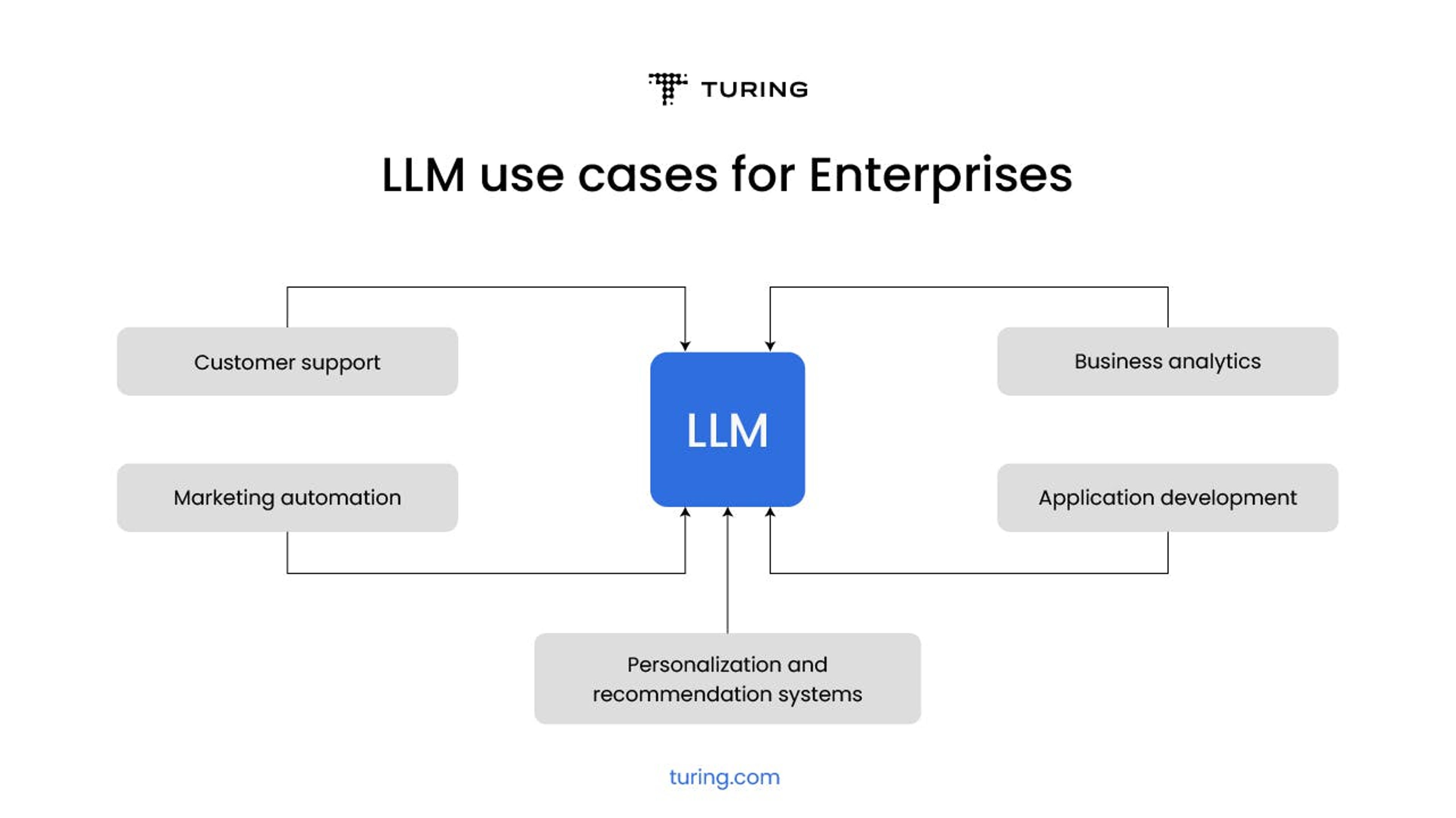
Enterprises are realizing significant benefits by integrating large language models into their workflows. Understanding how companies use LLMs highlights their transformative potential across industries.
Common Enterprise Use Cases
- Customer Support Automation: AI chatbots powered by LLMs automate responses, handle queries instantly, and escalate complex issues with contextual accuracy. This reduces wait times and frees human agents for higher-value tasks.
- Automated Content Generation: Marketing and communication teams use LLMs to create personalized messages, social media content, and campaign materials efficiently. More info
- Advanced Data Analysis: LLMs assist analysts by extracting actionable insights from unstructured data, enabling smarter decisions.
- Knowledge Management: With capabilities like summarization and automated documentation, enterprises improve internal knowledge sharing and compliance record-keeping.
- Translation & Code Generation: Multilingual support and code suggestions help global operations and developer productivity.
Real-World Business Benefits
- Improved Sentiment Analysis: Enhanced natural language processing boosts sentiment detection for better customer understanding.
- Personalized Communication: Tailored messaging improves engagement and brand loyalty.
- Automated Decision-Making: In healthcare diagnostics, LLMs augment clinical assessment; in finance, they streamline automation of repetitive tasks and risk evaluation. Learn how
Return on investment (ROI) for LLM initiatives comes from workflow optimization, reduced operational costs, and competitive differentiation. However, success depends on aligning LLM applications with clear business objectives to maximize impact.
Deploying LLMs in Business: Models and Challenges
Choosing the right deploying LLMs in business strategy is crucial for balancing performance, security, and cost. Enterprises typically consider these deployment models: Technical overview
Deployment Models
- Cloud-Based: Leveraging platforms such as Oracle Cloud Infrastructure allows scalability and ease of management without significant upfront hardware investment. Cloud offers elasticity but requires strong data governance to mitigate privacy risks. Learn more
- On-Premises: Hosting LLMs on internal servers or within existing database environments ensures full control over data and infrastructure. This approach is preferred when strict compliance and latency demands exist. Oracle’s database machine learning supports embedding models directly where data resides.
- Hybrid: Combining cloud scalability with on-premises control offers flexibility, enabling sensitive data to remain on-site while utilizing cloud resources for computation-intensive tasks. Understand hybrid models
Enterprise Challenges
- Data Privacy and Compliance: Ensuring sensitive customer or proprietary data is protected according to industry regulations is complex, especially in cloud environments. Read more
- Integration Complexity: Enterprise IT stacks are heterogeneous and often legacy-based, complicating smooth AI integration.
- Infrastructure Costs: Training and running LLMs require significant computation resources, driving up operational expenses.
- Maintaining Performance: Delivering contextually relevant responses consistently at scale demands sophisticated optimization and monitoring.
Best Practices
- Begin with foundation models like Llama 2 or GPT-3, which have proven architecture and wide adoption. Explore models
- Optimize inference speed and cost using multi-GPU setups or cloud-managed services to handle workloads efficiently.
- Prioritize managed AI services to reduce complexity in maintenance and scalability.
These approaches accelerate deployment timelines while mitigating key risks associated with building AI capabilities from scratch.
Private LLM Deployment: Ensuring Privacy and Security
Enterprises face a critical need for private LLM deployment to maintain control over sensitive information. Using public LLMs introduces risks related to data exposure and regulatory violations. Details
Advantages of Private Deployment
- Isolated Secure Environments: Private infrastructure isolates data processing and storage, preventing unauthorized access.
- Controlled Data Governance: Enterprises manage data policies, retention, and compliance without external provider dependency.
- Compliance Assurance: Especially crucial for regulated industries where data sovereignty laws apply, private deployment offers superior auditability and control.
Technical Approaches to Private Deployment
- Dedicated GPU Clusters: On-premises or in private clouds, specialized hardware accelerates training and inference workloads securely.
- In-Database Machine Learning: Running LLM models directly within databases minimizes data movement and reduces attack surface. More info
- Security Guardrails & RAG: Incorporating retrieval-augmented generation with strict filters limits data leakage risks during response generation. Open-source LLMs can be customized with enterprise-grade security layers for private use.
Private LLM deployment balances AI capabilities with enterprise risk management, enabling innovation without compromising security.
Fine Tuning LLMs for Business: Customizing AI for Enterprise Needs
Fine tuning LLMs for business is the process of adapting large, pre-trained models with enterprise-specific data to improve relevance and accuracy.
Why Fine-Tuning Matters
- Align with Brand Voice: Ensures AI outputs reflect company style and communication standards.
- Increase Domain Specificity: Improves understanding of industry jargon, workflows, and regulatory terminology. Learn more
- Enhance User Satisfaction: Context-aware responses provide more meaningful and personalized interactions.
Methods and Strategies
- Self-Supervised Pre-Training: Models initially learn language patterns broadly from unlabeled data.
- Supervised Fine-Tuning: Followed by training on labeled enterprise datasets, focusing on specific tasks or domains.
- Frameworks like NVIDIA NeMo: Enable scalable development of custom models with integrated optimization and evaluation tools.
- Iterative Optimization: Continuous tuning based on user feedback and performance metrics improves model quality over time.
Fine-tuning drives measurable improvements in operational efficiency and customer engagement, turning generic AI into a strategic differentiator.
LLM Integration for Enterprises: Seamless Embedding AI into Business Systems
Successful LLM integration for enterprises requires embedding language models into existing IT ecosystems without disrupting workflows.
Integration Needs
- Connect with core applications like Customer Relationship Management (CRM), Enterprise Resource Planning (ERP), and workflow automation platforms. Learn more
- Access proprietary enterprise data dynamically for contextualized AI responses.
Integration Techniques
- APIs and Middleware Layers: Standardize communication between LLMs and enterprise software, enabling modular and scalable architectures.
- Retrieval-Augmented Generation (RAG): Dynamically fetches relevant enterprise documents or database entries to inform AI outputs, enhancing accuracy. See details
- Vector Embeddings & Attention Mechanisms: Advanced AI techniques improve semantic understanding and maintain contextual relevance across interactions.
Integration Benefits
- Automation of routine tasks such as report generation or customer query handling.
- Generation of tailored outputs, for example, bulleted summaries or personalized recommendations.
- Enhancement of operational efficiency with minimal interruption to user workflows.
Effective integration maximizes the ROI of LLM investments by making AI capabilities accessible across business functions.
Strategic Considerations for Enterprise Decision-Makers
IT leaders and business decision-makers must evaluate enterprise large language models holistically to realize their potential while managing risks.
Key Evaluation Criteria for Vendors
- Managed Services & Customization Tools: Support for easy deployment, fine-tuning, and scaling.
- Security & Compliance Features: Certifications and security architectures to fit organizational standards.
- Support for Private Deployment: Ability to operate in isolated environments for sensitive workloads.
- Fine-Tuning Capabilities: Tools and frameworks to personalize models to enterprise data. Vendor comparison
Balancing Innovation and Risk
- Implement AI guardrails to prevent model misuse or bias.
- Ensure full compliance with relevant data privacy regulations. Read more
- Conduct careful ROI assessments focusing on tangible workflows and business objectives.
Recommended Scaling Roadmap
- Start with proven foundation models (e.g., GPT-3, Llama 2).
- Iteratively fine-tune with proprietary datasets for domain relevance.
- Prioritize private deployments where data sensitivity is critical.
- Continuously monitor and optimize inference performance and costs.
Adhering to a strategic plan reduces implementation friction and maximizes AI’s business impact over time.
Conclusion
Enterprise large language models are reshaping business operations by enabling deeply tailored AI solutions. Their ability to understand and generate human-like language at scale drives improved productivity, customer engagement, and operational efficiency.
However, successful adoption hinges on thoughtful deploying LLMs in business—from selecting the right foundational models and leveraging private deployments for security, to rigorous LLM integration for enterprises and fine-tuning tailored to specific needs.
Decision-makers should:
- Assess high-impact use cases within their organizations.
- Choose appropriate foundation models aligned with business goals.
- Pilot private LLM deployments to safeguard proprietary data.
- Partner with trusted technology providers to scale AI adoption effectively.
A strategic and disciplined approach unlocks the true potential of enterprise large language models as competitive business assets.
Frequently Asked Questions
What are enterprise large language models?
Enterprise large language models are AI systems trained on vast data and tailored specifically for corporate needs with enhanced security, scalability, and customization.
How do companies deploy LLMs securely?
Deployment typically involves choosing between cloud, on-premises, or hybrid infrastructure, with private LLM deployment providing stronger data control and compliance. More info
What are common business use cases for LLMs?
LLMs are widely used for customer support automation, content generation, data analysis, knowledge management, and multilingual support.
Why is fine-tuning LLMs important for enterprises?
Fine-tuning adapts models to company-specific language, improving accuracy, brand alignment, and user satisfaction. Learn more
How can enterprises integrate LLMs with existing systems?
Integration is done via APIs, middleware, and techniques like retrieval-augmented generation (RAG) to connect LLMs with CRM, ERP, and workflows securely and efficiently.
This comprehensive guide is designed to help enterprises understand and navigate the complexities of leveraging large language models effectively for business success.