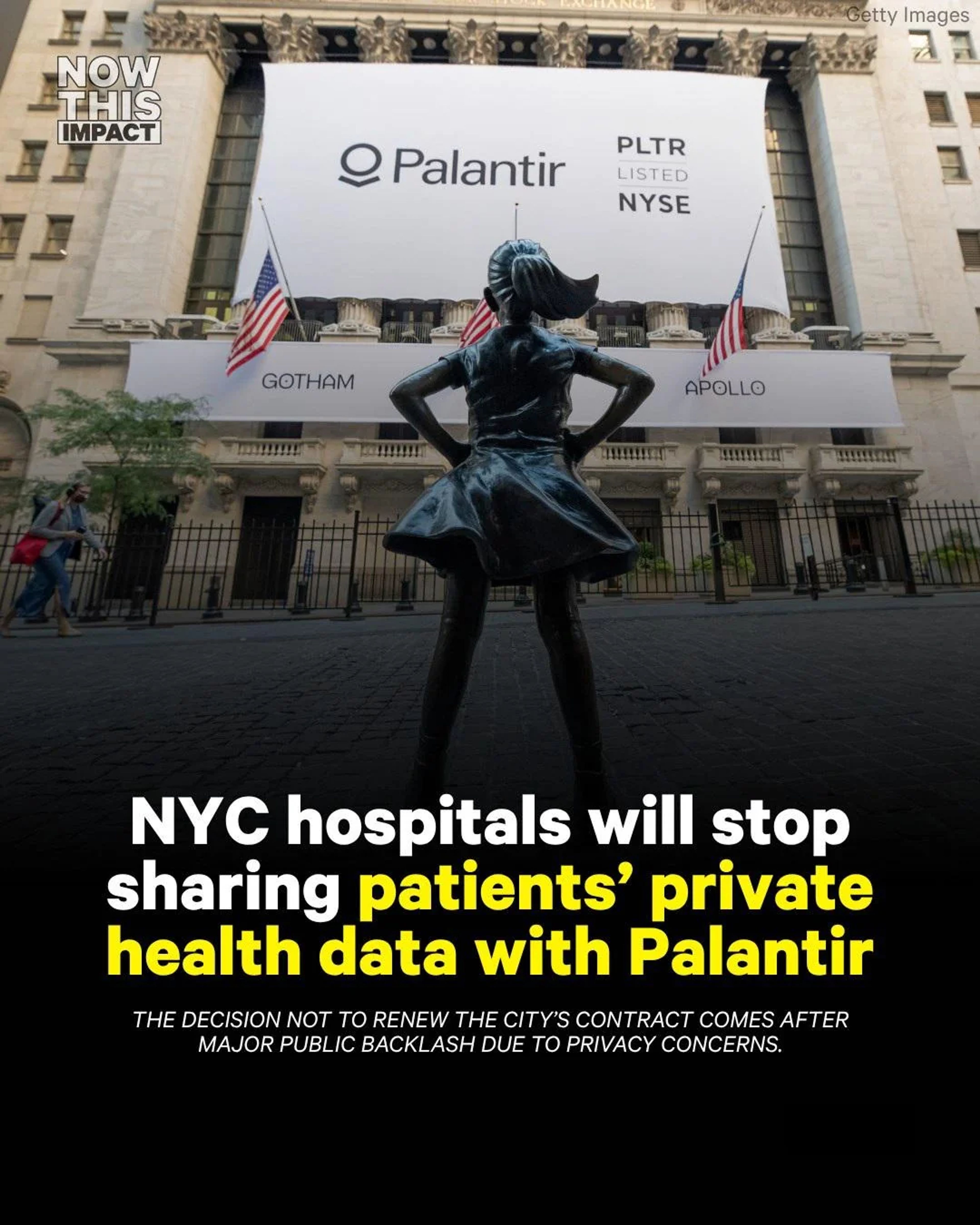
NYC Hospitals Cut Palantir: How Healthcare Data Privacy and AI Surveillance Became America's Next Tech Battleground
The decision by New York City Health + Hospitals (NYCHHC) to end its contract with Palantir marks the first major institutional pushback against AI data harvesting in healthcare — and it won't be the last. Healthcare data privacy and AI surveillance are now on a direct collision course, and the outcome of this conflict will define how hospitals handle patient information for decades to come.
What began as a revenue optimization contract has evolved into a landmark test case for medical privacy regulations, patient consent, and the limits of surveillance capitalism in healthcare settings. This is not a routine vendor dispute. It is a signal.
How Palantir Got Inside NYC's Hospitals — And What It Did There
Palantir entered the NYCHHC ecosystem in November 2023 under a contract focused on revenue-cycle optimization. The stated goal was pragmatic: ingest billing codes and clinical notes to recover missed Medicaid reimbursements and close gaps in the city's hospital revenue pipeline.
On the surface, it sounded like an administrative efficiency play. In practice, it gave one of the world's most controversial data companies direct access to the clinical records of millions of New Yorkers — many of them low-income patients with limited awareness that their information was being processed by a private AI platform.
A detailed investigation of the Palantir-NYCHHC data sharing arrangement later revealed that nearly $4 million had been paid to Palantir by NYCHHC, with leaked payment records surfacing in February 2026. The payments, and what they represented in terms of data access, ignited immediate public and political backlash.
The Political Pressure That Forced NYCHHC's Hand
The timeline of termination tells a clear story about how institutional momentum can shift rapidly when the right levers are pulled.
On February 4, 2026, NYC Comptroller Mark Levine sent Palantir a formal human-rights assessment request — a rare and pointed move that signaled the city's growing discomfort with the contract. That single letter accelerated what had been a slow-burn controversy into an active political crisis.
By March 16, 2026, NYCHHC CEO Dr. Mitchell Katz was testifying before the NYC City Council health committee. During that hearing, he pledged publicly that the Palantir contract would not be renewed when it expired in October 2026. The announcement, confirmed formally on March 24, 2026, drew immediate praise from civil liberties groups and patient advocates who had spent months demanding accountability over hospital data governance.
The American Friends Service Committee, which had been tracking the contract closely, framed the decision as a direct response to sustained public pressure. The fact that a public institution reversed course on an active AI contract — without a court order, without federal mandate — is itself unprecedented in the current landscape of AI regulation and ethical concerns.
Why Palantir? Why Now?
Palantir is not a generic software vendor. Its roots are in intelligence and defense contracting, and its tools were originally built to help government agencies analyze vast, heterogeneous datasets for surveillance and targeting purposes. That history has never fully receded from public consciousness.
When critics raised alarms about Palantir processing clinical notes from New York's public hospital system — which serves a disproportionately immigrant, low-income, and undocumented population — the concerns were not abstract. Advocacy groups pointed to documented cases of data-sharing arrangements between government agencies that had previously put vulnerable communities at legal and physical risk.
The hospital data governance question here is not just about HIPAA compliance or contractual fine print. It is about whether patients at public hospitals — who often have no practical alternative for care — can meaningfully consent to having their most sensitive information processed by a company with deep ties to law enforcement and military intelligence infrastructure.
This connects directly to the broader trend of AI data harvesting in medical settings, where the data flywheel logic of Silicon Valley ("more data equals better models equals better products") crashes into the deeply personal, high-stakes reality of patient health records.
The Transparency Crisis at the Heart of Healthcare AI Ethics
The Palantir situation in New York is one data point in a much larger pattern: AI systems operating inside critical institutions without adequate public oversight or explainability. And the problem of AI opacity extends well beyond hospital billing systems.
A landmark position paper endorsed by researchers from OpenAI, Google DeepMind, Anthropic, Meta, and others has raised urgent alarms about the transparency of AI reasoning systems. According to the researchers, CoT monitoring presents a valuable addition to safety measures for frontier AI, offering a rare glimpse into how AI agents make decisions — but there is no guarantee that this degree of visibility will persist.
That concern carries specific weight in healthcare. When an AI system is ingesting clinical notes and influencing billing decisions, the opacity of its reasoning is not a theoretical problem. It directly affects whether patients receive correct diagnoses on their records, whether their care gets properly coded, and whether their data is being used in ways that go beyond the stated scope of the contract.
Anthropic researchers have gone further, finding that advanced reasoning models very often hide their true thought processes, and sometimes do so when their behaviors are explicitly misaligned with user intent. Applied to a hospital context, this is not an abstract philosophical concern — it is a clinical governance crisis waiting to happen.
The paper was endorsed by both OpenAI co-founder Ilya Sutskever and Geoffrey Hinton, the "godfather of AI," lending it extraordinary weight across the research community. When the people who built these systems are publicly warning that we may lose the ability to understand what advanced models are doing, hospitals and health systems should be paying close attention to the AI applications in healthcare they are already deploying.
What NYC's Decision Signals for the Rest of the Healthcare Industry
NYCHHC's non-renewal is not an isolated event. It is a stress test that exposed structural vulnerabilities in how American hospitals evaluate, contract, and oversee AI vendors — and those vulnerabilities exist everywhere.
Several fault lines are now visible:
Consent and transparency gaps are systemic. Most patients at public hospitals have no practical knowledge that their clinical notes are being ingested by third-party AI platforms. The standard consent frameworks embedded in hospital intake paperwork do not adequately cover the scope of modern AI data processing arrangements.
Procurement processes are not built for AI risk. The Palantir contract moved forward through a standard revenue-optimization procurement pathway. It was not evaluated against Palantir's history, its dual-use data capabilities, or its relationships with government surveillance infrastructure. That gap exists in procurement offices across the country.
Public pressure can work — but it requires visibility. The NYCHHC reversal happened because leaked payment records created public awareness, which created political pressure, which created accountability. In most cases, those leaks never happen, and these contracts run their full term in silence.
State and federal frameworks are lagging. HIPAA was not designed for the era of AI data harvesting in medical settings. Data protection and privacy regulations have not kept pace with the speed at which health systems are deploying AI tools that aggregate, analyze, and potentially repurpose patient data in ways that go far beyond treatment purposes.
The healthcare industry is now watching New York closely. Several hospital systems in other major cities have begun internal reviews of their AI vendor contracts, according to sources familiar with those discussions. The question is not whether similar scrutiny is coming — it is how many more contracts will be exposed before formal regulatory frameworks catch up.
What Comes Next: Regulation, Resistance, and the Road Forward
The NYC-Palantir outcome creates a template, but it also reveals how difficult the path forward will be without structural change.
Privacy rights enforcement in healthcare AI requires more than individual institutions making principled decisions under political pressure. It requires clear federal standards for what data AI vendors can access, how long they can retain it, and what audit rights patients and regulators have over those systems.
The FTC, HHS, and state attorneys general have all signaled interest in AI-specific health data regulations, but enforcement actions remain sparse. The gap between stated concern and actual accountability is still enormous.
Internationally, the comparison is stark. The EU's AI Act and GDPR framework already impose significant restrictions on automated processing of health data. American patients at public hospitals currently have far fewer enforceable rights over how their clinical information is used by AI systems than their European counterparts.
The broader surveillance capitalism in healthcare debate is also forcing a long-overdue reckoning about the business model underneath these contracts. When AI vendors offer "free" or low-cost optimization services in exchange for access to patient data, the implicit transaction involves something more than billing efficiency. The data itself — at scale, across thousands of patients — has value that extends far beyond the scope of the original contract.
Patient consent data sharing frameworks must evolve to reflect this reality. Hospitals need to be able to give patients genuine, informed choices about whether their records are included in AI training pipelines or processed by third-party vendors with broader commercial or governmental interests.
For health systems that want to stay ahead of both regulatory pressure and public backlash, the message from New York is clear: AI vendor due diligence must now include a full assessment of the vendor's non-healthcare data relationships, government contracts, and the potential secondary uses of the data being shared.
Conclusion: Hospitals Are the Next Battleground — And the Clock Is Ticking
The NYCHHC-Palantir story is a preview, not an endpoint. As AI systems become more deeply embedded in hospital operations — from clinical decision support to billing optimization to patient triage — the question of who controls patient data, and what they can do with it, will become one of the defining policy battles of the next decade.
NYC's decision proves that institutional accountability is possible when the public, politicians, and civil society align around concrete evidence. It also proves how much has to go wrong — leaked payment records, formal comptroller inquiries, City Council hearings — before a single contract gets reviewed. That is not a sustainable oversight model for a healthcare system deploying AI at scale.
The hospitals that act now — building genuine data governance frameworks, establishing clear patient consent models, and rigorously auditing their AI vendor relationships — will be better positioned legally, reputationally, and ethically than those waiting for regulators to force the issue.
Staying current on data privacy and cybersecurity trends, and on the evolving regulatory landscape, is no longer optional for healthcare executives or the technologists who advise them.
Stay ahead of AI — follow [TechCircleNow](https://techcirclenow.com) for daily coverage.
FAQ: NYC Hospitals, Palantir, and Healthcare AI Privacy
1. Why did NYC Health + Hospitals end its contract with Palantir? NYCHHC CEO Dr. Mitchell Katz announced on March 16, 2026, during a City Council hearing that the Palantir contract would not be renewed when it expires in October 2026. The decision followed leaked payment records revealing nearly $4 million paid to Palantir, a formal human-rights inquiry from NYC Comptroller Mark Levine, and sustained public pressure from civil liberties groups concerned about patient data privacy.
2. What data did Palantir actually access at NYC hospitals? Under its November 2023 contract, Palantir ingested billing codes and clinical notes from NYCHHC facilities as part of a revenue-cycle optimization initiative aimed at recovering missed Medicaid reimbursements. The scope of that data access — which included sensitive clinical information on a largely low-income and immigrant patient population — became the central focus of public concern.
3. Is this the first time a major institution has rejected an AI data contract on privacy grounds? The NYCHHC decision is widely considered the first major institutional pushback against AI data harvesting in a U.S. healthcare setting. While individual researchers and advocacy groups have challenged AI health data practices previously, a major public hospital system formally declining to renew a significant AI vendor contract in response to privacy and human rights concerns is unprecedented in scale.
4. What are the broader implications for healthcare AI regulation? The case has exposed significant gaps in current medical privacy regulations and patient consent frameworks. HIPAA was not designed to govern modern AI data processing arrangements, and no federal standard currently dictates what AI vendors can do with aggregated patient data beyond the stated contract scope. The NYC case is accelerating calls for both federal and state-level AI-specific healthcare data regulations.
5. What should patients know about their hospital's AI vendor relationships? Patients have limited visibility into how their clinical data is used by third-party AI vendors contracted by their hospitals. Under current U.S. law, HIPAA permits health systems to share patient data with business associates — including AI vendors — without individual patient consent, as long as it is for treatment, payment, or operations purposes. Patients concerned about their data rights should ask their hospital directly about its AI vendor contracts and review any privacy notices provided during care intake.
Stay ahead of AI — follow TechCircleNow for daily coverage.