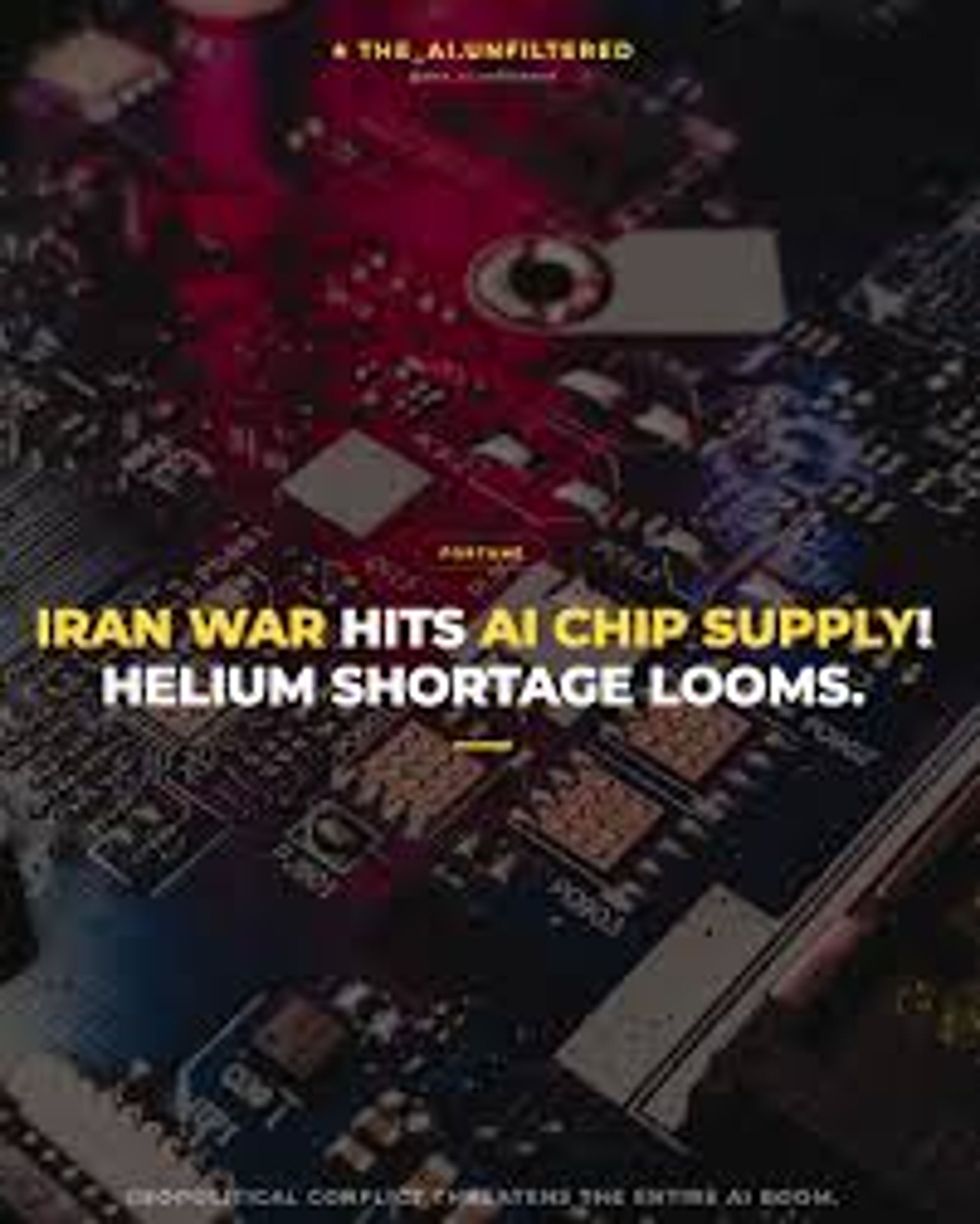
Helium Shortage AI Semiconductors: How Geopolitical War Is Quietly Strangling AI Hardware Development
The helium shortage AI semiconductors depend on has become one of the most underreported supply chain crises of 2026. While mainstream coverage fixates on AI model capabilities and GPU availability, a quieter catastrophe is unfolding in the physical infrastructure that makes AI possible — and geopolitical conflict is at the center of it.
Most industry analysts are missing the supply chain angle entirely. This piece connects the dots: why helium is irreplaceable in chip manufacturing and data center cooling, which AI labs face the most exposure from Iran-region tensions, and what — if anything — the industry can do about it.
For a deeper look at how physical constraints are reshaping the AI industry, the global helium supply chain crisis analysis provides essential context that most tech publications haven't caught up to yet.
Why Helium Is Non-Negotiable for AI Chip Manufacturing
Helium isn't a luxury input in semiconductor fabrication — it's a fundamental process gas with no readily available substitute at scale.
In chip manufacturing, helium plays several roles that engineers cannot simply engineer around. It serves as a carrier gas in chemical vapor deposition (CVD), cools optical systems in lithography equipment, and is used to pressurize and purge systems where even trace contamination would ruin wafers worth tens of thousands of dollars. Its extremely low boiling point — minus 269 degrees Celsius — makes it the only practical choice for cryogenic cooling helium applications in superconducting systems and quantum-adjacent hardware.
For AI infrastructure specifically, the dependency runs deeper than raw chip fabrication. High-capacity helium-sealed hard drives are the backbone of the massive storage requirements that large-scale AI training and inference workloads demand. Without them, data centers simply cannot hold the volumes of training data that frontier AI development requires.
Understanding this dependency is critical for anyone tracking semiconductor manufacturing and AI chip production over the next 18 to 24 months. The bottleneck isn't just compute — it's the gas keeping that compute alive.
The Geopolitical Trigger: Iran, Qatar, and the Collapse of One-Third of Global Supply
The Iran war just exposed America's hidden AI chokepoint, and helium is it. According to analysis of geopolitical impacts on helium and AI infrastructure, Middle East conflicts have directly damaged Qatar's Ras Laffan LNG facility — one of the world's largest helium production complexes.
The consequences are stark. Ras Laffan's disruption removes approximately one-third of the global helium supply from the market in a single geopolitical event. That's not a marginal disruption — it's a structural shock to a supply chain that was already operating with thin buffers.
Global helium production reached around 190 million cubic meters in 2025, with the United States accounting for roughly 81 million cubic meters — approximately 43% of world output. But U.S. production alone cannot compensate for the sudden removal of Qatar's contribution. The physics of helium extraction and liquefaction don't allow for rapid capacity scaling, and new production facilities require years of capital investment and permitting.
Persian Gulf war constraints on helium supplies are now stressing the hi-tech industry in ways that extend far beyond headline price increases. The Iran helium supply AI dependency chain runs through Asian manufacturing hubs particularly hard — Taiwan, South Korea, and Japan all rely on imported helium for their foundry and memory chip operations that feed directly into AI hardware build-outs.
Hard Drives, Data Centers, and the AI Chip Cooling Crisis
The AI chip cooling crisis triggered by helium shortages is already showing up in enterprise hardware procurement in concrete, measurable ways.
Seagate and Western Digital — the two dominant providers of high-capacity helium-sealed hard drives for enterprise data centers — are reportedly showing empty order books for 2026 delivery slots. These aren't speculative projections. These are the storage systems that hyperscalers and AI labs use to house training datasets, checkpoint models, and inference caches at scale.
When storage availability tightens, AI infrastructure scaling timelines slip. It's not just about raw storage capacity — it's about the cost, latency, and reliability characteristics that only high-capacity helium-sealed drives currently provide at enterprise scale. Flash alternatives exist but come with prohibitive cost penalties at the petabyte scale that frontier AI training demands.
The compounding problem is that the AI chip cooling crisis isn't isolated to storage. Cryogenic cooling helium is also critical for testing superconducting interconnects and quantum error correction hardware that next-generation AI accelerators increasingly incorporate. Multiple failure points are converging simultaneously across the AI infrastructure development and market growth timeline.
Red Sea Shipping Chaos: Compounding the Geopolitical AI Supply Chain Shock
The helium production crisis doesn't exist in isolation. A second geopolitical supply shock is hitting AI hardware supply chains from a different direction — and the two are combining to create a compound disruption that procurement teams weren't modeling for.
Hardware shipping delays from Red Sea conflicts have reached up to 15 days for routes that previously ran on predictable schedules. Marine war risk insurance premiums for Red Sea routes increased 50 times compared to pre-conflict baselines. That cost increase doesn't disappear — it passes through to every piece of AI hardware shipped from Asian manufacturing centers to U.S. and European data center operators.
The result is a geopolitical AI supply chain problem with two independent failure modes. Even if helium supply were restored tomorrow, the shipping disruption would continue to delay hardware delivery and inflate procurement costs. Even if Red Sea routes normalized, the helium shortage would continue to constrain what hardware can actually be built.
For a broader look at how these disruptions intersect with tech industry supply chain disruptions across sectors, the pattern is consistent: geopolitical conflict is revealing structural fragilities that were invisible during the period of globalization stability.
AI labs most exposed to this dual shock are those operating aggressive hardware expansion timelines with limited inventory buffers — particularly second-tier cloud providers and national AI initiatives in Europe and Southeast Asia that lack the procurement leverage of hyperscalers like Microsoft, Google, and Amazon.
Alternative Cooling Solutions: What the Industry Is Actually Testing
The obvious question is whether the AI industry can engineer its way out of a helium dependency. The honest answer: partially, eventually, but not at the speed the current crisis demands.
Several alternative cooling technology approaches are under active development and deployment. Immersion cooling — submerging server hardware in dielectric fluid — eliminates the need for helium in the cooling loop entirely and can handle the thermal density of modern AI accelerator clusters. Companies like Submer, LiquidStack, and GRC have working deployments at scale, and hyperscalers are accelerating adoption.
Direct liquid cooling (DLC), which routes coolant directly to chip heat spreaders, is being adopted rapidly in new data center builds. Neither immersion nor DLC requires helium, and both outperform traditional air cooling for the thermal load profiles of GPU and TPU clusters running continuous AI workloads.
The harder problem is the storage layer. No current alternative to helium-sealed drives offers equivalent cost-per-terabyte performance for cold and warm storage at the scale AI training requires. All-flash alternatives are thermally and electrically efficient but roughly four to five times more expensive per raw terabyte. That cost delta matters enormously when you're building storage infrastructure at petabyte or exabyte scale.
Emerging technologies like heat-assisted magnetic recording (HAMR) may eventually enable helium-free high-density drives, but these are not ready for mass deployment in 2026. The semiconductor manufacturing supply chain for HAMR components is itself subject to many of the same geopolitical supply shocks affecting helium.
Strategic Implications: Which AI Labs Are Most Exposed?
Not all AI infrastructure operators carry equal exposure to the helium shortage AI semiconductors crisis. Understanding the risk distribution matters for investors, enterprise buyers, and policymakers watching AI infrastructure scaling timelines.
Hyperscalers with massive procurement leverage — Google, Microsoft, Amazon, and Meta — have the capacity to lock in helium supply contracts, hold larger strategic inventories, and absorb cost increases that would be existential for smaller operators. They're not immune, but they have buffers.
Mid-tier cloud providers and hardware-as-a-service companies operating on thinner margins are far more exposed. A sustained 30-40% reduction in helium availability translates directly into an inability to fulfill data center build commitments, which delays customer migration to AI-enabled infrastructure.
National AI programs present a specific exposure category. Countries that have announced aggressive AI infrastructure investments — France's sovereign AI data center program, the UAE's AI hub ambitions, India's public compute initiative — are often procuring hardware through channels that have less supply chain resilience than U.S. hyperscaler procurement operations.
The geopolitical AI supply chain dimension also creates regulatory pressure points that are beginning to emerge. Governments are starting to classify helium as a strategic material in the same category as rare earth elements. Tracking the policy response requires watching geopolitical supply chain regulation closely — export controls and strategic reserve programs are likely to follow.
The fundamental tension is this: AI development is racing forward on a timeline defined by model capability benchmarks and competitive pressure. But the physical infrastructure that AI runs on is governed by geology, geopolitics, and the hard physics of chemical supply chains that don't bend to software release schedules.
Conclusion: The Hidden Variable Nobody Is Watching Closely Enough
The helium shortage AI semiconductors crisis is a case study in how AI infrastructure constraints can emerge from entirely unexpected directions. The industry's attention is fixed on GPU availability, energy costs, and model training efficiency. Meanwhile, a noble gas used in quantities measured in cubic meters per chip is becoming one of the most consequential bottlenecks in the global AI build-out.
The editorial thesis of this piece is deliberately uncomfortable: most technology coverage — including most AI industry coverage — systematically underweights physical supply chain risk in favor of software and capability narratives. Helium isn't a metaphor. It's a literal gas that must flow through literal pipes to literal facilities to make the hardware that runs every AI system in production today.
The geopolitical supply shocks from the Iran-region conflict and Red Sea disruptions have collided with an already-tight helium market to create a compounding constraint that will affect AI infrastructure scaling timelines in 2026 and likely into 2027. The alternative cooling solutions that exist are real but insufficient for the storage layer. The AI labs most exposed are those with the least procurement leverage and the most aggressive expansion commitments.
The industry needs to treat helium supply with the same strategic seriousness it gives to GPU allocation. Until it does, every AI scaling roadmap is operating with an unacknowledged single point of failure.
Stay ahead of AI — follow TechCircleNow for daily coverage.
Frequently Asked Questions
Q1: Why is helium specifically required for semiconductor manufacturing?
Helium's unique physical properties — including its extremely low boiling point, chemical inertness, and high thermal conductivity — make it irreplaceable for specific steps in chip fabrication. It's used as a carrier gas in deposition processes, a coolant in lithography systems, and a purge gas in environments where contamination would destroy wafers. No other element combines all these properties at a practical scale.
Q2: How much of the global helium supply has been disrupted by Middle East conflicts?
Damage to Qatar's Ras Laffan LNG facility — where helium is extracted as a byproduct of natural gas processing — has removed approximately one-third of global helium supply. Given that global production was approximately 190 million cubic meters in 2025, this represents a significant structural shock that U.S. production at 81 million cubic meters cannot fully offset.
Q3: Which AI companies are most at risk from the helium shortage?
Mid-tier cloud providers, hardware-as-a-service operators, and national AI programs in Europe and Asia face the greatest exposure. They lack the procurement leverage, strategic inventory depth, and supplier relationship access that hyperscalers like Google, Microsoft, Amazon, and Meta use to buffer supply shocks. Second-tier providers with aggressive expansion commitments and thin margins are particularly vulnerable.
Q4: Are there viable alternatives to helium for cooling AI data centers?
For server cooling, yes — immersion cooling and direct liquid cooling are mature alternatives that eliminate helium from the thermal management loop. The harder problem is storage: high-capacity helium-sealed hard drives used for AI training data storage have no cost-competitive alternative at scale. All-flash options are four to five times more expensive per terabyte, which is prohibitive at exabyte scale.
Q5: How long could the helium shortage impact AI hardware development?
New helium production facilities require years of planning, permitting, and capital investment — they cannot be spun up quickly in response to price signals. If Ras Laffan disruption continues and no other major production source comes online rapidly, the supply constraint is likely to affect AI infrastructure scaling timelines through 2026 and into 2027. The Red Sea shipping disruption compounds this by adding cost and delay to hardware that does get manufactured.