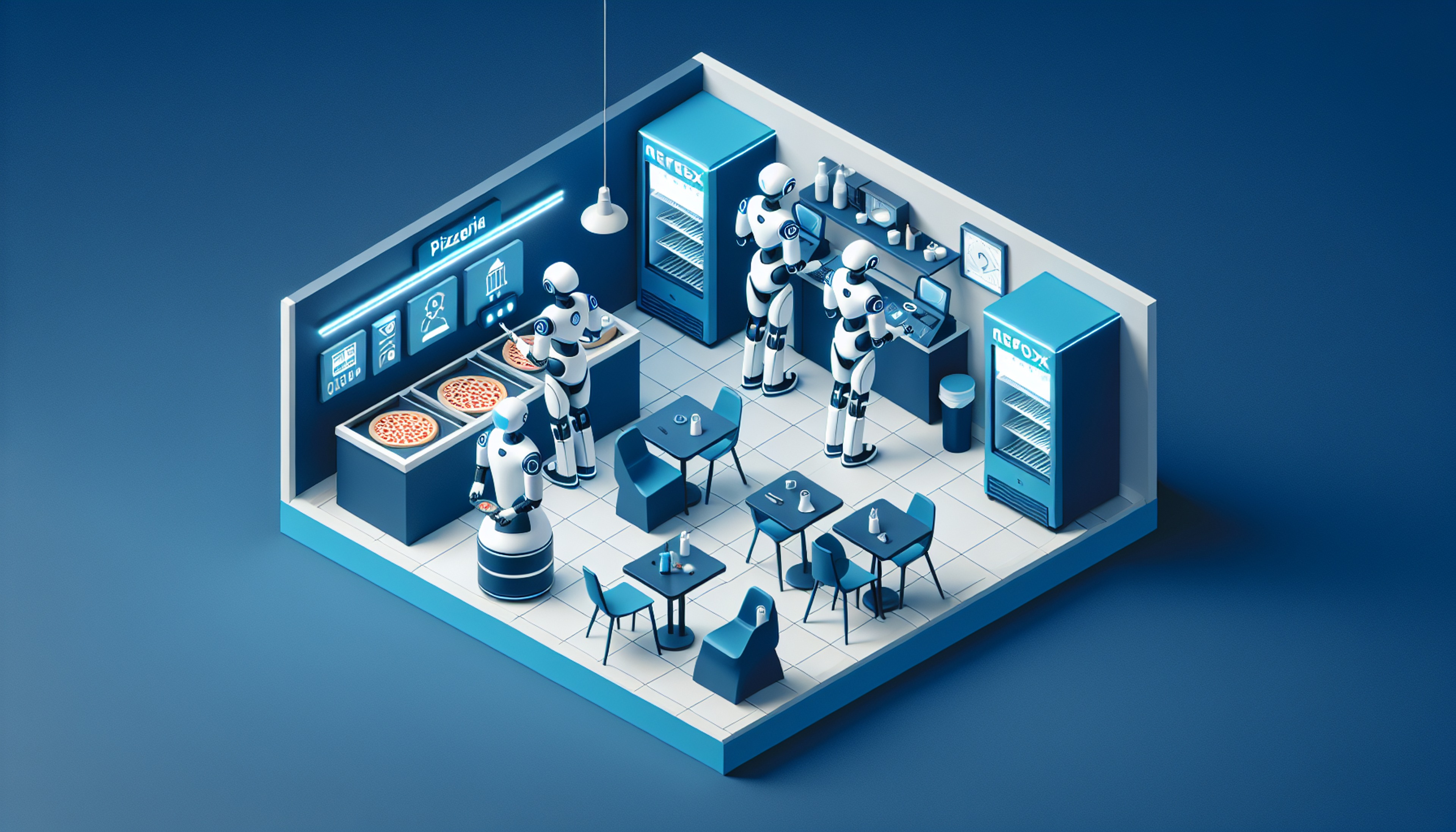
Humanoid Robots Workplace Deployment 2026: Why a Pizza Shift and an Amazon Acquisition Matter More Than Any Viral Demo
Humanoid robots workplace deployment in 2026 has a perception problem. Most coverage fixates on backflipping machines and viral obstacle courses — spectacle engineered for funding rounds, not factory floors. But two quieter stories that landed this week tell us far more about where this industry is actually heading: a company called Reflex Robotics just put a humanoid through a live pizza shift, and Amazon quietly absorbed Fauna Robotics, a startup purpose-built for safe, compliant collaboration alongside human warehouse workers.
Neither story involves a robot doing a cartwheel. Both stories signal that the unglamorous, commercially serious phase of humanoid robotics has begun. These aren't demos anymore. These are coworkers — and understanding the difference matters enormously, for business strategy, labor economics, and the future of work itself. These developments sit squarely within the broader workplace automation trends reshaping how we work, and they deserve the serious analysis that flashier stories routinely steal.
From Demo Floor to Dough Floor: What Reflex Robotics Actually Did in That Pizzeria
Reflex Robotics didn't send a robot to a trade show. They sent one to work a pizza shift.
The commercial humanoid robot handled real-world kitchen tasks in an operational restaurant environment — not a controlled lab, not a curated press event. The significance of that distinction cannot be overstated in an industry where "we have a working prototype" has historically meant "we have a working prototype in our building, with our engineers standing three feet away."
Restaurant environments are genuinely hostile to robots. They're hot, cramped, unpredictably staffed, and filled with the kind of edge-case chaos — a dropped tray, a wet floor, an unexpected rush — that demolishes brittle automation. The fact that a humanoid navigated that environment during an actual service period suggests Reflex has crossed a threshold that many better-funded competitors haven't.
The service industry robotics space has seen plenty of false starts. Burger-flipping robots, automated kiosks, delivery bots — most have solved one narrow problem while creating friction everywhere else. A humanoid form factor theoretically solves the integration problem: a robot shaped like a human can use tools, spaces, and workflows designed for humans, without expensive retrofitting of the environment itself.
That's the commercial proposition Reflex is testing. And a live pizza shift is more convincing evidence than a thousand press releases.
Amazon's Fauna Robotics Acquisition: Safe Collaboration Is the Whole Point
Amazon acquiring robotics companies is not news. Amazon acquiring this particular kind of robotics company is.
Fauna Robotics was not building the fastest warehouse robot or the strongest one. They were building a compliant robot — one engineered specifically to operate safely in physical proximity to human workers. That design priority reflects a hard lesson from two decades of warehouse automation: pure speed creates dangerous environments, and workers and rigid industrial robots occupying the same space is a liability problem that has slowed adoption across the sector.
Amazon warehouse automation has already reshaped logistics globally. The company operates more than 750,000 robots across its fulfillment network. But most of those systems operate in segregated zones — humans on one side of a fence, robots on the other. Fauna's technology dissolves that boundary by making the robot safe enough to work next to a person, not just near them.
This is where Amazon's Fauna Robotics acquisition in the context of big tech M&A becomes a strategic inflection point rather than a routine bolt-on. Amazon isn't just adding robot units to its fleet. It's acquiring the capability to redeploy humans and machines in genuinely integrated workflows — which unlocks a new tier of operational flexibility that purely segregated automation cannot offer.
Compliant robot design is technically demanding. It requires force-sensing, real-time environmental modeling, and physical structures that yield safely under unexpected contact. Fauna apparently cracked enough of that problem to attract Amazon's attention. That's a meaningful signal about where the frontier of practical warehouse robotics actually sits.
The Market Numbers Behind the Momentum
The Reflex and Fauna stories don't exist in isolation. They're data points in a much larger curve.
The global humanoid robot market forecast of $29.5 billion by 2036, per IDTechEx analysis, reflects projected scaling that begins in automotive manufacturing and logistics — exactly the environments these two stories represent. That's not a moonshot projection; it's a relatively conservative extrapolation from deployment trajectories already visible in early 2026.
Deloitte's physical AI analysis projects 2 million humanoid robots in workplaces by 2035, rising to 300 million by 2050, with a total addressable market of $30–50 billion by mid-decade. Critically, those projections are demand-driven, not technology-driven — meaning the limiting factor isn't whether we can build the robots, but whether deployment environments are ready to absorb them.
By early 2026, approximately 16,000 humanoid robot units had been installed in real workplaces worldwide. That's a small number relative to the projections, but it's the number that matters most — because it represents the shift from prototype to production. Every unit in that count is generating operational data, failure modes, and institutional knowledge that accelerates the next wave of deployment.
The economic logic is stark. Workplace humanoid robots are achieving ROI within 12 to 24 months, operating at an effective cost of $3–8 per hour equivalent versus $22–40 or more for human labor in high-wage markets, while running 20-plus hours daily. For operators in the restaurant and logistics sectors — where labor costs are existential — those numbers are not abstract. They're a business case.
The Labor Displacement Conversation We Keep Avoiding
Here's where honest journalism requires acknowledging the uncomfortable subtext.
A global shortage of nearly 8 million manufacturing workers is projected by 2030. That figure is real and is driving genuine urgency in humanoid adoption — not because companies are malicious, but because the labor simply won't exist to fill those roles at current wage structures. Humanoid robots in warehouses and restaurants are, in part, a structural response to a structural shortage.
But "labor shortage" and "labor displacement" aren't mutually exclusive. The workers who do exist in these sectors — and who depend on these jobs — face a genuinely uncertain transition. The pizza kitchen might need fewer people during a Reflex Robotics deployment. The Amazon warehouse might restructure workflows in ways that reduce headcount even as it improves safety for those who remain.
AI advances driving physical robotics and automation are accelerating this dynamic in ways that outpace policy responses. Sam Altman has said plainly: "We see the wave coming. Now this time next year, every company has to implement it — not even have a strategy. Implement it." That framing — implement, not pilot, not evaluate — describes the pace at which commercial pressures are now moving.
Dario Amodei offers a counterweight worth considering: "The future of AI is about alignment — making these tools truly beneficial at every level." The question of whether humanoid robot deployment is beneficial at every level — including for the worker whose shift it's replacing — is not one the industry has answered satisfactorily. It's not a reason to stop the technology. It is a reason to think hard about the policy environment surrounding it.
Stanford HAI researchers have cautioned that many companies will report AI hasn't yet delivered broad productivity increases — except in targeted areas. That nuance matters here: a humanoid robot working a pizza shift is a targeted deployment, not evidence of economy-wide productivity transformation. The gap between a successful pilot and systemic impact is where most technological transitions stall or stumble.
Why Compliant, Human-Safe Design Is the Actual Frontier
Most public discourse about humanoid robots is captured by capability metrics: how fast, how strong, how dexterous. Fauna Robotics' acquisition by Amazon recenters the conversation on a different question — how safe.
Safe collaborative robotics is not a soft engineering problem. It's an extraordinarily hard one. A robot that's safe enough to work alongside a human in an unscripted environment needs to model human intent, predict movement, yield appropriately under contact, and recover gracefully from unexpected physical interaction. It needs to do all of that in real time, reliably, without failure modes that turn a coworker into a hazard.
This is precisely where UC Berkeley's Nicole Holliday adds a useful caution: "I'm expecting that, in spite of the commercial pressures, we will realize that there is no such thing as general intelligence, artificial or natural." The robots being deployed today — including whatever Fauna built — are not generally intelligent. They are very good at specific tasks in constrained environments. That's not a bug; that's exactly what makes them deployable. General intelligence would actually make them less predictable and less safe in production settings.
The commercial humanoid robots that win in the next five years will likely be the ones that do fewer things more reliably, not the ones that attempt to replicate the full range of human cognitive and physical capability. Reflex Robotics apparently understood that when they designed for the kitchen. Fauna apparently understood it when they designed for the warehouse floor. Both represent a maturation of ambition that the field desperately needed.
What Comes Next: Reading the Signals Correctly
Neither the Reflex Robotics restaurant pilot nor the Amazon Fauna acquisition is a revolution on its own. Together, they're something more significant: independent confirmation that the commercial conditions for humanoid workplace deployment are crystallizing simultaneously across two very different sectors.
Restaurants and logistics warehouses share critical characteristics. Both involve repetitive physical tasks. Both have high labor costs relative to margins. Both have environments that, while messy, are ultimately structured enough for current robotic capabilities. Both are sectors where 24-hour operation creates compounding value that human-only staffing models structurally cannot match.
The sectors that come after — healthcare, construction, retail — are harder. They involve more variability, more human interaction, and higher stakes for failure. The long-term predictions for robotics and AI in the workplace that reach beyond 2030 require sustained progress on exactly the compliant, adaptive, human-safe capabilities that Fauna was building. Amazon just bought the time to figure that out at scale, with the operational data only Amazon can generate.
That's the story. Not a robot doing a backflip. A robot making your pizza while you wait, and another one working next to a human warehouse employee without anyone getting hurt. That is what the inflection point actually looks like — and it looks far less dramatic than the demos, while being far more consequential.
The UC Berkeley AI experts are watching in 2026 for exactly this gap between performance and genuine generalization. Their skepticism about artificial general intelligence should not be read as skepticism about robots at work — it should be read as a call for precision about what these machines actually are and what they're actually doing. Narrow, reliable, physically safe robots doing specific jobs well: that's not a limitation of the technology. That's the technology working.
Conclusion: The Boring Story Is the Real Story
Humanoid robot coverage will keep chasing the spectacular. That's what gets clicks, funding rounds, and TED talks. But the genuine inflection point in humanoid robots' workplace deployment in 2026 isn't spectacular. It's a robot covering a dinner rush and an acquisition designed to make warehouse collaboration safer.
Those are the stories that will matter in five years, when the market has scaled, the labor economics have reshuffled, and the next wave of industries is deciding whether to adopt. The foundation being laid right now — in pizza kitchens and fulfillment centers — will determine how quickly and how safely that scaling happens.
Pay attention to the boring stories. They're where the future is being built.
Follow TechCircleNow.com for daily coverage of AI, robotics, and the technology shaping how we work. Our team tracks commercial deployments, acquisitions, and workforce impacts across every sector — so you can make informed decisions before the headlines catch up.
Frequently Asked Questions
1. What is Reflex Robotics and what did they do in a pizzeria? Reflex Robotics is a humanoid robot startup that recently deployed one of its commercial robots to work an actual pizza shift in an operational restaurant environment. Unlike lab demonstrations, this pilot involved real kitchen conditions, unpredictable variables, and live service — marking a significant step toward practical service industry robotics deployment.
2. Why did Amazon acquire Fauna Robotics? Amazon acquired Fauna Robotics primarily for its compliant, human-safe robot design — technology engineered to work directly alongside human workers rather than in segregated zones. This acquisition gives Amazon the capability to build genuinely integrated human-robot workflows in its warehouses, expanding beyond the fenced-off automation models that define most current warehouse robotics.
3. How big is the humanoid robot market expected to get? According to IDTechEx, the global humanoid robot market is forecast to reach $29.5 billion by 2036. Deloitte projects 2 million humanoid robots in workplaces by 2035, rising to 300 million by 2050, with a total addressable market of $30–50 billion by mid-decade. These figures are largely demand-driven, reflecting labor shortages and cost economics rather than purely technological push.
4. Will humanoid robots displace human workers in restaurants and warehouses? The relationship between robot deployment and human employment is complex. A projected global shortage of nearly 8 million manufacturing workers by 2030 is partly driving adoption — robots are filling roles that may lack human applicants. However, displacement in sectors where labor does exist is a real concern. Current deployments are targeted rather than wholesale replacements, but the pace of scaling makes thoughtful labor policy increasingly urgent.
5. What makes "compliant" robot design different from standard warehouse robots? Compliant robots are specifically engineered to operate safely in physical proximity to humans. They incorporate force-sensing, real-time environmental awareness, and physical structures designed to yield safely under unexpected contact. This is technically much harder than building fast or strong robots — and it's the design approach that enables human-robot collaboration rather than the segregated, fenced-off automation that currently dominates warehouse environments.
Stay ahead of AI — follow TechCircleNow for daily coverage.