Chinese AI Companies Faster, Cheaper, and More Open: How DeepSeek, Qwen, and China's Open-Source Wave Are Outpacing Western AI Development
Chinese AI companies are moving faster and spending less than anyone in Silicon Valley predicted. The rise of DeepSeek, Qwen, and a wave of open-weight models from Chinese labs represents more than a technical achievement — it's a structural competitive advantage built on infrastructure, talent concentration, regulatory arbitrage, and open-source momentum that is eroding Western AI moats faster than the industry anticipated.
This isn't a story about one impressive benchmark. It's a story about systemic speed — and what happens when the world's largest tech ecosystem decides to operate without the constraints that slow everyone else down. For context on how this fits into the broader transformation underway, see our coverage of the latest AI trends and market growth reshaping the global technology landscape.
The Numbers Don't Lie: China's Open-Source Models Are Capturing Global Usage at Warp Speed
The most striking data point in the current AI competitive landscape isn't a benchmark score — it's raw adoption velocity. According to global AI usage statistics from SCMP analysis, China's open-source AI models now account for nearly 30% of total global AI usage by token volume in 2025 — a surge from just 1.2% in late 2024.
That's not a gradual climb. That's a near-vertical trajectory.
Chinese open-source LLMs also averaged 13% of weekly global token volume throughout 2025, nearly matching the 13.7% generated by the rest of the world outside the US and China combined. The acceleration intensified in the second half of 2025, suggesting the momentum isn't slowing — it's compounding.
Proprietary Western models still hold 70% of global AI usage. But the direction of travel is unambiguous, and the speed of market share erosion should alarm anyone inside OpenAI, Anthropic, or Google DeepMind.
Shipping Velocity: How Chinese Labs Are Releasing Models in Months, Not Years
Innovation velocity comparison is where China's advantage becomes most concrete. The release cadence from Chinese labs over the past 18 months has been relentless.
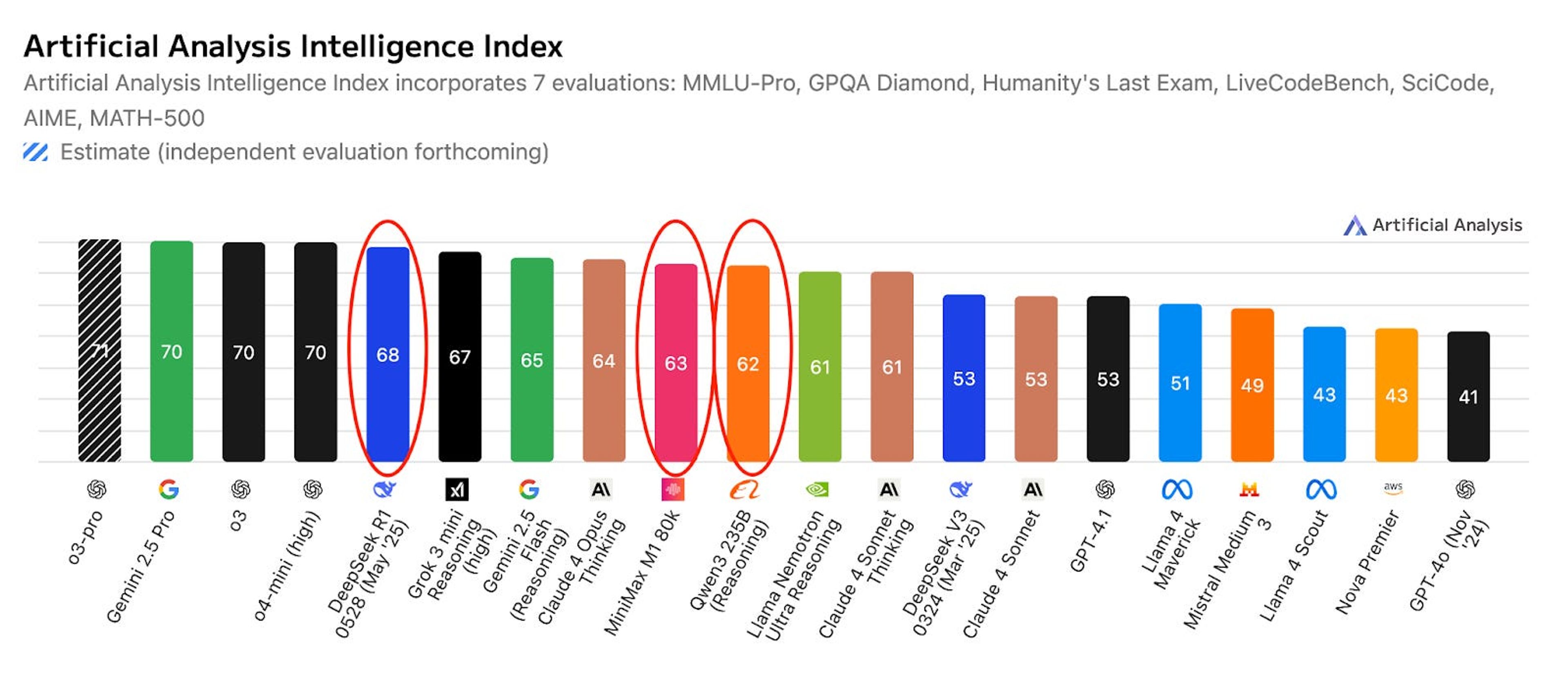
According to arXiv research on Chinese AI model releases, DeepSeek V3 shipped in December 2024. Alibaba followed with Qwen 2.5 Max in January 2025, then Qwen3 235B in April 2025. The Understanding AI intelligence index benchmarks confirm that Qwen3 235B achieved an Intelligence Index of 57, positioning it as one of the leading open-weight model families globally — matching much of the US open ecosystem.
DeepSeek R1 arrived in January 2026, just four months after OpenAI's o1 reasoning model announcement. It briefly surpassed ChatGPT as the top iOS App Store app globally — an event that triggered what analysts are calling a "Chinese open-weight renaissance."
That four-month gap matters. Western labs often take 12–18 months between major model generations. Chinese labs are iterating on a quarterly cycle. This isn't coincidence — it reflects deliberate organizational design, streamlined decision-making, and a willingness to ship and iterate publicly rather than polish behind closed doors.
The competitive threat assessment for Western AI developers is straightforward: when your competitor ships four major models in the time you ship one, the capability gap closes faster than any compute advantage can compensate for.
Cost Efficiency as Competitive Weapon: The 70% Compute Reduction Advantage
Speed alone wouldn't be decisive if it came at unsustainable cost. But Chinese AI companies, particularly Alibaba, have weaponized cost efficiency AI development to an extraordinary degree.
Alibaba's Mixture-of-Experts (MoE) architecture underlying Qwen reduces compute costs by 70% compared to dense models like GPT-4. This isn't a marginal operational improvement — it's a structural pricing advantage that changes the economics of AI deployment at scale.
Dense transformer models activate all parameters for every inference call. MoE architectures route inputs through only a subset of specialized "expert" layers, dramatically reducing the compute load per query while preserving — or even enhancing — output quality. Alibaba's engineers identified this efficiency frontier early and built their entire model stack around it.
The downstream implications are significant. Lower inference costs mean more aggressive API pricing. More aggressive pricing means faster developer adoption. Faster adoption means more training signal and community feedback. The flywheel accelerates.
DeepSeek employed similar efficiency innovations in its training pipeline, reportedly training high-performance models at a fraction of the hardware cost of comparable Western systems. In an environment where US export controls have restricted China's access to cutting-edge Nvidia GPUs, this forced optimization may have created a durable efficiency advantage rather than just a workaround.
Regulatory Arbitrage and the Open-Source Strategy
One of the most under-analyzed elements of China's AI speed advantage is regulatory arbitrage advantage. Chinese AI labs operate under a different regulatory constraint set than their Western counterparts — and in several critical ways, this accelerates development cycles.
Western labs face increasing pressure from the EU AI Act, emerging US federal AI governance frameworks, and internal safety review processes that can add months to model deployment timelines. China has its own AI regulation regime, but it is structured differently — focused primarily on content controls and national security alignment rather than the pre-deployment capability evaluations that slow Western releases. Our analysis of AI regulation and government policies in 2025 covers how these divergent frameworks are reshaping competitive dynamics globally.
The open-source strategy amplifies this advantage in a counterintuitive way. By releasing weights publicly, Chinese labs avoid being the primary point of accountability for downstream use — while simultaneously maximizing global adoption. Developers worldwide integrate Qwen and DeepSeek into their products, creating a distributed network of deployment that Western proprietary vendors simply cannot match through closed APIs alone.
Open-source release also accelerates external research contribution. When thousands of researchers worldwide fine-tune, benchmark, and build on your model architecture, you receive the equivalent of a massively distributed R&D team working for free. This community compounding effect is something Western open-source efforts like Meta's Llama have benefited from — but Chinese labs have now joined this game at scale.
For developers evaluating open-source AI models and LLM alternatives, the practical implication is clear: the open-weight ecosystem is no longer a US-only conversation.
Talent Concentration in Asia: The Human Capital Dimension
The geopolitical AI development race is often framed as a chip war or a compute war. It's also a talent war — and China's position is stronger than Western media coverage typically acknowledges.
Talent concentration Asia is a long-term structural advantage. China graduates more STEM PhDs annually than any country in the world. Domestic AI research publication output has grown dramatically, with Chinese institutions consistently appearing in top-tier venues like NeurIPS, ICML, and ICLR. The assumption that top Chinese AI researchers inevitably migrate to US labs is increasingly outdated.
Several factors are driving talent retention. Compensation at top Chinese AI labs — Alibaba DAMO Academy, Baidu Research, Zhipu AI, and DeepSeek — has become globally competitive. The domestic market opportunity is enormous. And visa uncertainty in the US has made the career calculus more complex for researchers who might previously have defaulted to Silicon Valley.
The result is a deep domestic talent pool building in parallel to Western AI development. This isn't a catching-up story anymore — it's a parallel-track story with different constraints, different incentives, and increasingly comparable output quality.
Among the emerging AI startups reshaping the landscape globally, Chinese AI companies represent some of the most aggressive growth trajectories, backed by domestic capital and government alignment that US venture-backed startups cannot easily replicate.
What the West Gets Wrong: Underestimating Iteration Speed Over Peak Capability
The Western AI industry has a consistent analytical failure mode: evaluating Chinese AI by peak benchmark performance rather than by iteration rate. A model that scores 10% lower on MMLU but ships every 90 days will, over an 18-month horizon, outperform a higher-scoring model that ships every 12 months — because the faster model accumulates more real-world feedback, more developer integrations, and more improvement cycles.
China AI competitive advantage development speed is not primarily about any single model. It's about the compounding effect of faster cycles applied consistently over time.
DeepSeek's rise from niche research project to global App Store chart-topper in under 24 months is the clearest illustration of this principle. Qwen's expansion from a Chinese-market model to a globally deployed open-weight family — with competitive intelligence index scores — demonstrates that the quality ceiling is rising with each iteration.
The open-source competition dimension matters for Western AI companies in a specific way: open models commoditize capabilities. When DeepSeek releases a reasoning model four months after OpenAI, and makes it freely downloadable, it compresses the commercial window during which OpenAI can charge premium prices for exclusive access to that capability. The moat shrinks. The economic model strains.
Western AI companies have responded with their own open-weight releases — Meta's Llama series being the most prominent — but the competitive dynamic has fundamentally shifted. Open-source AI Western competition is no longer a Western-dominated conversation. It's a global one, and China is currently setting the pace.
Conclusion: The Structural Shift Is Already Happening
The evidence is now too consistent to dismiss as outliers or temporary surges. Chinese AI companies — led by DeepSeek and Alibaba's Qwen team — have built a genuine, structural advantage in development speed, cost efficiency, open-source distribution, and talent depth.
The 30% global token volume share achieved in roughly 12 months is not a number that reverts easily. Developer ecosystems, once built around a model architecture, generate switching costs. Community momentum, once established around an open-weight model family, compounds. The infrastructure, talent, and regulatory arbitrage advantages that power Chinese AI labs are not temporary conditions — they are durable features of the competitive landscape.
Western AI companies still hold advantages in frontier model capability, established enterprise relationships, and access to the most advanced semiconductor hardware. But each of those advantages faces pressure. Export controls accelerate Chinese efficiency optimization. Enterprise relationships erode when open-source alternatives offer 70% lower compute costs. Frontier capability gaps narrow with every quarterly Chinese model release cycle.
This is not a prediction of Western AI collapse. It is an observation that the competitive map has been redrawn — and that the redrawing is accelerating. The companies, investors, and policymakers who recognize this structural shift now will be better positioned than those still operating on 2022 assumptions about who leads global AI development.
For ongoing analysis of these competitive dynamics, including the latest model releases, benchmark comparisons, and policy responses, [TechCircleNow.com](https://techcirclenow.com) is your authoritative source for daily AI and tech intelligence.
Frequently Asked Questions
1. Why are Chinese AI companies like DeepSeek and Qwen releasing models faster than Western competitors?
Chinese labs operate with streamlined internal decision-making processes, aggressive iteration cultures, and a public-first release philosophy. Combined with domestic regulatory frameworks that do not require extended pre-deployment safety evaluations comparable to emerging Western standards, this allows quarterly model releases rather than annual ones. The competitive pressure within China's domestic AI market also pushes labs to ship rather than polish indefinitely.
2. How significant is the 70% compute cost reduction from Alibaba's Qwen MoE architecture?
It is highly significant for commercial deployment. A 70% reduction in compute costs per inference translates directly into lower API pricing, higher margins, and the ability to offer competitive pricing in markets where Western vendors must charge more to cover GPU infrastructure expenses. At scale, this cost efficiency advantage becomes a durable commercial moat, particularly in price-sensitive emerging markets.
3. Does China's access to fewer advanced chips hurt its AI development long-term?
Paradoxically, US export controls on Nvidia GPUs may have forced Chinese engineers to optimize training efficiency more aggressively than they otherwise would have. The result is model architectures and training pipelines that achieve strong performance at lower compute budgets — a capability that could prove advantageous as AI scaling costs continue to climb globally.
4. Are Chinese open-source AI models safe to use in enterprise applications?
Enterprise adoption of any open-source model — Chinese or Western — requires careful security review, fine-tuning for organizational context, and ongoing monitoring. Chinese models carry additional considerations around data governance, potential backdoor risks (which have not been substantiated but remain a concern in security-sensitive contexts), and export compliance requirements for US-based organizations. IT and legal teams should assess these factors before deployment.
5. How should Western AI companies respond to China's development speed advantage?
The most effective responses involve embracing open-source distribution to capture community compounding effects, doubling down on application-layer differentiation rather than relying on model capability exclusivity, and accelerating iteration cycles internally. Relying solely on frontier capability leadership as a moat is increasingly insufficient when Chinese competitors are releasing near-equivalent open-weight models on a quarterly cadence.
Stay ahead of AI — follow TechCircleNow for daily coverage.