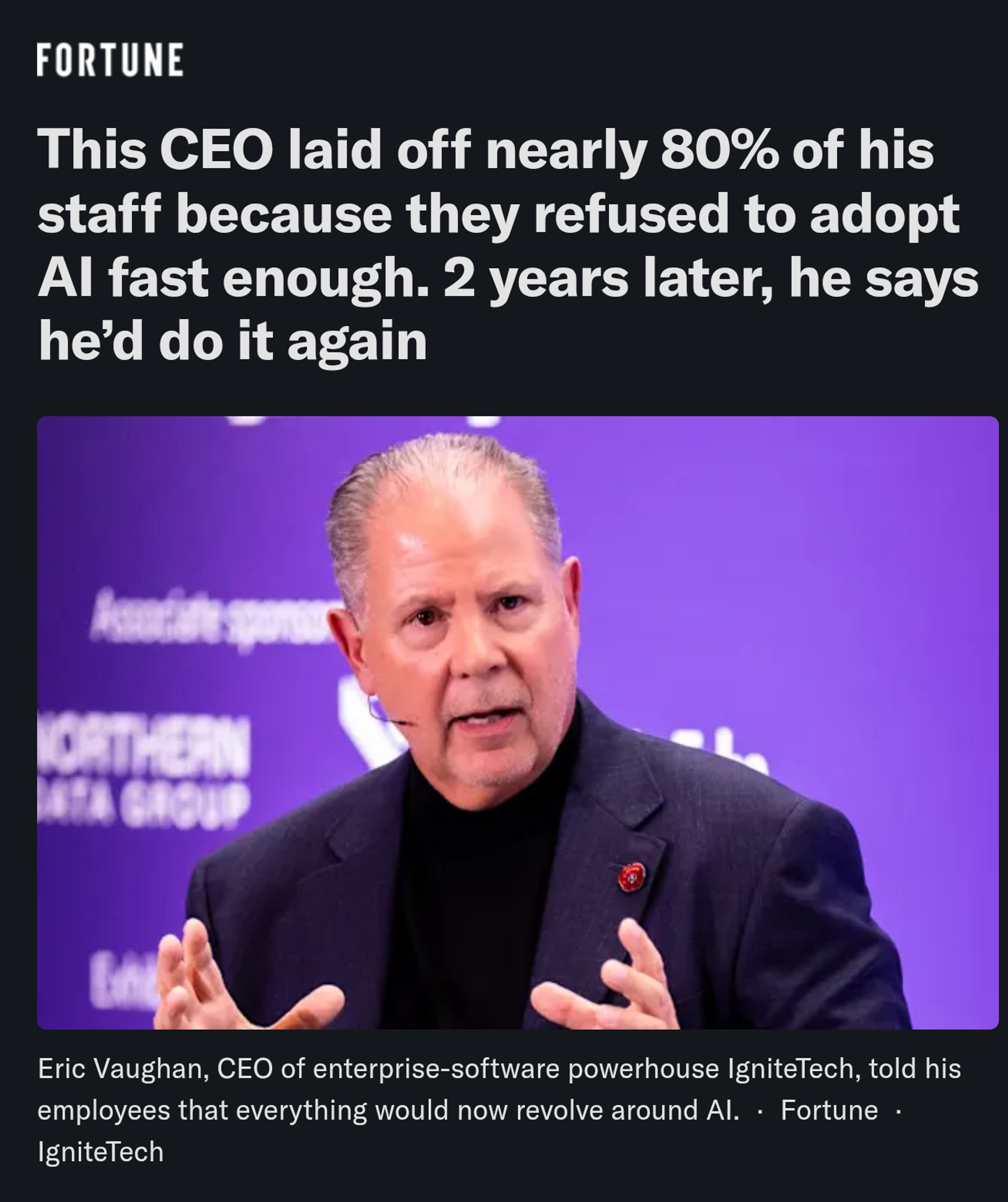
Workers Reject AI Adoption Mandates: Why 80% of White-Collar Employees Are Pushing Back Against Corporate AI Rollouts
A quiet but significant rebellion is spreading across corporate America. Workers reject AI adoption mandates at scale — and the data confirms this isn't passive discomfort but active, measurable resistance that's costing companies their best talent. While venture capital narratives and C-suite enthusiasm dominate the headlines, the real story of 2026 is unfolding in cubicles, Slack channels, and exit interviews.
This disconnect represents the first genuine sign of organizational pushback against top-down AI integration — and it may be the most important story that the tech industry is getting wrong. For a deeper picture of where things stand, it's worth anchoring this conversation against broader AI adoption trends that have shaped the landscape heading into this year.
The Adoption Gap Nobody at the Top Wants to Admit
The headline number is striking: only 27% of white-collar employees now frequently use AI at work, according to a recent Gallup survey. That figure is up 12 points since 2024, which sounds like momentum — until you realize that CEOs have been announcing AI-first mandates since late 2023, and billions of dollars have been poured into enterprise AI licensing deals.
The gap between executive expectation and worker reality is wide and widening. Adoption is heavily concentrated in tech (50%), professional services (34%), and finance (32%) — sectors where employees were already predisposed to tool experimentation. Outside those verticals, the numbers are far more sobering.
This isn't a story about technophobia. It's a story about organizational change management done poorly, at industrial scale, in a very short period of time.
The Training Deficit at the Heart of Employee Resistance to AI Implementation
Here's where the corporate AI strategy begins to fall apart: companies are demanding adoption without providing the infrastructure to support it. Only 23% of workers received structured, company-funded AI training, according to research cited in a January 2026 Pew Research Center analysis. That means the vast majority of employees are being told to use tools their employers haven't bothered to teach them.
Workers, predictably, have responded with self-reliance. 62% of those who do use AI at work taught themselves through free online resources, YouTube tutorials, or peer coaching — not through any employer program. They built their own fluency because they had no other choice.
The contradiction becomes even sharper when you look at market-level signals. AI-related course enrollments surged 142% year-over-year, according to LinkedIn Learning's 2026 Workplace Learning Report, demonstrating genuine worker curiosity and initiative. Yet companies allocated just 4.2 hours per quarter for AI training — roughly the length of a moderately long team meeting. That's not a learning program. That's a checkbox.
The parallels to the return-to-office debacle are impossible to ignore. In both cases, leadership issued top-down directives without adequately addressing employee concerns, and in both cases, the backlash was swift and costly. Understanding the full scope of workplace automation and productivity challenges makes it clear that this pattern of mandate-before-infrastructure is becoming a defining failure mode for enterprise technology rollouts.
Mandatory AI Policies Are Driving Away High Performers
If the training deficit represents the "why" of adoption friction, the talent crisis represents the "so what" — and it's expensive. Organizations with mandatory AI policies saw 23% higher voluntary turnover among high-performers compared to those using voluntary approaches, according to Gartner research published in February 2026.
That number should stop any CHRO cold. High-performers — the employees hardest to replace, most capable of leveraging AI effectively, and most valuable to competitive strategy — are the ones most likely to walk out when they feel their professional judgment is being overridden by mandate.
The mechanism isn't complicated. Mandatory adoption policies signal distrust. They communicate that leadership doesn't believe employees will make good decisions about their own workflows without coercion. For high-performers who have built careers on autonomous problem-solving, that message is both insulting and actionable. They leave.
This is the quiet quitting AI integration story that rarely makes the press releases. It's not workers refusing to learn. It's workers — specifically the best workers — refusing to be managed by ultimatum.
The Leadership-Workforce Divide Is Philosophical, Not Just Operational
The tension here runs deeper than training hours and policy design. It reflects a genuine philosophical disagreement about the nature of knowledge work, professional identity, and employee agency in AI-augmented environments.
Dario Amodei, CEO of Anthropic, has framed the stakes in civilizational terms: "I believe if we act decisively and carefully, the risks can be overcome — I would even say our odds are good. And there's a hugely better world on the other side of it. But we need to understand that this is a serious civilizational challenge." That framing captures the ambition of AI's architects — but it also illustrates the altitude gap between those building the technology and those being asked to integrate it into their daily workflows.
At the organizational level, employees aren't thinking in civilizational terms. They're thinking about whether AI outputs can be trusted, whether their expertise is being devalued, and whether using these tools will ultimately accelerate their own obsolescence. Anthropic's own global user research captures this duality well: one academic user described Claude as "like having a faculty colleague who knows a lot, is never bored or tired, and is available 24/7" — while simultaneously flagging fears about AI unreliability and cognitive atrophy.
This ambivalence is rational. It deserves a more sophisticated organizational response than a policy memo.
Safety Concerns and Model Opacity Are Adding to Workforce Skepticism
Employees resisting AI mandates are often more right than leadership acknowledges — particularly when it comes to concerns about reliability and transparency. The professional risk of embedding opaque, poorly understood tools into consequential workflows is real, not imagined.
OpenAI, Google DeepMind, and Anthropic researchers — 40 of them, in a joint position paper — recently warned that chain-of-thought visibility in advanced AI models may disappear as those models become more capable. Their statement that there is "no guarantee that the current degree of visibility will persist" is not a reassuring message for workers being told to trust AI outputs in high-stakes professional contexts.
AI safety research from leading labs underscores the point: even the people building these systems are urgently flagging transparency risks. If AI researchers are concerned about their ability to monitor model intent, professionals in law, finance, medicine, and communications have entirely legitimate grounds for caution when deploying these tools in regulated or liability-sensitive environments.
This dimension of resistance rarely surfaces in corporate AI adoption discussions, which tend to focus on productivity metrics and change management frameworks. But it's inseparable from AI governance and ethical concerns that are increasingly shaping both regulatory posture and employee trust.
What Organizations Are Getting Wrong — and What Fixes Actually Look Like
The data points to a clear failure pattern: mandate first, support later (if ever). The organizations avoiding the worst of this backlash are doing something different. They're treating AI adoption as an organizational behavior problem rather than a technology deployment problem.
The distinction matters. A technology deployment problem gets solved with licenses, integrations, and policy documents. An organizational behavior problem requires investment in psychological safety, genuine skill-building, role-specific use case development, and — critically — employee agency in deciding how and when to use new tools.
Bottom-up resistance isn't irrational. It's a predictable response to top-down imposition of tools that workers don't yet trust, haven't been adequately trained on, and have legitimate reasons to approach carefully. The organizations that will win the AI productivity race aren't the ones mandating the most aggressively. They're the ones creating the conditions in which adoption becomes genuinely desirable.
Practically, this means:
- Replacing compliance-driven mandates with outcome-oriented frameworks that give employees discretion in how they achieve results
- Investing in meaningful training — not 4.2 hours per quarter, but role-specific, continuous, and funded programs that build genuine fluency
- Acknowledging risk openly rather than papering over legitimate concerns with productivity talking points
- Measuring adoption quality, not just adoption rate — using AI badly at high volume is worse than not using it at all
For teams and organizations looking to move beyond this impasse, revisiting effective AI training and adoption strategies offers a useful starting framework for building programs that employees actually engage with.
Conclusion: The Mandate Era Is Already Failing
The story of 2026 isn't that AI has failed. The technology is advancing faster than anyone credibly predicted, and its long-term implications for knowledge work remain genuinely transformative. The story is that the corporate playbook for deploying AI — top-down, compliance-driven, underinvested in human infrastructure — is producing exactly the outcomes that organizational psychologists and change management researchers would have predicted.
Workforce resistance to automation isn't new. What's new is the speed and scale at which it's playing out, and the sophistication of the employees pushing back. These aren't Luddites. They're high-performing professionals with legitimate concerns about trust, training, and autonomy — and they have options.
The companies that will look back on 2026 as a turning point in their AI strategy will be the ones that treated worker skepticism not as a communications problem to overcome, but as signal worth listening to. Everyone else will be publishing updated turnover statistics and wondering where their best people went.
Frequently Asked Questions
Q: Why are workers rejecting AI adoption mandates if AI tools are genuinely useful?
A: The resistance isn't primarily about the tools themselves — it's about how mandates are being implemented. When employers issue top-down requirements without providing adequate training, addressing legitimate safety concerns, or respecting employee judgment, resistance is a rational organizational response, not a technological one.
Q: What does the data say about AI training at work?
A: The numbers reveal a stark gap. Only 23% of workers have received structured, company-funded AI training. Meanwhile, companies allocate an average of just 4.2 hours per quarter for AI learning — far below what's needed to build genuine fluency. The majority of employees who use AI at work (62%) taught themselves through free resources and peer networks.
Q: Are mandatory AI policies actually hurting companies?
A: Yes, measurably. Gartner research found that organizations with mandatory AI policies experience 23% higher voluntary turnover among high-performers compared to those using voluntary adoption approaches. The top talent most capable of leveraging AI effectively are also the most likely to leave when they feel their professional autonomy is being undermined.
Q: Which industries have seen the highest AI adoption among white-collar workers?
A: According to Gallup data, adoption is highest in technology (50%), professional services (34%), and finance (32%). Overall, only 27% of white-collar workers report frequently using AI at work — a figure that lags far behind the pace of corporate mandate announcements.
Q: What can companies do to reduce employee resistance to AI integration?
A: The most effective approaches prioritize employee agency over compliance. This includes investing in meaningful, role-specific training programs; shifting from mandate-driven policies to outcome-oriented frameworks; openly addressing legitimate concerns about AI reliability and transparency; and measuring the quality of AI use rather than simply its frequency.
Stay ahead of AI — follow [TechCircleNow](https://techcirclenow.com) for daily coverage.