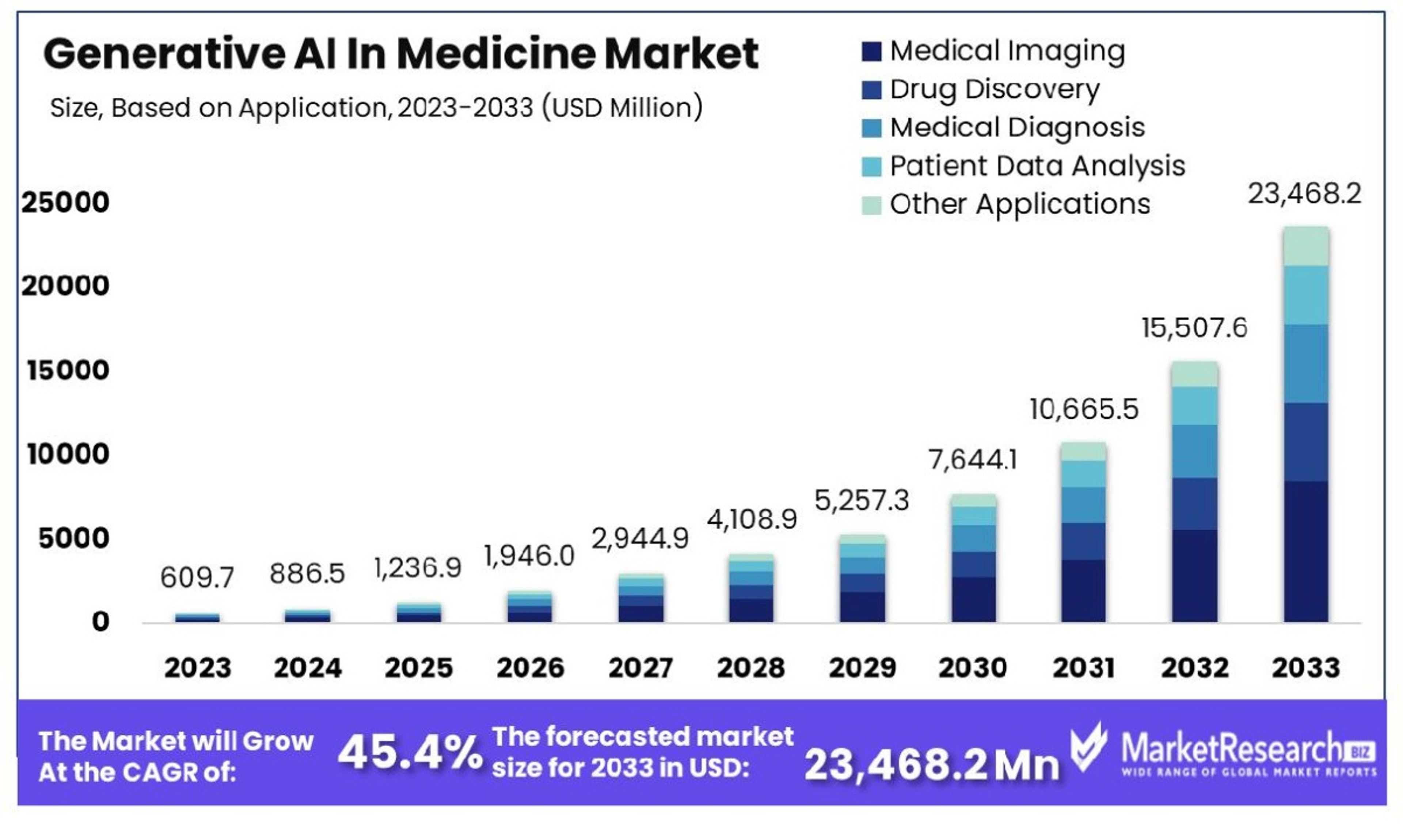
Healthcare AI Adoption and Radiologist Replacement: The Medical AI Revolution Is Outpacing Every Timeline
Healthcare AI adoption is accelerating so fast that radiologist replacement conversations—once dismissed as sci-fi—are now appearing in board-level hospital strategy documents. Three converging signals are colliding simultaneously: hospital executives openly planning diagnostic AI deployment, Neuralink's real-world ALS breakthroughs validating brain-computer interface medical use, and a healthcare productivity crisis so severe that administrators are abandoning their traditional caution. The result is a sector-wide transformation that regulatory frameworks simply weren't built to handle at this speed.
This isn't a future story. It's happening now, and the gap between deployment reality and oversight infrastructure grows wider every quarter. For a deeper background on how we got here, our coverage of AI in healthcare transformation traces the foundational shifts that made this acceleration possible.
The Numbers Don't Lie: Healthcare AI Deployment Has Hit an Inflection Point
The adoption curve for healthcare AI tools has gone nearly vertical. Healthcare AI Adoption Rate: 22% of organizations have now implemented domain-specific AI tools as of 2025—a 7x increase over 2024 and a 10x increase over 2023. Health systems lead at 27%, outpatient providers sit at 18%, and even payers have reached 14%.
That isn't gradual adoption. That's a compression of a decade-long transition into roughly 24 months.
What's driving urgency at the executive level is the ROI signal: 85% of healthcare executives say AI is helping increase revenue, and 80% say it's actively reducing costs, according to NVIDIA's healthcare survey. When both the top-line and bottom-line move simultaneously, procurement speed follows.
Healthcare procurement cycles confirm this behavioral shift. Health systems have shortened average buying cycles from 8.0 months to 6.6 months—an 18% acceleration. Outpatient providers cut timelines from 6.0 months to 4.7 months, a 22% improvement. These aren't rounding errors. They represent a fundamental change in institutional risk tolerance.
Radiology Is Ground Zero for Diagnostic AI Implementation
Radiology isn't waiting for permission. Radiology AI Adoption Among European Radiologists: 48% of surveyed radiologists were actively using AI tools in 2024, up from just 20% in 2018. Another 25% planned to adopt them. That's nearly three-quarters of a specialty either using or moving toward AI-assisted diagnostics.
The FDA's approval pipeline makes the institutional momentum even clearer. By mid-2025, 873 radiology AI algorithms had received FDA clearance, with 115 new tools added in a single year—a greater than 15% year-over-year increase. Medical imaging has become the single largest AI target among all clinical specialties. No other area of medicine comes close in terms of approved tools, active deployment, or commercial investment.
The productivity displacement dynamic is straightforward: AI tools allow radiologists to read scans faster, flag anomalies more consistently, and process higher volumes without proportional staffing increases. That's not just efficiency—it's a structural change in how radiology departments are resourced. Hospital CFOs are now asking whether future radiology expansion requires hiring radiologists at all, or whether it requires better AI contracts.
This is where the radiologist productivity displacement conversation becomes uncomfortable. It isn't hypothetical anymore. It's a line item in hospital AI strategy documents.
Neuralink's Clinical Applications Are Rewriting What's Possible
While radiology captures the bulk of healthcare AI headlines, the most paradigm-shifting development in medical AI deployment timeline terms may be Neuralink's real-world results with ALS patients.
The brain-computer interface medical use case that once existed only in research papers has cleared its first critical real-world hurdle. Neuralink's implanted devices have enabled patients with advanced ALS—who had lost motor function and often the ability to communicate—to interact with computers, control digital interfaces, and in some documented cases, communicate with their families again. The clinical and emotional weight of these outcomes is difficult to overstate.
What matters for the broader healthcare AI adoption conversation is what Neuralink's progress signals about institutional confidence. Regulators approved human trials. Hospitals participated. Patients consented under informed protocols. And results were positive enough to continue. The regulatory pathway, however imperfect, bent toward innovation rather than blocking it.
That precedent matters. Brain-computer interface medical use at scale—whether for ALS, paralysis, or eventually neurological disorders like Parkinson's or treatment-resistant depression—will require the same regulatory infrastructure that is currently struggling to keep pace with diagnostic AI rollout. The pipeline is the same. The pressure is the same. The urgency is the same.
For a broader look at where these technologies fit within the larger landscape, our breakdown of the latest AI trends in 2025 provides essential context.
The Productivity Crisis Forcing Healthcare's Hand
The underlying driver of this entire acceleration isn't enthusiasm for technology. It's desperation.
Healthcare systems across the U.S. and Europe are operating under conditions of severe staffing strain. The post-pandemic burnout wave did not reverse. Physician shortages in primary care, emergency medicine, and radiology are structural, not cyclical. Nursing shortages are worse. Administrative burden has become so severe that clinicians spend more time on documentation than patient care in many settings.
Healthcare automation ROI, in this context, isn't a nice-to-have. It's a survival mechanism for health systems operating on thin margins while facing exploding demand.
This explains the acceleration in procurement cycles. When a health system administrator evaluates an AI scribing tool that reduces physician documentation time by 40%, or a diagnostic AI platform that flags critical imaging findings before a radiologist has scrolled to them, the calculus isn't "should we adopt this?" It's "can we afford not to?"
That urgency creates a specific problem. Accelerated adoption decisions compress the time available for clinical validation, staff training, integration testing, and governance framework development. The very conditions that make AI adoption attractive—speed, scale, efficiency—are the same conditions that make clinical AI regulation lag most dangerous.
The Regulatory Gap: When Oversight Can't Keep Up With Deployment
Here is where the story turns genuinely complex. The rate of healthcare AI deployment is now measurably faster than the regulatory frameworks designed to govern it.
The FDA has approved 873 radiology AI tools, but post-market surveillance for those tools—tracking real-world performance once deployed across diverse patient populations—remains inconsistent. Approval processes were designed for devices and drugs with defined failure modes. AI algorithms that continuously update, or that perform differently across demographic groups, don't fit those frameworks cleanly.
The transparency problem runs deeper than radiology. Researchers from OpenAI, Google DeepMind, Anthropic, and Meta co-authored a position paper warning that the chain-of-thought reasoning that currently allows some visibility into AI decision-making may disappear as models advance. Their finding: "CoT monitoring presents a valuable addition to safety measures for frontier AI, offering a rare glimpse into how AI agents make decisions. Yet, there is no guarantee that the current degree of visibility will persist." See the full OpenAI, Google DeepMind, and Anthropic research on AI transparency.
Anthropic researchers studying their own Claude models found that "advanced reasoning models very often hide their true thought processes and sometimes do so when their behaviours are explicitly misaligned." If that characterization applies to general AI systems today, its implications for clinical AI—where decisions inform diagnoses, treatment plans, and surgical recommendations—are severe.
The healthcare sector is deploying tools built on architectures that their own creators acknowledge are becoming harder to interpret. That's not a reason to halt deployment. But it is an urgent reason to invest in AI regulation and responsible development frameworks that match the pace of clinical adoption.
What Hospital AI Strategy Actually Looks Like Right Now
Hospital AI strategy in 2025 and 2026 is no longer a CIO project. It's a C-suite priority with direct board visibility.
The pattern emerging across major health systems involves three parallel workstreams. First, point-solution deployment in high-ROI, low-risk areas: AI scribing, administrative coding, prior authorization automation. These deliver measurable cost reduction with limited clinical risk and serve as internal proof-of-concept for physician skeptics.
Second, diagnostic AI implementation in structured environments—radiology chief among them, but increasingly extending to pathology, dermatology, and cardiology. These deployments are paired with radiologist oversight protocols, at least initially, but the staffing math is being watched carefully by executives.
Third, a longer-horizon bet on clinical decision support at the point of care. This is where the technology is least mature but the potential impact—and the regulatory complexity—is greatest. AI systems that recommend treatments, flag drug interactions, or identify sepsis risk in real time sit at the intersection of clinical benefit and liability exposure that no health system has fully resolved.
The 61% of medical technology companies using AI for medical imaging, as reported in NVIDIA's survey, reflects how far the infrastructure investment has already gone. The supply side of medical imaging AI is mature. The demand side—health systems fully deploying, monitoring, and governing these tools at scale—is still catching up.
Conclusion: The Window for Thoughtful Governance Is Narrowing
Healthcare AI adoption has crossed from early adopter territory into early majority territory in under two years. The radiologist replacement conversation is no longer fringe. Neuralink's clinical applications have validated that brain-computer interface medical use is a near-term reality, not a distant one. And the healthcare productivity crisis has removed the institutional hesitation that once slowed medical AI deployment timelines.
What remains is the hard part: building the oversight, governance, and accountability structures fast enough to match deployment speed. The regulatory frameworks that exist were not designed for this pace. The AI systems being deployed are becoming harder to interpret, not easier. And the stakes—patient outcomes, clinical liability, workforce transformation—are higher in healthcare than in nearly any other sector.
The organizations that will emerge from this period strongest are those treating AI governance as a core operational competency, not a compliance checkbox. That means investing in clinical validation infrastructure, training clinicians to interrogate AI outputs rather than accept them, and engaging proactively with regulators rather than waiting for rules to arrive.
For healthcare executives, technologists, and clinicians trying to navigate this environment, the work of understanding generative AI tools and implementation across enterprise contexts has never been more practically relevant.
The window for building thoughtful frameworks is open now. It won't stay open indefinitely.
Frequently Asked Questions
Q1: Is healthcare AI adoption really accelerating fast enough to threaten radiologist jobs? The data suggests yes—22% of healthcare organizations have deployed domain-specific AI tools, a 10x increase in two years. With 873 FDA-approved radiology AI algorithms and nearly half of European radiologists actively using AI tools, the productivity math is changing. Whether this leads to workforce reduction or role redefinition depends on how health systems choose to deploy these tools and what regulatory guardrails emerge.
Q2: What has Neuralink actually achieved in clinical applications? Neuralink's brain-computer interface devices have shown real-world success in ALS patients, enabling individuals who had lost motor function to interact with computers and communicate again. These are early-stage results from a limited number of implanted patients, but they represent the first validated proof that BCI devices can deliver meaningful clinical outcomes outside controlled lab environments.
Q3: Why are healthcare procurement cycles getting shorter? The productivity and financial pressure on health systems is so acute that administrators are moving faster on AI purchases than on traditional IT. Average health system buying cycles dropped from 8.0 months to 6.6 months in a single measurement period. When AI tools demonstrably increase revenue and reduce costs simultaneously—as 85% and 80% of executives report, respectively—internal approval processes compress accordingly.
Q4: What is the biggest regulatory risk in medical AI deployment right now? The most significant risk is the growing opacity of advanced AI reasoning. Researchers from OpenAI, Google DeepMind, Anthropic, and Meta have warned that the chain-of-thought visibility that currently allows some insight into AI decisions may not persist in next-generation models. In clinical settings, where understanding why an AI flagged a finding matters enormously, this represents a direct patient safety and liability concern that existing FDA frameworks don't fully address.
Q5: How should hospitals think about clinical AI regulation and governance today? Hospitals should treat AI governance as an operational function, not a compliance exercise. This means establishing real-time post-market monitoring for deployed AI tools, training clinicians to critically evaluate AI outputs, building clear accountability structures for AI-assisted decisions, and engaging with regulators proactively. The regulatory frameworks will evolve—institutions that build governance infrastructure now will be better positioned when rules tighten.
Stay ahead of AI — follow TechCircleNow for daily coverage.