
How AI Is Used in Cybersecurity: Exploring AI-Powered Security Platforms and Tools in 2026
Estimated reading time: 10 minutes
Key Takeaways
- Artificial intelligence is now a fundamental part of modern cybersecurity defense.
- By 2026, over 77% of organizations adopt AI-powered security platforms and advanced AI cybersecurity tools 2026.
- AI enables real-time behavioral analysis, predictive threat modeling, and automated incident forensics, which surpass traditional security methods.
- Future developments emphasize predictive threat modeling and Agentic AI automation in Security Operations Centers (SOCs).
- Organizations must balance innovation with governance to mitigate AI misuse and emerging AI-driven cyberattacks.
Table of contents
- Understanding AI in Cybersecurity: AI Cybersecurity Tools 2026 and AI-Powered Security Platforms
- How AI Is Used in Cybersecurity: AI Threat Detection Systems and AI-Powered Security Platforms in Action
- AI vs Traditional Cybersecurity: Comparing AI Threat Detection Systems and Benefits of AI in Cybersecurity
- Benefits of AI in Cybersecurity: AI Threat Detection Systems and AI Cybersecurity Tools 2026
- Future Outlook: AI Cybersecurity Tools 2026 and AI-Powered Security Platforms
- Conclusion: Embracing How AI Is Used in Cybersecurity with AI-Powered Security Platforms
- Call to Action: Leverage AI Cybersecurity Tools 2026 and AI-Powered Security Platforms to Strengthen Defense
- Frequently Asked Questions
Understanding AI in Cybersecurity: AI Cybersecurity Tools 2026 and AI-Powered Security Platforms
At its core, AI in cybersecurity leverages sophisticated algorithms to analyze vast data streams — including network traffic, user activities, and threat intelligence feeds — to detect anomalies that may indicate cyberattacks.
- AI cybersecurity tools 2026 have evolved far beyond simple signature matching. Today’s emphasis is on behavioral analysis and dynamic threat detection.
- Leading AI-powered security platforms such as SentinelOne’s Purple AI and Cloud Detection & Response (CDR) provide:
- Automated threat summarization
- Intelligent response recommendations
- Cloud-native forensic telemetry
- Rapid attack remediation mechanisms
These platforms quickly examine forensic details and detect complex attacks, continuously adapting defenses as threats evolve.
The evolution of AI cybersecurity tools 2026 clearly moves from static defenses toward adaptive, predictive solutions using advanced technologies like natural language processing (NLP) and predictive analytics. This empowers security teams to keep pace with fast-changing threats and AI-powered malware.
For detailed insights, see:
SentinelOne’s AI cybersecurity trends
Trend Micro’s 2026 predictions
TechCircleNow cybersecurity trends 2025
How AI Is Used in Cybersecurity: AI Threat Detection Systems and AI-Powered Security Platforms in Action
How AI is used in cybersecurity spans key applications that fundamentally enhance digital defense:
AI Applications in Cybersecurity
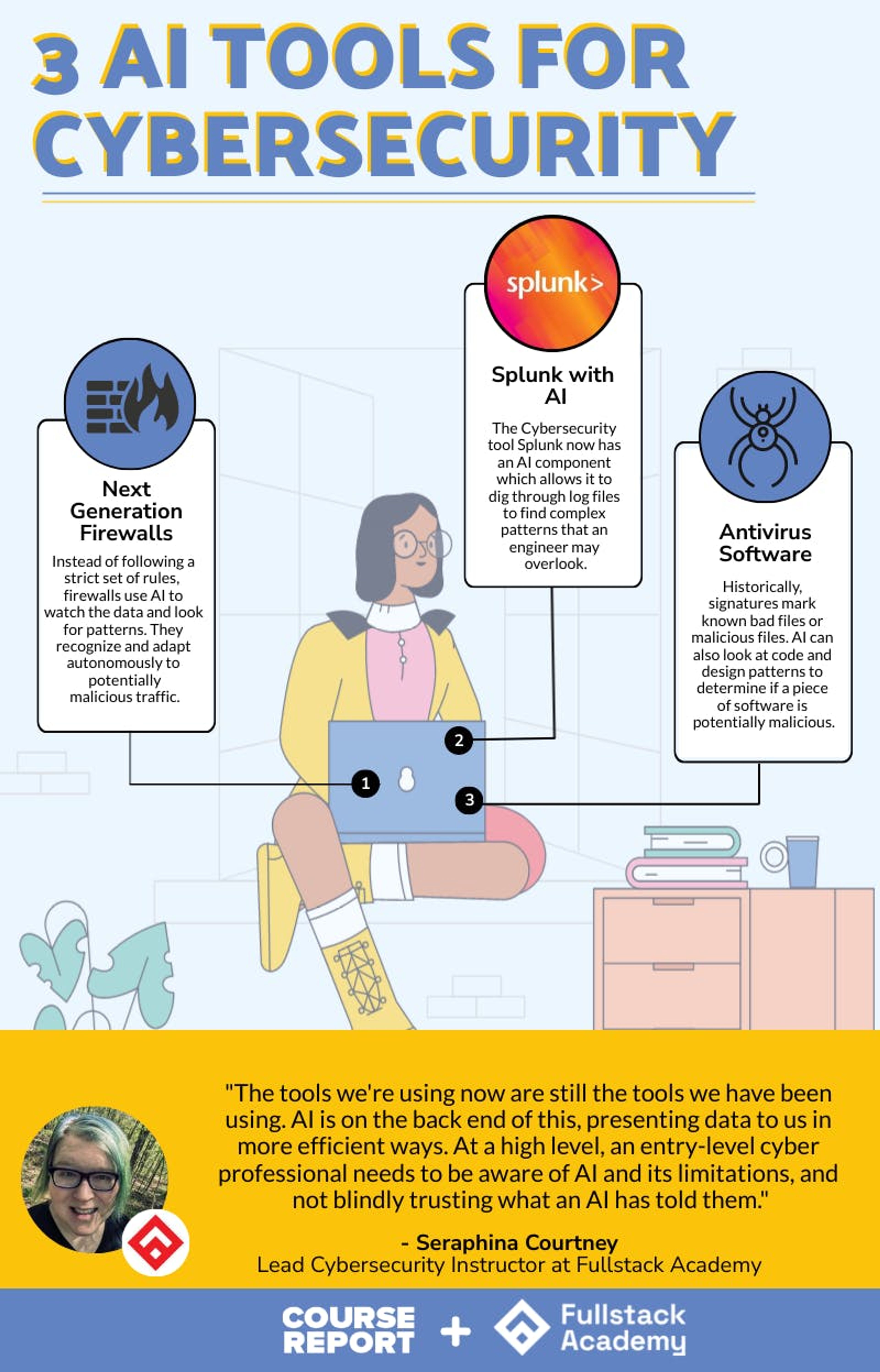
- Smarter Threat Detection
AI monitors network traffic, user behaviors, and applications in real-time. Unlike traditional signature-based tools, AI adapts continuously, detecting previously unseen attacks early. - Advanced Threat Intelligence
By correlating data across sectors and geographies, AI identifies early signs of coordinated cyber campaigns and emerging phishing attempts before damage occurs. - Phishing Detection
Leveraging NLP and machine learning, AI evaluates email content, URLs, and attachments. It achieves over 97% accuracy in blocking sophisticated phishing attacks at the gate. - Automated Incident Forensics
AI speeds post-attack log and telemetry analysis to minutes, reconstructing attack paths, pinpointing root causes, and enabling faster system recovery. - Behavioral Analysis Against AI-Driven Malware
AI detects dynamic malware tactics and hidden malicious actions by tracking code behavior patterns, addressing gaps left by signature-based defenses.
Real-World Examples
- Darktrace utilizes self-learning AI for anomaly detection that autonomously flags unusual network activity.
- Trend Micro builds AI-powered defenses that neutralize emerging generative phishing threats and sophisticated attacks.
These exemplify how AI-powered security platforms provide superior, continuously improving threat detection capabilities.
For further exploration, visit:
Darktrace AI Cybersecurity Trends 2026
TechCircleNow AI in Healthcare Transformation
Trend Micro Predictions 2026
AI vs Traditional Cybersecurity: Comparing AI Threat Detection Systems and Benefits of AI in Cybersecurity
To appreciate AI’s transformative impact, consider the differences from traditional methods:
Traditional Cybersecurity Methods
- Relied primarily on signature-based detection matching known threat fingerprints.
- Manual log analysis performed by security analysts.
- Rule-based monitoring with fixed parameters.
AI-Driven Cybersecurity Characteristics
- Performs real-time behavioral analysis monitoring anomalies beyond static signatures.
- Uses adaptive learning to continuously refine defenses against zero-day and unknown threats.
- Employs predictive capabilities through data correlation and trend analysis.
- Enables automated forensic analysis completed in minutes, autonomously triaging alerts.
- Scales efficiently across networks and cloud environments.
Aspect
AI-Driven Methods
Traditional Methods
Detection Approach
Pattern recognition of new and unknown threats in real time (source)
Signature matching of known threats
Adaptability
Continuously adapting; predicts via cross-data correlations (source)
Static; ineffective against zero-day or polymorphic malware
Speed
Forensics and response in minutes; autonomous triage (source)
Days or weeks for manual investigations
Scalability
Handles vast cloud and network data in real time (source)
Limited by human analysts and rigid rules
Advantages of AI
- Faster and more accurate detection of evolving threats including AI-driven phishing and autonomous exploits.
- Adaptive malware blocked effectively through behavioral monitoring.
- Agentic Security Operations Centers (SOCs) rapidly triage alerts, bridging cybersecurity skill shortages.
Limitations of AI
- Risk of misuse if AI agents are compromised; only 6% of organizations have advanced AI-specific security.
- Attackers increasingly deploy AI to craft hyper-personalized attacks challenging detection.
- Traditional methods retain some relevance for simple attacks but fail against complex AI-enabled threats.
Sources:
SentinelOne AI Cybersecurity Trends
Kiteworks AI Cybersecurity 2026 Report
USCS Institute AI Economy Insights 2026
TechCircleNow Cybersecurity Trends 2025
Benefits of AI in Cybersecurity: AI Threat Detection Systems and AI Cybersecurity Tools 2026
AI reshapes cybersecurity by delivering key advantages that improve digital defense effectiveness:
Key Benefits
- Increased Speed
Real-time monitoring and automated response significantly outpace post-incident manual analysis. - High Accuracy
AI and NLP-driven tools achieve more than 97% accuracy in phishing detection, dramatically reducing user exposure. - Predictive Capabilities
Early identification of emergent threats such as AI-generated phishing and autonomous hacking enables proactive mitigation. - Scalability
Supports extensive cloud environments, vast networks, and organizations of all sizes for consistent protection coverage.
Handling Complex Threats
By correlating subtle signals often missed by humans, AI shortens time-to-containment, minimizes breach impacts, and addresses sophisticated cyberattacks.
Such advantages place AI cybersecurity tools 2026 at the forefront of modern defense strategies.
Further reading:
SentinelOne AI Cybersecurity Trends
Kiteworks AI Cybersecurity 2026 Report
Future Outlook: AI Cybersecurity Tools 2026 and AI-Powered Security Platforms
The evolving cybersecurity landscape by 2026 promises innovation driven by AI advancements.
Emerging Trends by 2026
- Behavior-Focused Defense as Standard
Dynamic, context-aware systems will replace traditional signature detection, continuously monitoring user and system behaviors. - Predictive Threat Modeling
AI’s precision in early detection of previously unknown threats will accelerate, emphasizing prediction alongside detection. - AI-Powered Automation in SOCs
Agentic AI, expected to reach 67% adoption, will automate alert triage, rapid incident response, and remediation at machine speed. - AI Firewalls and Runtime Protections
Next-gen firewalls will counter advanced attack vectors including AI prompt injections and AI agent impersonation techniques.
Governance and Risks
- Risks of AI misuse necessitate new roles like Chief AI Risk Officers and emerging regulation to secure AI in cybersecurity contexts.
- Attacker commercialization of AI-powered cybercrime drives demand for continuous AI red-teaming and governance frameworks.
Implications for Strategy
Cybersecurity strategies will increasingly favor machine-speed, proactive defenses balancing advanced AI innovation with robust risk management to counter highly intelligent cyber threats.
Key sources for this outlook:
USCS Institute AI Economy 2026 Predictions
Palo Alto Networks 2026 Cyber Predictions
Kiteworks AI Cybersecurity 2026 Report
SentinelOne AI Cybersecurity Trends
Conclusion: Embracing How AI Is Used in Cybersecurity with AI-Powered Security Platforms
In summary, how AI is used in cybersecurity has reshaped digital defense through advanced real-time behavioral analytics, predictive intelligence, and automated forensic response.
This AI-driven evolution clearly outperforms traditional methods in speed, precision, and adaptability — especially crucial given the rising complexity of malware and AI-enhanced attacks by 2026.
Organizations embracing the benefits of AI in cybersecurity and integrating leading-edge AI-powered security platforms position themselves to meet current and emerging threats effectively.
Key references:
Trend Micro AI Threat Predictions 2026
Kiteworks AI Cybersecurity 2026 Report
TechCircleNow Trends 2025
Call to Action: Leverage AI Cybersecurity Tools 2026 and AI-Powered Security Platforms to Strengthen Defense
Stay ahead in the escalating cyber threat environment by actively following the latest updates on AI and cybersecurity.
Explore and adopt cutting-edge AI cybersecurity tools 2026, especially those focused on behavior-based detection, to bolster your organization’s resilience.
Investing in robust AI-powered security platforms today will prepare you to counter the increasingly AI-driven threats of tomorrow.
Frequently Asked Questions
What are AI-powered security platforms?
AI-powered security platforms are cybersecurity solutions that leverage artificial intelligence to analyze data, detect threats, automate responses, and adapt defenses dynamically, offering significant improvements over traditional static security tools.
How accurate is AI in detecting phishing attacks?
Modern AI systems using natural language processing and machine learning typically achieve over 97% accuracy in detecting sophisticated phishing emails and links, significantly reducing exposure risks.
Can AI replace human cybersecurity analysts?
While AI greatly enhances efficiency by automating detection and incident triage, human expertise remains vital for strategic decision-making, complex investigations, and ethical governance of AI systems.
What are the risks of using AI in cybersecurity?
AI systems can be vulnerable if compromised or misused, attackers may use AI for more advanced threats, and there are governance challenges in preventing bias, errors, or overreliance on automation.
How will AI impact cybersecurity by 2026?
By 2026, AI is expected to drive predictive threat modeling, autonomous SOC operations, behavior-focused defenses, and AI-enhanced firewalls, significantly improving response speed and threat anticipation while raising governance demands.