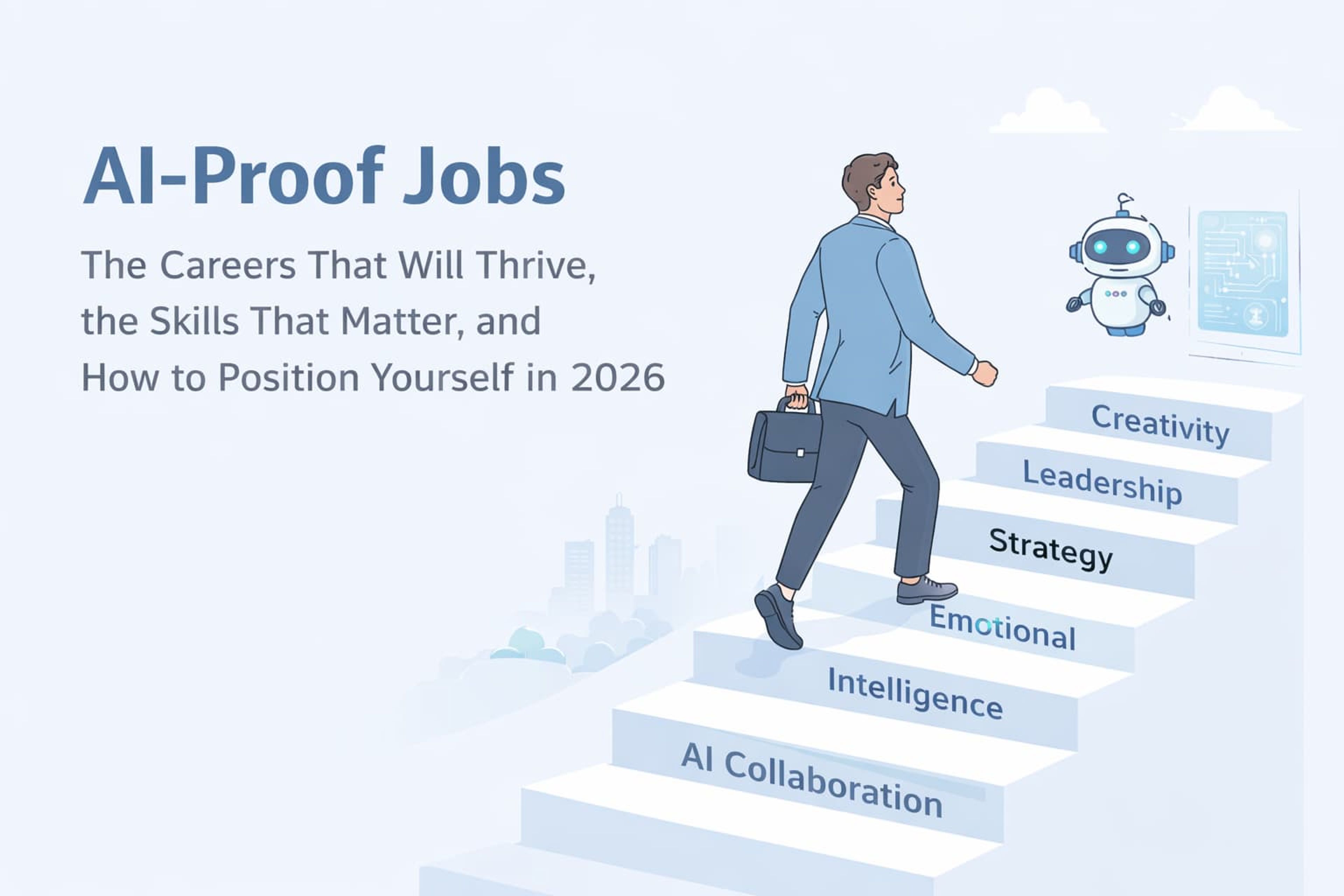

Top AI Careers in 2026: Your Guide to Future Proof Careers with AI
Estimated reading time: 12 minutes
Key Takeaways
- The top AI careers in 2026 represent rapidly expanding roles essential for future job markets.
- Global AI investment is booming, approaching the trillion-dollar mark by 2027, highlighting the critical demand for AI skills.
- Roles from AI Engineers to AI Product Managers and emerging specialties like Prompt Engineers will be in high demand.
- Employers seek both deep technical skills and strong soft skills, including responsible AI principles and problem-solving.
- Non-technical professionals can thrive in AI-driven markets by developing AI literacy and focusing on hybrid career paths.
Table of contents
- Overview of Top AI Careers in 2026: Future Proof Careers with AI
- Key AI Skills Employers Want: Future Proof Careers with AI
- How to Get a Job in AI: A Step-by-Step Guide
- Best AI Certifications 2026: AI Skills Employers Want
- Learning AI for Non-Technical Professionals: Future Proof Careers with AI
- Future Proof Careers with AI: Strategies and Opportunities
- Conclusion: Seize the Best AI Careers in 2026 and Beyond
- Frequently Asked Questions
Overview of Top AI Careers in 2026: Future Proof Careers with AI
AI is no longer a niche or experimental tech – companies globally are scaling AI from small projects into core business functions. This means top AI careers in 2026 will be highly diversified and in demand across sectors like finance, healthcare, technology, manufacturing, and digital platforms.
Learn more about AI industry impact.
Here’s a detailed look at the most important AI job roles emerging by 2026:
AI Engineer
- Role: Designs, develops, and implements AI tools and systems. They translate business needs into AI models and processes.
- Growth: Job postings grew 143% year-over-year in 2025.
- Demand: Ranked as the #1 fastest-growing US job in 2026.
- Value: Essential for bridging technical innovation and business outcomes.
Source: Onward Search
Machine Learning Engineer
- Role: Builds models for automation, predictive analytics, and intelligent decision-making.
- Salary: £60k to £95k typical range.
- Demand: High across many industries, with growing needs for scalable, reliable AI systems.
Read breakthroughs in machine learning.
Source: Lorien Global
MLOps Specialist / Machine Learning Operations Lead
- Role: Deploys, monitors, and maintains machine learning models in production.
- Importance: Over 60% of enterprise AI initiatives fail without MLOps support.
Enterprise AI strategy guide 2026. - Salary: £110k to £190k.
- Market Growth: MLOps projected to grow to a $39 billion market by 2034.
Source: Lorien Global
Data Scientist
- Role: Analyzes complex data, builds models, and delivers insights that impact strategy and operations.
- Salary: £50k to £90k.
- Outlook: Strong continued demand despite automation trends; critical for cross-functional teams.
Source: Lorien Global
AI Product Manager
- Role: Bridges technical teams and business units, defining AI product roadmaps and measuring ROI.
- Salary: £65k to £92k.
- Significance: Seen as strategic leadership, not just a technical or niche position.
AI marketing automation tools guide.
Source: Lorien Global
Prompt Engineer / AI Interaction Specialist
- Role: Specializes in AI-human communication, optimizing prompts for AI accuracy and efficiency.
Prompt engineering guide for beginners. - Salary: £60k to £115k.
- Trend: Rapidly emerging and growing with the rise of generative AI applications.
Source: Lorien Global
Retrieval-Augmented Generation (RAG) Engineer
- Role: Combines AI with trusted external data sources to improve response accuracy and reduce “hallucinations.”
Latest LLM developments 2026. - Salary: £110k to £180k.
- Demand: Rising quickly in regulated and enterprise environments.
Source: Lorien Global
AI Solutions Architect
- Role: Evaluates, selects, and integrates AI tools across business functions to meet company goals.
- Business Impact: 88% of companies now use AI in at least one function, increasing need for architects.
Enterprise AI strategy guide 2026.
Source: Onward Search
Agentic AI Specialist
- Role: Designs and manages autonomous AI workflows that operate independently across systems.
- Salary: £100k to £180k.
- Growth: Budget increases by 88% of leaders highlight expansion in this emerging specialty.
Biggest fintech trend: AI agents.
Source: Lorien Global
AI Researcher
- Role: Develops groundbreaking AI methods and theories pushing the field forward.
- Growth: Expected to increase 20% by 2034.
- Relevance: Crucial for long-term AI innovation.
Source: Onward Search
Industry Impact
The surge in AI adoption spans technology, finance, healthcare, manufacturing, and platform-based businesses, driving career growth in diverse areas. These industries need a blend of AI expertise, domain knowledge, and operational skills to succeed.
Source: Lorien Global
Key AI Skills Employers Want: Future Proof Careers with AI
Employers in 2026 seek candidates who combine deep technical knowledge with strong soft skills. Here are the key competencies categorized for clarity.
Technical Skills
Core Programming
- Python remains the foundational programming language for AI roles, essential for AI development and experimentation.
Learn about machine learning basics.
Source: Talent500 AI Job Trends 2026
AI Frameworks and Technologies
- Experience with machine learning libraries and frameworks.
- Proficiency in generative AI, large language models (LLMs), and Retrieval-Augmented Generation (RAG) architectures.
What is generative AI? - Understanding software engineering fundamentals aligned with data engineering and analytics.
Source: Talent500 AI Job Trends 2026
Specialized Expertise
- Statistics and applied machine learning.
- MLOps practices vital for sustaining operational AI deployments.
Enterprise AI Strategy Guide 2026. - Skills in computer vision and natural language processing (NLP).
Source: Talent500 AI Job Trends 2026
Soft Skills and Emerging Competencies
Responsible AI Principles
- Understanding fairness, transparency, and ethical implications is critical.
AI regulation updates 2025. - Awareness of security concerns around AI models is increasingly demanded.
AI in cybersecurity.
Source: Talent500 AI Job Trends 2026
Problem-Solving and Critical Thinking
- Ability to adapt AI solutions to real-world business challenges, such as automating workflows or optimizing supply chains.
Source: Talent500 AI Job Trends 2026
Together, these skills ensure candidates meet employer demands and can drive AI initiatives successfully.
How to Get a Job in AI: A Step-by-Step Guide
Whether you’re new to AI or transitioning from another field, here’s a detailed roadmap for success.
For Newcomers
- Build Foundational Knowledge
- Learn Python programming fundamentals.
See guide. - Study statistics basics and introductory machine learning.
Machine learning breakthroughs. - Use platforms like Coursera for structured learning.
- Learn Python programming fundamentals.
- Develop a Portfolio
- Build machine learning models with open datasets.
- Contribute to open-source AI projects.
- Document your projects clearly on GitHub.
- Gain Relevant Certifications
- Pursue AI certifications to validate your skills (see next section).
- Network and Build Community
- Join AI meetups, conferences, and forums.
Tech conferences 2026. - Leverage LinkedIn to connect with AI professionals.
Networking guide.
- Join AI meetups, conferences, and forums.
- Apply Strategically
- Target entry-level roles such as junior data analyst or machine learning engineer positions matching your skill level.
For Professionals Transitioning Into AI
- Identify Transferable Skills
- Analyze how your domain knowledge in finance, healthcare, or manufacturing can blend with AI.
AI in healthcare transformation.
- Analyze how your domain knowledge in finance, healthcare, or manufacturing can blend with AI.
- Pursue Targeted Upskilling
- Select courses and certifications matching your career goals and industry sector.
- Leverage Existing Networks
- Use contacts in your industry to explore AI applications in your current field.
- Build Credibility Incrementally
- Volunteer for AI-related projects at work to gain experience and demonstrate impact.
- Highlight Business Impact
- Emphasize your combined knowledge of AI and industry problems in interviews.
Source: Talent500 AI Job Trends 2026
Best AI Certifications 2026: AI Skills Employers Want
Certifications that prove hands-on experience with next-gen AI technologies will become invaluable. When choosing programs, consider:
- Curriculum Relevance: Must cover generative AI, LLMs, RAG, MLOps, and responsible AI.
- Industry Recognition: Look for certifications valued by your target employers.
- Learning Format: Choose from self-paced, instructor-led, or project-based, depending on your learning style.
- Practical Experience: Hands-on projects should be a core part of the course, not just theory.
Prioritize certifications focusing on building and deploying production-grade AI systems rather than purely academic credentials. These credentials align best with employer expectations in 2026.
Source: Talent500 AI Job Trends 2026
Learning AI for Non-Technical Professionals: Future Proof Careers with AI
AI knowledge is not just for engineers. Non-technical professionals can gain AI literacy to boost their career prospects.
What is AI Literacy?
- Understanding fundamentals of AI models, including their capabilities and limits.
Understanding large language models. - Familiarity with ethical AI use and governance.
AI regulation updates 2025. - Awareness of how AI applies to business contexts.
Source: Talent500 AI Job Trends 2026
Recommended Learning Focus for Non-Technical Roles
- Basic concepts of machine learning, generative AI, and large language models.
Guide to generative AI. - Business applications relevant to your industry.
- Responsible AI, fairness, and governance principles.
- Data literacy, interpretation, and decision support.
- Basic prompt engineering skills to effectively use generative AI tools.
Prompt engineering for beginners.
High-Growth Hybrid Roles
Positions that merge domain expertise with AI literacy include:
- AI Product Managers
- AI Solutions Architects
- AI Consultants
These roles don’t require advanced coding skills but benefit greatly from understanding AI concepts.
AI literacy gives leaders, strategists, and product teams a competitive edge in driving AI-enabled innovation.
Source: Talent500 AI Job Trends 2026
Future Proof Careers with AI: Strategies and Opportunities
AI is accelerating automation and creating new hybrid roles combining AI savvy with domain knowledge.
Continuous Learning Strategies
- Subscribe to trusted AI industry publications and research.
AI News Weekly January 2026. - Engage with AI communities and attend conferences.
Major tech conferences 2026. - Take refresher courses on emerging technologies like agentic AI and advanced RAG.
Latest LLM developments 2026. - Experiment with new AI tools regularly.
Best AI tools 2026 for productivity.
Hybrid Career Paths with Longevity
- Healthcare AI specialists: Merge medical expertise with AI for diagnostics and predictive analytics.
AI in healthcare transformation. - Finance AI professionals: Combine risk assessment/fraud detection with AI tools.
AI in fintech: fraud and credit scoring. - Manufacturing AI engineers: Use AI for predictive maintenance and operational efficiency.
- AI ethics and governance specialists: Blend policy, compliance, and technical expertise.
Specialization for Career Growth
Focus your expertise on areas such as:
- Retrieval-Augmented Generation (RAG)
- MLOps and AI infrastructure
- Agentic AI autonomous workflows
- Responsible AI and governance
Specializing improves your value and opens clear advancement paths.
Sources:
Lorien Global
Talent500 AI Job Trends 2026
Conclusion: Seize the Best AI Careers in 2026 and Beyond
The top AI careers in 2026 cover a broad range of exciting, rapidly growing roles across multiple industries. From AI engineers and MLOps specialists to AI product managers and AI researchers, the opportunities are vast.
Acquiring in-demand AI skills employers want, coupled with targeted best AI certifications 2026, is essential. Remember, AI learning paths are accessible to non-technical professionals as well—combining domain expertise with AI literacy can unlock hybrid career roles.
Use the practical strategies outlined here—from learning foundational AI skills to continuous upskilling and strategic networking—to future proof careers with AI. The time to start your AI journey is now. Embrace the wave of transformation poised to reshape the job market and secure your role in the future of work.
Begin your path to how to get a job in AI today and capitalize on the incredible opportunities ahead.
Networking guide
Frequently Asked Questions
What are the top AI careers in 2026?
Top AI careers in 2026 include AI Engineer, Machine Learning Engineer, MLOps Specialist, Data Scientist, AI Product Manager, Prompt Engineer, RAG Engineer, AI Solutions Architect, Agentic AI Specialist, and AI Researcher.
What skills do employers look for in AI candidates?
Employers seek a combination of core programming skills (especially Python), proficiency with AI frameworks, MLOps expertise, problem-solving, critical thinking, and responsible AI practices including ethics and security awareness.
How can non-technical professionals benefit from AI?
Non-technical professionals can gain AI literacy focusing on fundamentals, ethics, AI applications in business, and prompt engineering, enabling hybrid roles like AI Product Manager, Consultant, or Solutions Architect.
What certifications are best for AI careers in 2026?
Certifications covering generative AI, LLMs, RAG, MLOps, and responsible AI principles with practical projects are highly recommended to align with employer expectations in 2026.
How can I start a career in AI?
Start by learning Python and statistics basics, build a portfolio, pursue relevant certifications, network in AI communities, and apply strategically for entry-level or domain-related AI roles depending on your background.
References:
Talent500 AI Job Trends 2026
Onward Search Top AI Jobs
Lorien Global Emerging AI Jobs